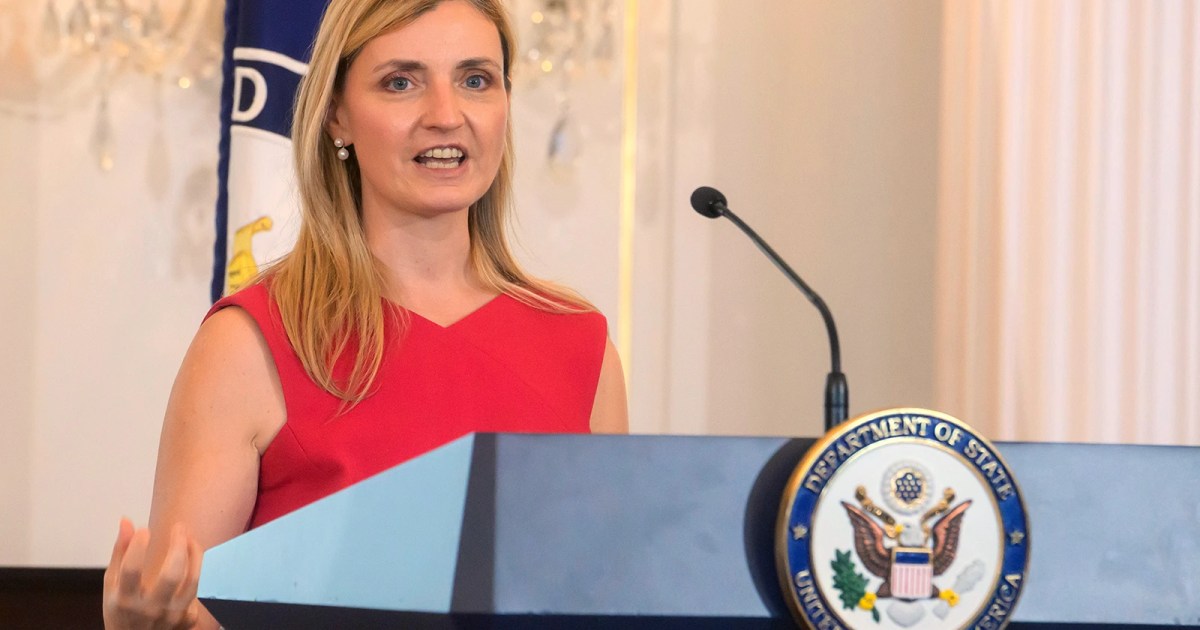
For 17 months, the State Department has promised to deliver evidence of a long-promoted conspiracy theory about its own agency: that its officials routinely censored conservative Americans. This week he failed in that mission, when the Undersecretary of Public Diplomacy, Sarah Rogers, published a trove of documents that proved nothing. The conspiracy theory has grown during President Donald Trump’s second term, providing the State Department with justification to dismantle offices that once studied and countered foreign disinformation campaigns, to fire officials with decades of experience and to close entire departments. The effort was initially led by Acting Undersecretary of State for Public Diplomacy Darren Beattie, a former far-right academic who had been fired from the first Trump administration after attending a white nationalist conference. Beattie claimed that the DOGE-style annihilation of the State Department was necessary to rid the agency of officials linked to a baseless conspiracy theory known as the “censorship industrial complex.” Promoters of the censorship-industrial complex—a secretive but somewhat extensive partnership between the Biden administration, journalists, academics, and civil society groups aimed at silencing conservative Americans—have repeatedly failed to prove their case, both in congressional investigations and in the courts, including the Supreme Court. Still, the theory persists. Beattie had no evidence for his baseless claims that the State Department had participated in that conspiracy, but in March 2025 he launched an investigation within the State Department that he said would reveal everything. Beattie requested the files, emails and other communications of State Department officials, including records with seemingly random keywords like “Black Lives Matter,” “great replacement theory” and “Pepe the Frog,” as well as any communications with figures Beattie believed were part of the conspiracy. (These included The Atlantic’s Anne Applebaum, Bill Gates, disinformation researcher Nina Jankowicz, and about 60 others, including this reporter.) In the official announcement for the closure of the Foreign Information Interference and Manipulation Center, formerly known as the Global Engagement Center (GEC), Secretary of State Marco Rubio told Mike Benz, a former pseudonymous racist YouTuber and chief architect of the censorship-industrial complex theory, that a reckoning was coming. It would be driven by evidence, revealed in the form of the “Twitter Files,” a 2022 dump of internal Twitter records that Elon Musk gave to select writers to show alleged censorship by conservatives. (It wasn’t like that). Rubio said the job now was to “document what happened.” “Because it is one thing to say it in a broadcast like this and another thing to put it on paper,” he said. This week, Rogers, Beattie’s replacement, finally had something to share. According to a series of posts on Pounds said he thought Rogers was handing over documents about Cuba, but that he was “pushed with a bunch of printed documents to leak” about the GEC. “I wanted to give you the option to ‘reveal’ the story as a kind of gift,” Rogers told him, according to a direct message Pounds posted. Then things got weird. Pounds have been a reliable vector for the Trump administration to push its narrative that the so-called deep state, or shadow government, was operating in secret and against the best interests of its citizens. But when he received the “gift” from the State Department, Pounds determined that it was a plot by Rogers to trap him into committing a crime, claiming that revealing or reporting the documents would be illegal. Rogers responded “lol” and posted the documents herself in a series of 35 posts that borrowed the breathless cadence of Twitter Archives, drawing ominous connections between GEC emails, international projects to combat foreign disinformation, and non-governmental coalitions. All of this implied the existence of a complex industrial censorship operation, without proving it. Rogers’ document dump received little attention from right-wing media. More articles “There were State Department employees sharing news articles. Diplomats had communicated with foreign governments. And somewhere in the rubble was a project examining ‘gender misinformation’ that had been (wait for it) announced at the Democracy Summit and posted on the State Department website,” former senior foreign service official Orna Blum wrote sarcastically on Substack. Pounds seemed to agree with the former State Department official. “The actual documents were nothing,” he posted. Neither the State Department nor Pounds responded to requests for comment. The debacle may show that half a decade of unproven censorship accusations has exhausted its audience. “The undersecretary is once again twisting decontextualized fragments of long-standing public emails and documents to try to propagate a conspiracy theory,” said Renée DiResta, an associate research professor at Georgetown University. As the former research director of the Stanford Internet Observatory, DiResta has long been the boogeyman of the censorship-industrial complex theory. “Claims of mass censorship were a hoax,” DiResta said. Over the weekend, some of the state officials ousted in last year’s purge lit up Signal chats, commenting on Rogers’ presentation of long-promised proof of the conspiracy that had cost them their jobs and hollowed out the agency where they had built their careers. One former senior official, granted anonymity to speak candidly, told MS NOW: “In the end, it’s not the greatest comfort in the world to discover that the people who ruined 10 years of your work and career are a bunch of galactic-level idiots.” However, the post revealed something: an inadvertent revelation about an undisclosed relationship between a federal agency and Pounds, an independent investigator who has often criticized others, without evidence, for being “a fed.” In her posts, Pounds alleged that Rogers was trying to threaten her employment, along the way revealing that she had been a special government employee of the Department of Defense since July. Before that, Pounds had been given credentials as a member of the Pentagon’s depleted press corps. A Defense Department official confirmed his employment but declined to provide further details. Brandy Zadrozny Brandy Zadrozny is a senior business reporter for MS NOW.