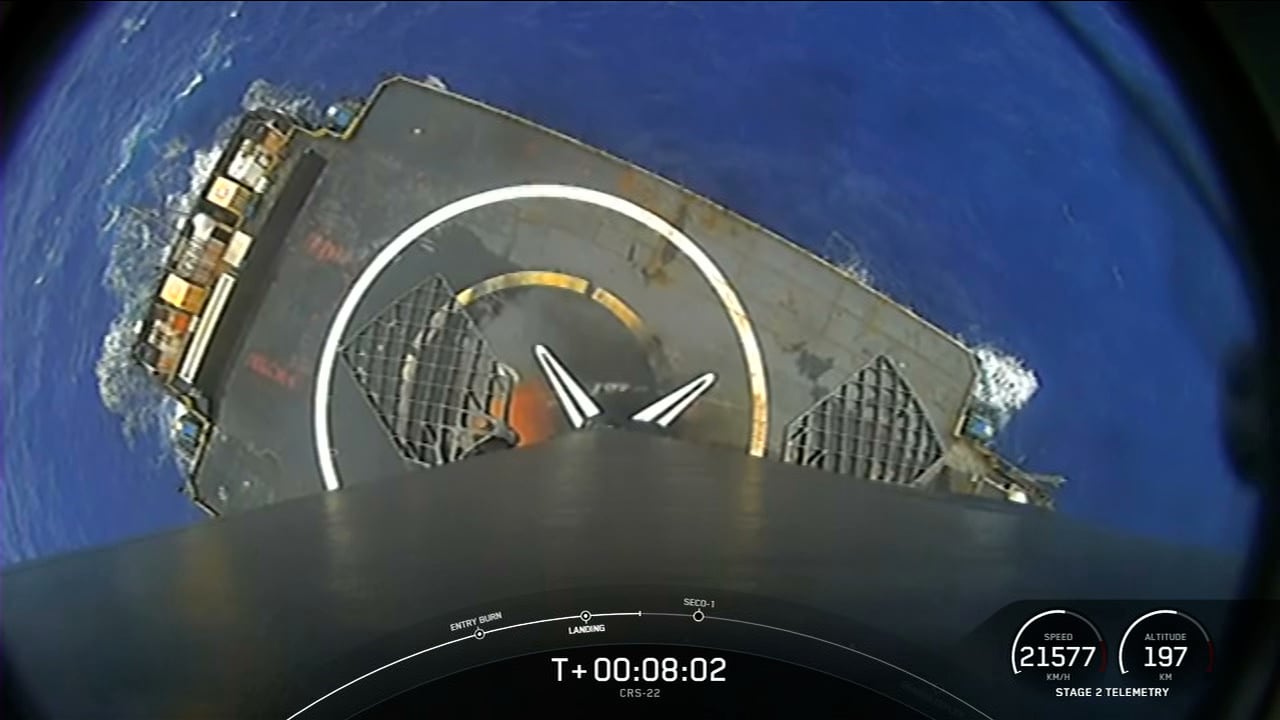
On 3 June 2021, a clean white Falcon 9 lifted NASA’s CRS-22 cargo mission from Kennedy Space Center. The first stage was new. NASA’s live account made a point of saying so, then showed the booster landing on the drone ship Of Course I Still Love You about eight minutes after launch.
That stage was B1067. Five years and 36 days later, on 9 July 2026, it rose from Cape Canaveral again. This time it carried 29 Starlink satellites and returned to a different ship, A Shortfall of Gravitas. The landing completed B1067’s 36th trip up and 36th controlled return.
The number is extraordinary precisely because almost nothing about the latest flight looked extraordinary. There was no experimental landing profile and no special recovery ceremony. The booster separated, the upper stage continued towards orbit, and B1067 touched down at sea about eight and a half minutes after leaving Florida. The record was absorbed into the working launch schedule.
Thirty-six flights put one Falcon 9 first stage within three missions of space shuttle Discovery’s lifetime total of 39. It has reached 92.3 per cent of that count in less than one-fifth of the time. That is a useful comparison, but only if the two things being counted are kept clear.
Thirty-six launches are not 36 shuttle missions
B1067 is one reusable part of Falcon 9. Its nine Merlin engines provide the opening thrust, the stage separates before reaching orbit, and a separate upper stage completes the payload’s ascent. The upper stage is not recovered. Payload fairing halves are often recovered and reflown, but they are separate hardware again.
On a typical drone-ship mission, the first stage spends only minutes in flight. After separation, cold-gas thrusters orient it, hypersonic grid fins steer it, and engine burns reduce its speed for atmospheric entry and landing. The legs unfold near the end. A successful landing preserves the stage, but the payload mission can succeed even if the recovery does not.
Discovery was the part of the space shuttle system that reached orbit. The orbiter carried astronauts, a payload bay, three main engines, life support, wings, landing gear and thousands of thermal-protection tiles. It remained in space for days, entered the atmosphere at orbital speed and landed on a runway. The shuttle’s external tank was discarded, while its solid rocket boosters were recovered and processed separately.
Counting B1067 and Discovery together therefore compares reusable vehicle cycles, not equal missions or equal exposure. The Falcon stage experiences ascent loads, separation, atmospheric return, salt-air recovery and landing. Discovery experienced all of ascent, prolonged orbital operation and the much harsher energy of orbital re-entry. The 36-versus-39 figure is illuminating because it reveals cadence. It is misleading if treated as proof that a first stage has done almost everything an orbiter did.
One flight every 53 days across five years
The elapsed time from B1067’s first launch to its 36th was 1,861 days and almost 16 hours. Divided across the 35 intervals between missions, that is an average turnaround of about 53.2 days. An average hides long and short gaps, yet it captures the deeper achievement better than a single record turnaround would.
B1067 did not merely survive a quick second flight. It remained useful through five years of launch assignment, pad processing, ocean landings, port returns, transport, inspection and maintenance. Its career also crossed several kinds of mission.
The first flight carried more than 7,300 pounds of NASA research, supplies and station hardware on CRS-22. NASA’s contemporaneous landing report said that the next assignment would be Crew-3. It was. B1067 later launched Crew-4 as well, sending a total of eight astronauts towards the International Space Station across those two flights.
Its non-Starlink work also included Türksat 5B, Eutelsat HOTBIRD 13G, O3b mPOWER spacecraft, Indonesia’s SATRIA broadband satellite, Telkomsat Merah Putih 2, a Galileo navigation mission and Koreasat-6A. Two NASA cargo missions, two crew launches, commercial communications spacecraft and European navigation hardware all appear in one stage’s logbook.
By the 36th launch, however, Starlink supplied 25 of its missions, including the latest one. That concentration is not a footnote. It helps explain how a booster acquires 36 flights in five years.
What the original ten-flight goal actually meant
Falcon 9 Block 5 debuted in May 2018 as the final major version of the rocket. SpaceX’s public ambition was that a first stage should manage at least ten flights without major refurbishment. Reports from the debut described scheduled maintenance at ten-flight intervals and the possibility of a much longer service life.
The language was easy to flatten into “ten flights”. It was not meant as an automatic expiry date. It was an engineering and maintenance target: get through a meaningful block of missions without dismantling the vehicle for major rebuilding, then use inspection and accumulated data to decide what came next. Reporting around Block 5’s introduction also recorded practical changes such as more reusable thermal protection, improved engines and landing legs designed to be folded again with less labour.
Earlier Falcon 9 versions had already landed and reflown, but Block 5 was designed so reuse shaped the hardware from the beginning. It is the difference between recovering a rocket and operating a recoverable rocket repeatedly.
B1067’s 36 flights do not show that the original ten-flight estimate was wrong. They show that ten became a qualification step rather than the edge of the map. SpaceDaily reported a record 16th first-stage flight in 2023, then a 24th flight in November 2024. Each record gave engineers another body of real load, heating and performance data from which to judge later missions.
Low refurbishment never meant no maintenance
A rocket does not become reusable by pretending it does not age. Combustion chambers face extreme pressure and temperature. Turbopumps spin at high speed. Tanks are repeatedly chilled and pressurised. Seals, valves, plumbing, landing hardware, grid fins and heat-protection systems experience their own cycles. Sea landings add a marine environment after the flight.
In 2022, SpaceX managers described an inspection system to Aviation Week using airline-like labels. An A check followed every flight. A more substantial B check occurred periodically, around every sixth or seventh mission. C-level attention covered life-leading stages and vehicles assigned to crewed flights. The company also discussed replacing selected components proactively and using every mission’s telemetry to update design, manufacturing and inspection decisions.
That account is valuable because it replaces the vague word “refurbishment” with a spectrum. Downloading flight data, visually inspecting hardware and checking fluids are not the same as removing an engine or replacing a life-limited seal. Targeted maintenance is not evidence that reuse failed. It is how a reusable fleet stays inside an accepted risk envelope.
SpaceX does not publish B1067’s complete maintenance ledger. There is no public basis for claiming that every engine, seal, valve or protective panel installed for CRS-22 remains on the stage. Nor does the number 36 reveal how many labour hours its inspections consumed. The defensible achievement is narrower and still substantial: the first-stage structure and vehicle identity have remained certifiable for 36 launches and 36 landings.
Starlink is both customer and flight laboratory
Reusable hardware has little economic value if there is nothing waiting to fly. Starlink supplied the demand that let SpaceX turn booster reuse from an occasional opportunity into a production rhythm. The company builds the satellites, operates the launch vehicle and needs a continuing stream of deployments. It does not have to wait for 25 unrelated customers to make B1067’s later flights possible.
That vertical relationship also gives SpaceX control over mission assignment. Managers told Aviation Week in 2022 that Starlink flights were useful for life-leading stages and demanding heating profiles. A company-owned payload can become a place to extend experience before an older stage is assigned elsewhere, although the precise certification decision for any B1067 mission is not public.
The fleet context matters. SpaceDaily’s review of Falcon 9’s 165 missions in 2025 found that 157 used flight-proven boosters. Reused first stages were not special cases inserted into a schedule built around new rockets. They were the schedule.
B1067 is therefore not a lone machine succeeding through heroic treatment. It is the fleet leader inside a system of factories, launch sites, drone ships, recovery crews, transport equipment, inspection rules, spare parts, upper-stage production, payload processing and range coordination. A booster ready to fly is useful only if the rest of that system can place another mission above it.
Discovery’s 39 flights carried a different weight
Discovery first launched on STS-41D on 30 August 1984 and completed its final mission, STS-133, in March 2011. NASA’s career history credits it with 39 missions across 27 years, 5,830 Earth orbits, about 149 million miles travelled and a cumulative 365 days in space.
The mission names explain why a simple count understates that career. Discovery deployed the Hubble Space Telescope and later returned for servicing. It flew the shuttle programme’s return-to-flight missions after the Challenger and Columbia losses. It docked with Mir, made the first shuttle docking with the International Space Station and supported station assembly and resupply.
Every orbiter turnaround required work across a crewed spacecraft: thermal protection, propulsion, hydraulics, electrical systems, payload bay, cabin and many other subsystems. Shuttle processing also existed inside a programme with multiple orbiters, external tanks, solid boosters, specialised buildings and a mission rate set by far more than the readiness of one vehicle.
Discovery’s average cadence should not be read as a direct measure of inferior engineering. The programme endured long fleet-wide pauses after two fatal accidents, and the orbiter’s assignments were complex national missions rather than repeated satellite deployments. B1067’s faster accumulation shows what a narrower, partially reusable architecture paired with abundant demand can do. It does not erase the work represented by an orbital shuttle mission.
A booster can retire without wearing out
Flight 39 is not an inevitable destination. A Falcon 9 stage can leave service because of inspection findings, damage during landing or transport, fleet economics, or a mission that needs all available performance and therefore cannot reserve propellant for recovery.
SpaceDaily covered that last case when a Falcon 9 core on its 20th flight was deliberately expended for a Galileo launch in 2024. Its disappearance did not mean the booster had failed on its 20th use. The mission traded the stage’s future for additional performance in the present.
The same logic applies at 36. B1067 may fly again, receive deeper maintenance, wait for an assignment or eventually be expended. It need not equal Discovery for its service history to matter. Another Falcon 9 booster may also pass it. A mature fleet makes the identity of the record holder less important over time, because the method is no longer confined to one unusually durable article.
The record is an operating model, not a magic rocket
The most useful way to read B1067’s record is not that one Falcon 9 part has nearly become a space shuttle. It is that a stage built when ten flights without major refurbishment sounded ambitious has exceeded that threshold three and a half times while continuing to land.
Its first and 36th recoveries bookend a change in what launch infrastructure looks like. In the first NASA image, a new booster is touching down and its next flight is noteworthy enough to announce. Five years later, the same stage returns from another mission inside a launch programme that can fly Falcon 9 more than three times a week.
SpaceX’s next system aims to remove Falcon 9’s largest remaining expendable element by recovering Starship’s upper stage as well. As SpaceDaily’s recent examination of the proposed tower catch for Starship explained, recovery is only the beginning. The harder proof is whether a vehicle can be inspected, serviced, assigned and flown again often enough to change operations.
B1067 has supplied that proof for a first stage. Discovery supplied a different proof for an orbiter, across missions that helped build the modern space age. The three-flight gap makes a memorable headline. The real history is in the radically different systems behind the numbers, and in how ordinary B1067’s 36th landing was allowed to look.