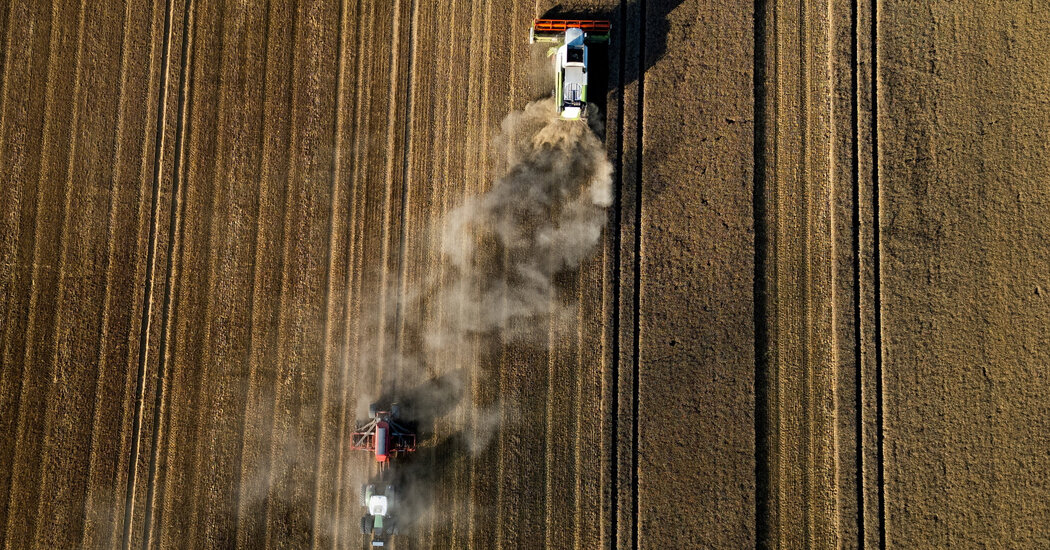
Katrin is away this week; I will be your host. Let’s start the week by analyzing the problems in the granaries of the world. One of the most sinister facets of the war in Iran has been the effect on fertilizer prices. Thanks to the closure of the Strait of Hormuz, they went off at exactly the wrong time: during the spring planting season in the northern hemisphere. The consequences are still unfolding, but will come at a time when the world is already facing high food prices. Today, my colleague Somini Sengupta writes about that all-important staple food: wheat. Instant noodles. Hot chapatis. Sliced bread. Wheat is the core of the modern diet. But this year, the breadbaskets of the world are in trouble. Heat and drought have reduced harvests in some of the largest wheat-producing countries. The little wheat that is harvested now is more expensive to transport, thanks to the war and the weather. The simultaneous problems reveal the risks inherent in the current global food system. Just a few crops, such as wheat, provide most of the world’s calories. Relatively few governments dominate wheat exports, including Russia, Canada, the United States, Ukraine and the European Union. Its customers are primarily low-income countries that no longer grow much of the food their people consume. “The system we currently have depends on three things: fluid trade, cheap energy and a stable climate,” said Evan Fraser, a professor who studies the global food system at the University of Guelph in Ontario. “Today it seems that none of these assumptions are fulfilled.” War, climate and wheatRussia and Ukraine together account for almost a third of the wheat the world buys. When Russia invaded Ukraine and blocked its Black Sea grain trade in 2022, at the start of its war, the sharp rise in global food prices put tens of millions of people at greater risk of acute food insecurity. But this year, just as harvests began, shipments of Russian and Ukrainian grain have all but stopped once again. In recent weeks, both Russia and Ukraine have stepped up their mutual attacks on grain export terminals and ships in the Black Sea. In the critical Russian Black Sea port city of Novorossiysk, grain terminals suspended operations after a drone attack this month. That attack followed a Russian bombing campaign against the Ukrainian port city of Odessa, on which Ukraine depends for its grain. The Danube River is a potential alternative, but water levels plummeted this year due to drought. In other years, the world might have been able to rely on European wheat producers to make up some of the shortfall. But not this year. France, which is the EU’s largest wheat producer, expects lower yields due to record heat this summer, according to government projections. Germany’s main farmers’ group said on Tuesday that yields of several crops, including wheat, had fallen. In July, European agricultural products trade group Coceral issued a special bulletin, estimating lower grain yields of 286.6 million metric tons this year, compared to 310 million metric tons in 2025, for the continent and for Britain. Australia, also a major wheat exporter, planted fewer acres of wheat due to high fertilizer costs stemming from the closure of the Strait of Hormuz. The United States is about to have its worst wheat harvest since 1970, largely due to a terrible drought in the Great Plains. A wake-up call Few things are as politically powerful as the price of bread. According to the Food and Agriculture Organization of the United Nations, wheat prices were already at their highest level in three years in July. Rising prices will put enormous pressure on governments, which are forced to buy high and then help subsidize costs to keep bread prices within their reach. Egypt, which buys most of its wheat from abroad, including Russia and Ukraine, has tried to boost wheat production at home, with the government offering higher prices to farmers. Still, Egypt remains far from achieving anything resembling self-sufficiency. There is simply not enough water to produce what the country needs. Then there are President Trump’s tariffs. To try to avoid higher additional rates, some wheat-importing emerging economies, such as Bangladesh, agreed to purchase substantial quantities of American wheat. That means they are obligated to pay whatever price U.S. wheat is offered, even if it is substantially higher than what other countries offer. Analysts in Bangladesh have denounced the agreement as unfair. The only saving grace this year is that the world had a bumper wheat harvest in 2025. There are still grains stored in the silos of farmers, traders and government reserves. But the year should serve as a wake-up call, experts say. The world depends greatly on a handful of granaries; When something goes wrong, there are few other options. “It is naive to think that we can rely on a food system built for a different era,” Fraser said. “And that’s why we need to reimagine how we feed ourselves.” Canada ‘at war’ with US over trade Prime Minister Mark Carney said Canada was under attack by Trump’s 50 per cent tariffs and was “at war” with the US. Carney blamed unspecified last-minute demands for the collapse of trade talks on Friday night. “They asked for too much and offered too little,” Carney said Saturday. “Canada wants the benefits of being a State, without being one!!!” Trump wrote in a social media post yesterday. In walking away, Carney chose a path no major U.S. ally has taken: With his country’s economy at stake, he stood up to Trump and refused to accept a new trade relationship with built-in tariffs. Many Canadians support him, but his tactic will be costly. This is what you need to know about the trade war. When wages are low and activities are expensive, some New Yorkers are finding new ways to socialize at home. In a city where “$40 easily falls out of your pocket,” as one resident put it, people are turning down invitations to go out on the town and instead arranging overnight stays. My colleague John Eligon, who covers South Africa, took a nine-kilometre walk between two Cape Town townships to show how the legacy of apartheid endures more than 30 years later. Join him. He’s 89 years old, hates matcha, and is a TikTok star. Werner Kalecinski wanted to try something new. For months, as he cared for his sick wife, he felt his own vigor waning. He needed a project and thought about trying TikTok, even though he didn’t understand it. Since then, he has built a following based on things he doesn’t understand. At first he thought “influencer” was a form of influenza. And you still haven’t found a matcha latte you like. He’s part of a growing cast of older influencers who have gained traction among younger users. Read more about Kalecinski’s viral moment.RECOMMENDATIONSWonder: An architect turned this mid-century house in Mexico City into a futuristic house with a secret chess room.Read: Here are six new books our reviewers and editors loved.Cope: Is the BRAT diet really the best way to treat a stomach bug?Chermoula, the North African green sauce made of mild herbs, ground spices and chili, is often eaten with seafood and also adds brightness and warmth to this vegan bean salad. Serve with something creamy like yogurt, hummus or burrata. WHERE IS THIS?