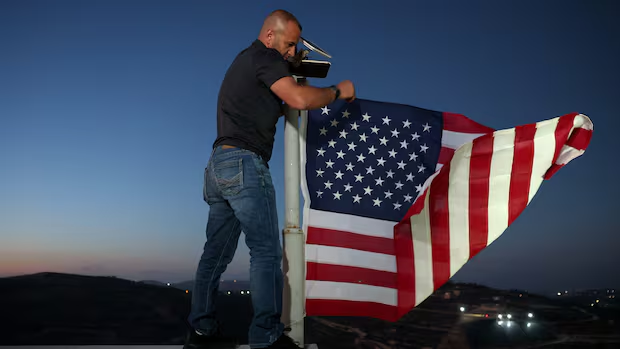
The recent siege of Palestinian homes by militant Israeli settlers in the occupied West Bank village of Qusra is far from an isolated incident. But the American citizenship of one of the Palestinian landowners has attracted more media attention than the almost daily acts of aggression by hardline Jewish settlers aimed at driving Palestinians from their land. Ohio-based businessman Loui Ridi returned to Qusra on Monday, August 17, to protect his home (and his brother and nephew, who live there) as settlers surrounded it and two nearby homes. “I called my brother and he said, ‘I don’t have food. I don’t want to leave the house, but I need food,'” Ridi told CBC News in a video call from Qusra after his arrival. For them to leave, he said, would be to invite settlers to take their home. SEE | Palestinian-American pleads for US to help end Israeli settler siege: “Just two months ago [settlers] They were in my neighbor’s village in Jalud,” he said. “They laid siege to the family for a couple of weeks. And unfortunately, they managed to drive them out of their own home.” Israeli settlements in the occupied West Bank are considered illegal under international law. They have expanded significantly under the current government of Israeli Prime Minister Benjamin Netanyahu and his ultra-nationalist coalition partners, whom critics accuse of giving tacit approval to settler violence. One of Ridi’s first acts after returning to Qusra was to wave an American flag from the roof of his building. He asked the U.S. embassy for help. Qusra is about 16 kilometers south of Nablus as the crow flies and is surrounded by settlement blocks, including Migdalim and Shilo, as well as a growing number of outposts occupied by radical settlers. Attacks by settlers causing casualties or property damage are averaging around six incidents per day this year, according to the United Nations Office for the Coordination of Humanitarian Affairs – “more than in any year on record.” in the West Bank amid the siege by Israeli settlers We hear from Loui Ridi, who traveled from Ohio to the West Bank village of Qusra to help his brother and nephew who were trapped in their home after Israeli settlers surrounded their home last week. Then-political analyst Dahlia Scheindlin talks about what this situation means in the broader context of increasing violence by Israeli settlers towards Palestinians in the West Bank. West Bank, and where Prime Minister Benjamin Netanyahu is The violence in Qusra prompted a rebuke from the US ambassador to Israel, Mike Huckabee, who denounced those responsible as “Israeli terrorists” on social media. “We are appalled by some of the things that have happened to families who are victims of criminal activity that is inexcusable and disgusting,” he told Reuters in a later televised interview. “I don’t call them settlers,” he said. Huckabee is a strong supporter of Israel’s settlement policy and Jewish claims to a biblical right to the land, referring to the West Bank as Judea and Samaria. More than 700,000 Israeli settlers live in the occupied Palestinian territories, including East Jerusalem. Many live in large, long-established blocs, while others live in unauthorized outposts considered illegal even under Israeli law, at least on paper. Palestinian officials said Israeli settlers set fire to two mosques in the occupied West Bank overnight on July 26, which they describe as a de facto institutional annexation of the West Bank that increasingly relies on violence. this week in the territory will leave six people dead. The Israeli-occupied West Bank has increased since the Gaza war began with the Hamas attack on Israel on October 7, 2023 (John Wessels/AFP/Getty Images). The problem is the system that produces this type of violence,” he said. “The idea that Israel can govern three million Palestinians in the West Bank through its army while more and more land is being appropriated and handed over to Israeli settlers.” In Qusra, Israeli border police and units of the Israel Defense Forces (IDF) were deployed. The IDF said the forces were deployed to restore order and eliminate settlers blocking Palestinian homes. “The IDF forces IDF and border police acted to restore order and expel Israeli civilians from the area.” “I told the IDF guy, or the soldier, even though it is a military zone. I am on my property…. Your job, they sent you here to move that settler and arrest him.” On Friday, Reuters published a video apparently filmed by Ridi showing one Israeli soldier throwing objects from the balcony of one of the besieged houses in Qusra and another throwing things into a well on the property. WATCH | Israeli soldiers appear to throw objects from the balcony of a besieged house in Qusra, West Bank:Israeli soldiers appear to throw objects from the balcony of a besieged house in Qusra, West BankVideo obtained by Reuters, filmed by Palestinian-American Loui Ridi, appears to show one Israeli soldier throwing objects from the balcony of one of the besieged houses in Qusra and another throwing things into a well on the property. For Palestinians, scenes like these contribute to an increasingly blurred line between soldiers and settlers. IDF units operating in the West Bank may include ideological settlers, and the army also trains settler security units. The IDF referred a question from CBC News about whether any Israelis had been arrested in connection with the Qusra blockade to the Israeli police, who have not responded. The fact that the settlers have not been permanently expelled has fueled the belief among Palestinians that the IDF is there to enable Israel’s settlement enterprise “because if the Israeli military wants to move the settlers, they can do it.” [them] in just one hour,” said Rabia Odeh, 22, another Qusra resident who lives across the village of Ridi. “But the settlers and the Israeli army are playing together, right before our eyes.” Israeli settlers and people in military uniforms stand outside a Palestinian house in Qusra, in the Israeli-occupied West Bank, in this screenshot taken from a video posted on August 10. (Reuters) CBC News met Odeh for the first time in the fall of 2023 after his family home was attacked by militant settlers from a nearby outpost on a hill overlooking Qusra chambers,” he said. “So if the colonists [are] outside, I can’t go out.” Both Odeh’s former and current homes are on the outskirts of Qusra, as is Ridi’s. “What we see happening in the last month is that this violence is increasingly directed to the outskirts of Palestinian urbanized areas,” Etkes said. “To reduce the area where Palestinians can live, where Palestinians move,” he said. Settlement monitoring groups say the strategy aims to push Palestinians into more small and facilitate connection between settlements and outposts in different parts of the West Bank. “Qusra, this is probably one of the best examples of what we have seen in the last month,” Etkes said. “But this is not something that happens only in Qusra. This is happening in dozens of other Palestinian villages in the West Bank as well.” Settlement expansion also continues on a much larger scale elsewhere. On Thursday, Canada joined France, Germany, the United Kingdom and several other countries in condemning Israel’s decision to issue tenders for the construction of a new settlement known as E1, just outside occupied East Jerusalem. “The E1 settlement will undermine the prospect of the two-state solution by driving a wedge into the West Bank and harm the territorial contiguity of the Palestinian Territories,” said a joint statement.