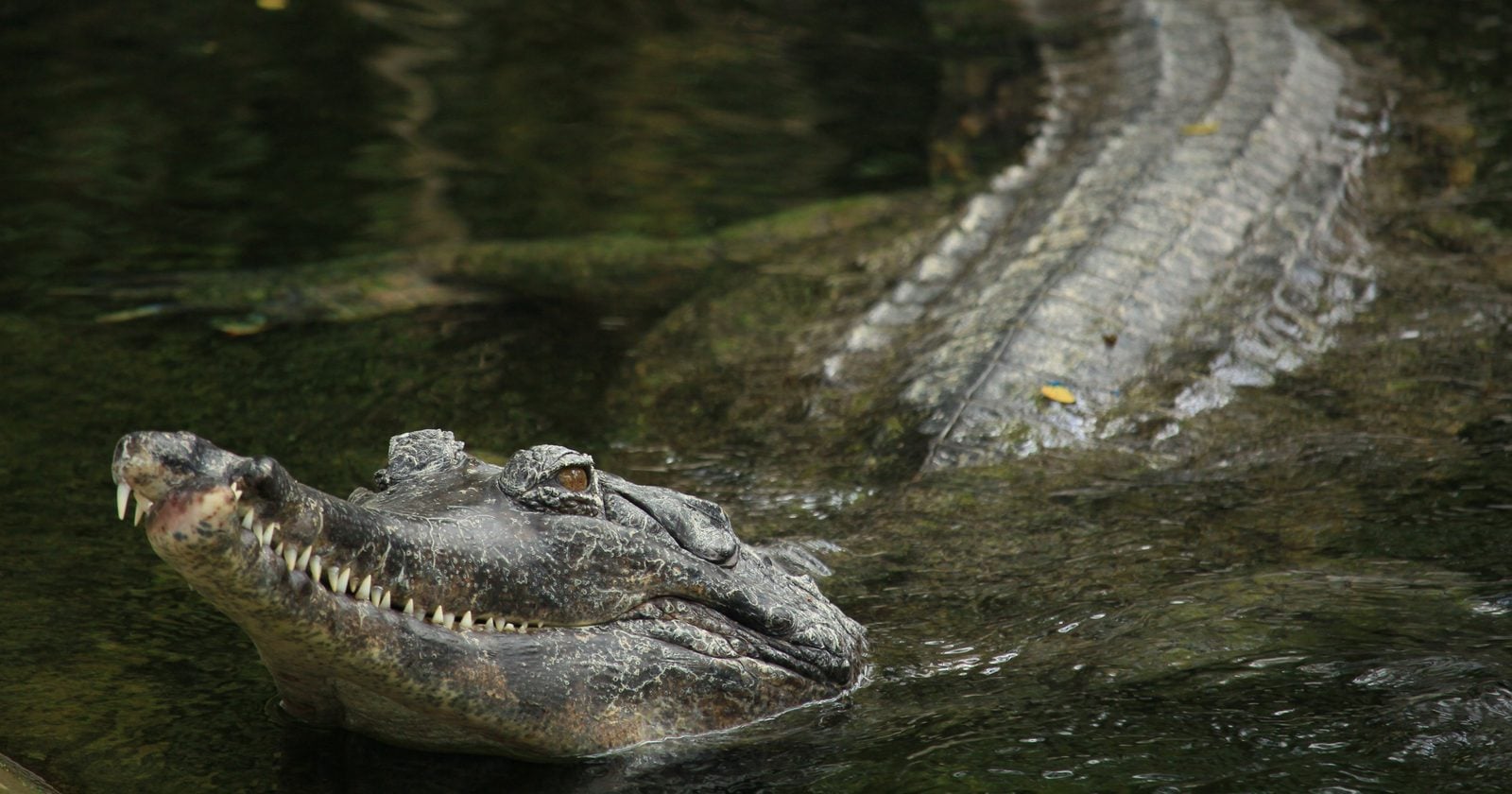
A crocodile lies motionless in shallow water near a colony of nesting birds, with most of its body underwater, so the only thing a passing egret sees is what looks like a floating log with some sticks on top. The bird, looking for twigs to build its nest, reaches out to grab one. The trunk is launched. That image is at the center of one of the most surprising claims about animal behavior of the last decade. The observation is real, but the interpretation is not as firm as the headlines seemed. Today we delve into it. We are not herpetologists or researchers of animal cognition, and what follows is our reading of a scientific dispute rather than a verdict on it. The main studies here are small, and one was later withdrawn, so treat this as a curious look at an open question, not a settled fact. The claim as first reported The observation came from a team led by Vladimir Dinets, then a research assistant professor of psychology at the University of Tennessee, Knoxville. In a 2013 paper titled “Crocodiles Use Tools to Hunt,” Dinets and his co-authors described mugger crocodiles in India and American alligators in Louisiana lying half-submerged with sticks balanced on their snouts. This happened near bird colonies, and mainly during the season when birds are building nests and good sticks are difficult to find. Dinets first noticed it in mugger crocodiles in India in 2007. The claim was ambitious. The paper called this the first report of tool use in any reptile, and the first known case of a predator synchronizing its attractiveness with a seasonal habit of its prey. Dinets did not underestimate him. “This study changes the way crocodiles have historically been viewed,” he said at the time. “They are generally considered lethargic, stupid and boring.” The phrase “lethargic, stupid and boring” is more rhetorical than a measured statement, but it captures why the outcome was successful. Gordon Burghardt, an ethologist at the same university who was not involved in the work, told LiveScience that “this is actually the first convincing evidence of tool use in any reptile.” That was his opinion in 2013. Where interpretation gets slippery To call this tool use, you have to show that the animal is doing something on purpose. A crocodile sunbathing near a bird colony in spring will likely accumulate floating debris in its snout, whether it intends to or not. The sticks move. The rivers near the nesting colonies are full of fallen twigs at exactly the season the article describes. So the real question is not whether you see crocodiles with sticks on their heads. It’s a question of whether they put them there deliberately and whether they do it to catch birds. The 2013 evidence was based on two things. One was scattered sightings. The other was a year of careful observation at four sites in Louisiana, two near bird colonies and two not. Stick display increased markedly from March to May, the nest-building window. That moment is really suggestive. What it can’t do on its own is differentiate deliberate baiting from an animal that simply picks up more debris when there are more birds and more loose sticks around. Royal hunts were rarely caught in the act. As a later article put it, “this behavior has never been documented to lead to successful predation of birds in the wild.” It is difficult to build a strong cause-and-effect case about rare events, no matter how surprising they are when they happen. Adam Rosenblatt and Alyssa Johnson of the University of North Florida tried to test the idea. They conducted a controlled experiment with captive American alligators in four Florida parks, two near bird colonies and two not, adding sticks during the nesting season to see if the animals would use them in the way the bait idea predicts. Their conclusion was cautious: “Our results generally do not support the hypothesis that crocodiles adapt their stick-display behaviors to specific environmental contexts, so the hypothesis that crocodiles are true tool users is also called into question.” In one comparison, they reported, “alligators at a site without colonies actually displayed the behavior more frequently than a site with paired colonies.” This seems like a clear rebuttal, but it is not for two reasons. First, the paper has since been withdrawn, so its conclusions cannot serve as a firm rebuttal. Secondly, the authors themselves warned that animals in captivity are not an ideal way to study this. The enclosures group the alligators in unnatural densities and feed them on a schedule, so their need to hunt birds is nothing like that of a wild animal. A report of the experiment noted that only four alligators displayed sticks for more than ten minutes, all at bird sites, but no birds approached and no alligators attempted to catch one. There is little evidence on both sides: it does not confirm harassment and does not clearly rule it out. What is really well supported If we remove the controversial part, something solid remains. Crocodiles and alligators appear near bird colonies with sticks in their snouts. It happens more during nesting season, when those sticks are worth more to the birds. Occasionally they eat a bird that comes for a stick. What is inferred, and is still disputed, is the intermediate step: that the reptile is deliberately setting a trap, rather than simply gnawing on whatever is within reach while carrying some remains with it. The two readings are not as far apart as they seem. Even the modest version, an ambush predator that parks itself where prey is lured and cashes in on a seasonal windfall, is more flexible than the old caricature of a clumsy log with teeth. Whether that clears the bar for “tool use” in the strict sense is partly a question about crocodiles and partly a question about how we define the term. Holding the find in general terms, Dinets suggested that the interest here runs deeper than crocodiles. These findings are important, he said, not only because they “show how easy it is to underestimate the intelligence of even relatively familiar animals,” but also because crocodiles are close relatives of dinosaurs, which he suggested could provide clues about how those animals behaved. It’s worth taking that last leap as a maybe rather than a conclusion. The fair position, as far as we know, is neither to present the use of crocodile tools as an established fact nor to treat it as discredited. One suggestive time-based study, plus a follow-up experiment that was removed and run in an environment its own authors deemed unsuitable, is not enough to close the case. What the episode does show is that the crocodiles continue to do things that don’t fit their reputation and that the interesting work is still ahead.