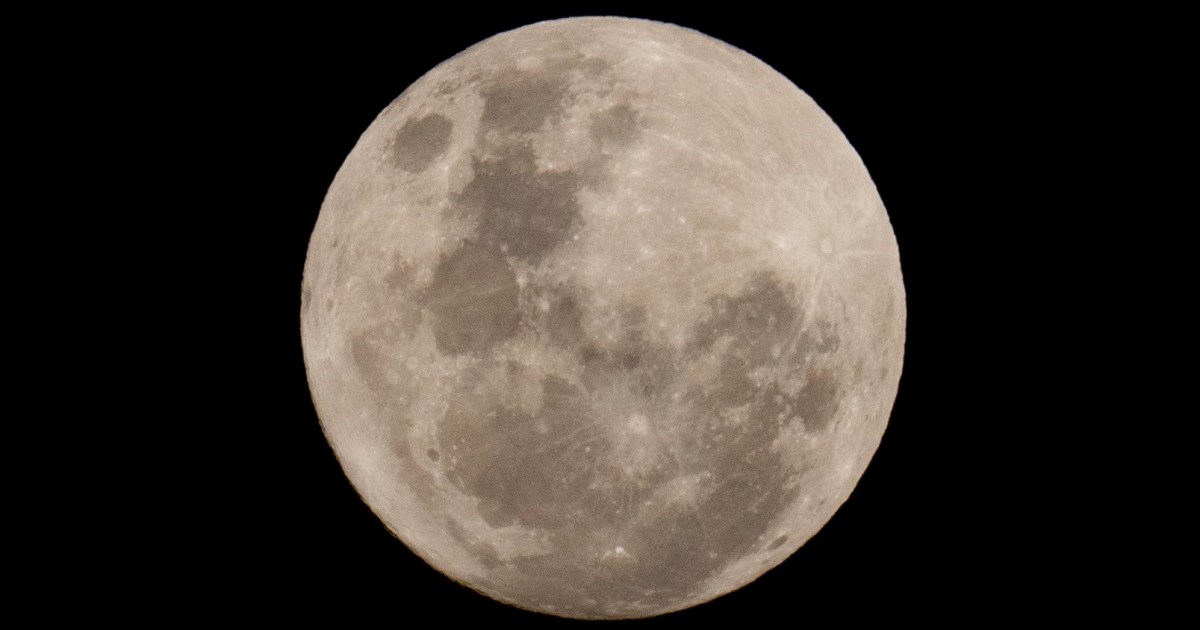
China is set to launch its Chang’e-7 unmanned robotic space mission, possibly as soon as Monday morning, to search for water ice in the permanently shadowed craters of the moon’s south pole. This is China’s seventh and most ambitious lunar mission so far. Here’s what we know about it. What do we know about Chang’e-7? The launch window for Chang’e-7 runs from Monday, August 24 to Monday, August 31, according to launch observers. That means the mission could take off any day during that period. Chang’e-7 comprises an orbiter, a lander, a rover and a hopper. The orbiter is the main spacecraft that will remain in the Moon’s orbit, mapping the surface and taking images while the mission is underway. It will also transmit data and communications between the other components of Chang’e-7 and Earth. The lander is the craft that will land on the lunar surface, loaded with the scientific instruments necessary for lunar exploration, near the rim of Shackleton Crater, a 21-kilometer-wide pit near the Moon’s south pole. Previous lunar missions had never come this close to the pole. The rover is a small robotic vehicle that can roam around the landing site and carries equipment to analyze the local environment, including rocks and soil. The hopper is a small, solar-powered robotic craft designed to “jump” – or fly – short distances from the moon’s surface and land again. It will be used to explore Shackleton Crater. How do we know there is water on the Moon? Over the past two decades, several space missions have established that there is water on the Moon. Since the 1960s, even before the first Apollo landing in 1969, scientists speculated that water could exist on the Moon. However, when Apollo crews returned samples for testing in the late 1960s and early 1970s, they appeared to be dry. Finally, in 2009, NASA deliberately crashed a rocket segment and its probe into a shadowed lunar crater to analyze the plume of dust it raised. This provided one of the clearest direct confirmations that a significant amount of water ice exists on the Moon, based on previous detections of water and hydrogen by probes. In October 2020, NASA scientists announced that water on the Moon is more widespread than previously known. They said water molecules had been found to be encapsulated within mineral grains on the lunar surface and speculated that there is more water hidden in patches of ice that lie in permanent shadows. NASA describes these permanent shadows as dark areas within deep craters near the moon’s north and south poles, where sunlight has not reached for millions or even billions of years. In 2018, before confirming it in 2020, NASA had detected water ice in shadowed parts of the Moon through mapping. Why is it important to know more about water on the Moon? Expanding knowledge about water on the Moon is vital because ancient polar ice may have preserved a record of lunar volcanic activity and water delivered by comets and asteroids to the Earth-Moon system, offering clues to how our own oceans originally formed. Additionally, if there is enough water on the Moon, it could realistically serve as a source of drinking water for manned lunar missions and could also help keep equipment cool. Hydrogen could also be extracted from Moon water to provide fuel, while oxygen could be extracted for breathing, supporting future missions to Mars or lunar mining. Could someone “own” the water on the Moon? The 1967 United Nations Outer Space Treaty prohibits any nation from claiming sovereignty over the Moon or possessing it as territory. It does not explicitly prohibit commercial operations, but requires that private activities in space be authorized and supervised by states and leaves key questions about resource ownership unresolved. What recent space missions have searched for frozen water on the Moon? In 2023, the Russian lunar spacecraft, Luna-25, was launched to search for frozen water at the Moon’s south pole. However, Luna-25 lost control and crashed. The accident prevented any scientific data collection or discovery of water. Opposing the Luna-25 mission was India’s Chandrayaan-3, which also sought to expand knowledge about lunar water ice. Chandrayaan-3 successfully landed in August 2023 and found critical new evidence of water on the surface of the moon’s south pole through ground temperature readings. Why is it a challenge to explore the moon’s south pole? Landing attempts at the moon’s south pole have failed before due to its challenging terrain, which is filled with craters and deep trenches. The south pole is far from the equatorial region targeted by previous missions, including the manned Apollo landings. What is different about the Chang’e-7 Mission? The upcoming Chang’e-7 aims to expand knowledge about where, exactly, water is found in the moon’s craters, how deep it is, what form it is in, and whether it is actually possible to access it. Chang’e-7’s six-legged hopper has been designed to jump in and out of the deep, shadowy craters near the south pole, which are difficult for traditional explorers to reach, to search for water ice and other resources. No previous space mission has used a dedicated Hopper to enter and exit lunar craters in this way.