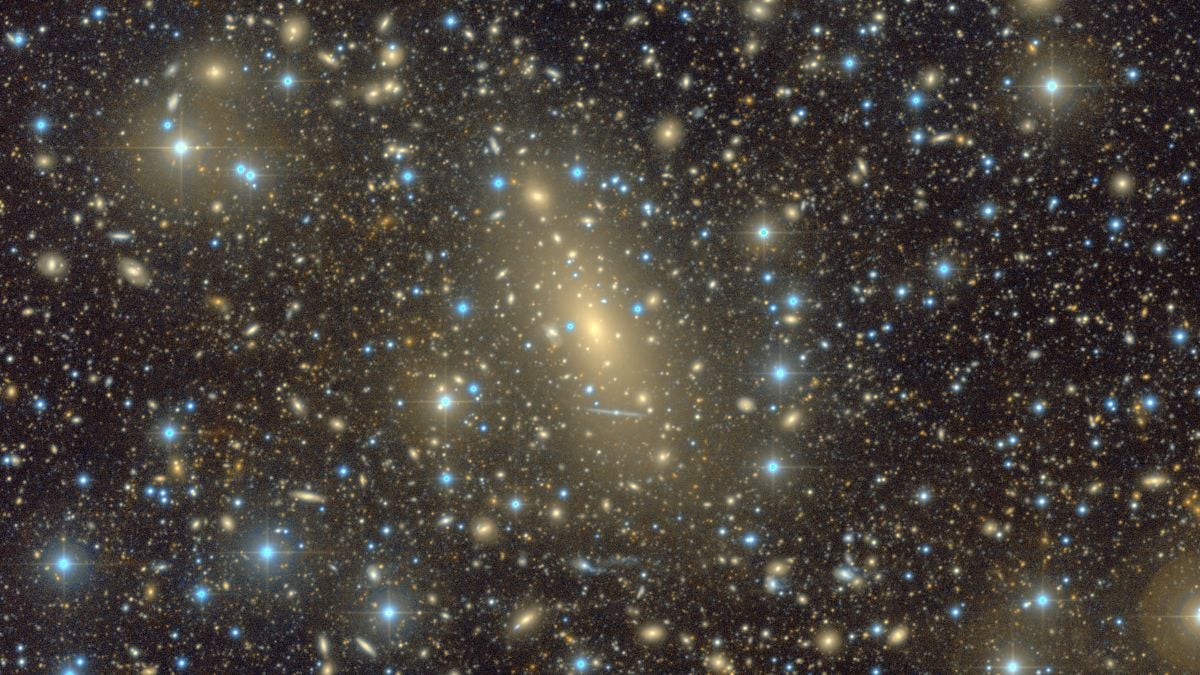
The Universe can do crazy things, especially when it comes to scale. From giant black holes to massive, sheet-like walls of galaxies, our reality is full of mind-blowing snarls. But a galaxy called IC 1101 is a crazy thing that dramatically exceeds the upper limit of normal. Using the deepest observations yet of IC 1101, astronomers have made the most robust measurement to date of its physical extent, identifying the boundary of its parent stellar body some 260 kiloparsecs from its center. That makes it around 1.7 million light years in diameter, making it, according to a team led by astrophysicist Carlos Marrero de la Rosa of Spain’s Canary Islands Institute of Astrophysics, the largest galaxy known to date. And the trick? It’s still growing. “For comparison, the Milky Way’s stellar disk is about twenty times smaller in diameter,” Marrero de la Rosa told ScienceAlert. “Another way to imagine its size is that if IC 1101 were located between the Milky Way and Andromeda, its main stellar body would almost close the gap between the two galaxies.” IC 1101 is located in the middle of a large galaxy cluster, which complicates observations. (C. Marrero de la Rosa et al.; data: Isaac Newton Telescope (INT/ING)) IC 1101 has long been recognized as a large galaxy. It sits within a galaxy cluster called Abell 2029 like a well-fed spider sitting in a web, glowing with the satisfaction that can only be expressed with billions and billions of stars. But pinning down its diameter has been a challenge, because the stars at the outer limits of its main body blend with the diffuse starlight that permeates the cluster around it, like a spider’s legs blend with the threads of its web, so to speak. “A galaxy does not usually have a sharp edge like a solid object; its stars become progressively more diffuse with distance from the center,” said Marrero de la Rosa. “So the ‘edge’ is not the place where stars suddenly disappear, but the radius where the main body of the galaxy stops behaving as a coherent structure.” Previous observations had shown that IC 1101 was widespread, but they were unable to clearly establish that edge. Because Marrero de la Rosa’s doctoral thesis work focused in part on the technical challenges of finding the edges of galaxies, the galaxy represented the perfect laboratory to test techniques for doing so. For the new study, he and his colleagues used the 2.5-meter Isaac Newton Telescope at Spain’s Roque de los Muchachos Observatory to obtain the deepest images ever taken of IC 1101. But the hardest part came next: painstakingly removing scattered light from foreground stars and concentrated bright light from IC’s center. 1101 itself. A comparison of different observations of IC 1101. The team’s observation is on the right. (C. Marrero de la Rosa et al.; data: Sloan Digital Sky Survey, DESI Legacy Imaging Surveys and Isaac Newton Telescope (INT/ING)) That part is crucial because light from bright objects can become diffused by the telescope and the atmosphere and disguise itself as genuine faint material on the outskirts of a galaxy. Once they removed those effects, the team looked for changes in various properties of IC 1101 as they moved away from its center. At about 260 kiloparsecs, several things changed together: the distribution of light, the color of stars, the amount of stellar mass, and even the shape and orientation of the galaxy. Because all of these independent measurements shifted at roughly the same distance from the galactic center in multiple directions, the researchers interpreted this as the edge of IC 1101’s main stellar body, a structure 520 kiloparsecs, or 1.7 million light years, across. But then something unexpected arose. “The scattered light was eliminated, the field became much cleaner and several very faint structures around IC 1101 became visible. Some of them are asymmetric, filamentous or plume-shaped, suggesting that they may be related to past accretion events or interactions with smaller galaxies,” explained Marrero de la Rosa. “What was especially interesting was that these structures did not look like random background fluctuations. They seemed to form a complex low surface brightness environment around the galaxy, consistent with the idea that IC. 1101 is still assembling material on its outskirts.” A deep image showing some of the structures the team found around IC 1101. (C. Marrero de la Rosa et al.; data: Isaac Newton Telescope (INT/ING)) boundary. In its diffuse outskirts, stars and debris from smaller galaxies continue to accumulate, gradually adding material to the huge system. And, delightfully, some of those external structures appear to align with vast perturbations seen in the X-ray emission around IC 1101. That emission tracks hot gas that researchers say may retain the signature of an off-axis merger with a smaller galaxy cluster a few billion years ago. This tells us two things. It’s a strong clue as to how monster galaxies like IC 1101 can reach prodigious size, and shows that the machinery capable of building such monsters is still at work in the Universe. “I would be cautious in saying that IC 1101 is the absolute upper limit, because the Universe may still contain other very extensive systems that have not yet been studied with comparable depth and care,” Marrero de la Rosa told ScienceAlert. “But IC 1101 is currently one of the strongest observing systems.” If they are out there, astronomers would like to identify them, because these giants preserve records of the most extreme galactic growth histories. They grow to such enormous sizes mainly by accreting and merging with other galaxies, and traces of those mergers are preserved in their surroundings. Related: This enormous galactic structure is 23 million light years away and we cannot understand it. The researchers plan to use their techniques to search for these giant galaxies to try to understand whether IC 1101 is truly exceptional or part of a population of similar objects that we have not been able to identify until now. “IC 1101 is, in a sense, a galaxy of the future: as time passes, more and more massive galaxies can grow to similar sizes,” said Marrero de la Rosa. have been accepted into Astronomy & Astrophysics and are available on arXiv. This article was fact-checked by Fiona MacDonald and edited by Fiona MacDonald. While we take pride in our process, we’re human. If you spot an error, please let us know.