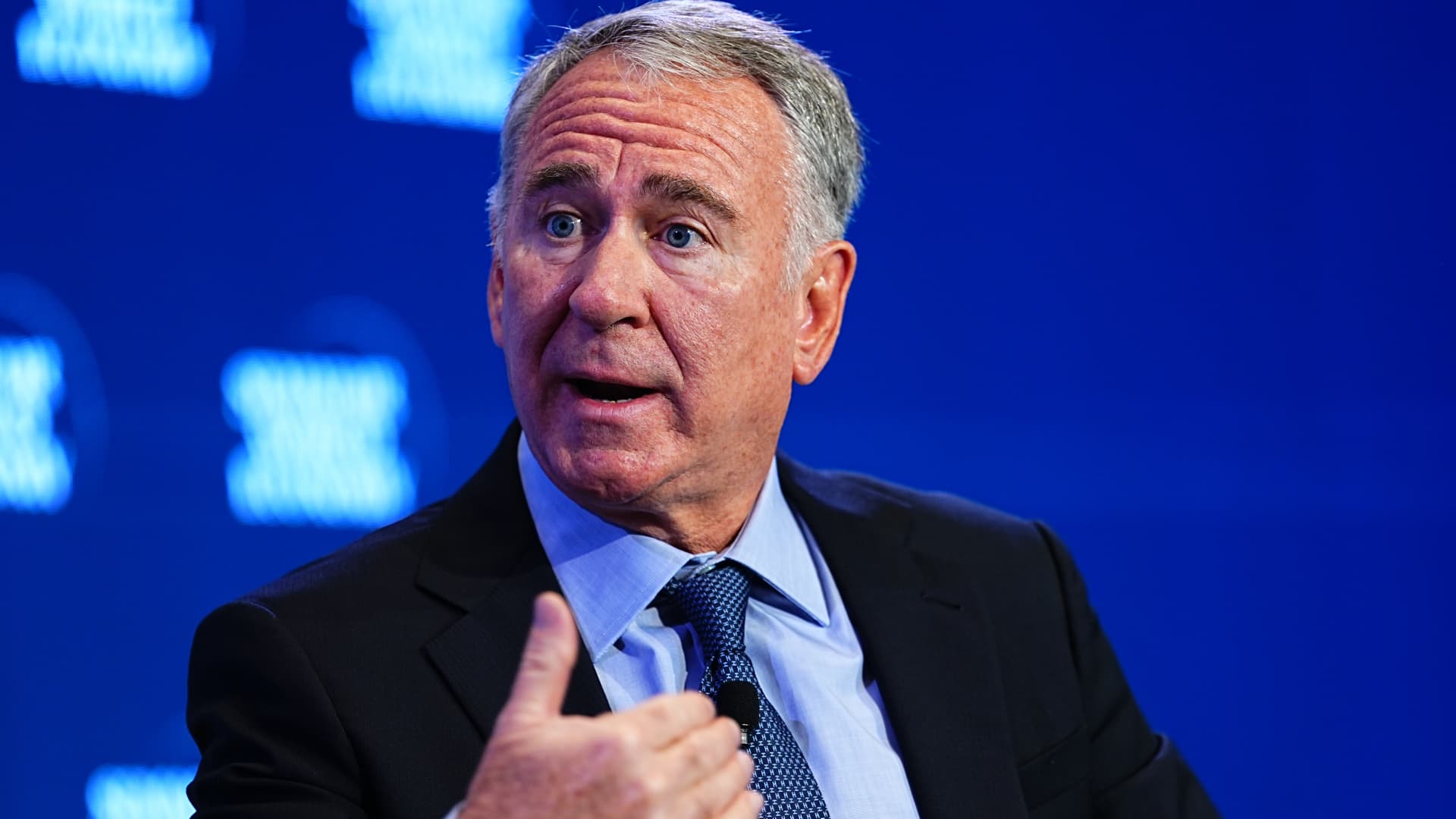
Citadel’s Ken Griffin, in a letter to clients on Friday, addressed for the first time the firm’s purchase of assets from Leopold Aschenbrenner’s Situational Awareness hedge fund. According to a letter obtained by CNBC’s Sara Eisen, Griffin told clients that Citadel has untangled more than 80% of the aggregate risk of the original acquired portfolio by making more than 100 block trades with a market value of more than $4 billion. Griffin detailed in the letter that Citadel began discussions with Situational Awareness to acquire some of the fund’s holdings on July 29. A day later, CNBC’s David Faber reported that Situational Awareness was forced to sell all of its public stock positions after facing large losses. Citadel was later revealed to be the buyer of the assets. “A transaction of this magnitude could not have been completed without the extraordinary cooperation of the prime brokerage and trading teams of the banks serving both companies,” Griffin wrote in Friday’s letter to clients. “I am grateful for the concentrated effort they contributed to the rapid transfer of the portfolio.” Ken Griffin, founder and CEO of multinational hedge fund Citadel, speaks during the 29th annual Milken Institute Global Conference at the Beverly Hilton in Beverly Hills, California, on May 5, 2026.Patrick T. Fallon | AFP | Getty ImagesGriffin also confirmed that the firm’s flagship Wellington multi-strategy fund returned 5.94% in July, which CNBC previously reported marked the fund’s best monthly performance since 2022. Situational Awareness as a hedge fund concentrated positions in artificial intelligence trading, building on 25-year-old Aschenbrenner’s belief that the technology would fundamentally reshape the world and the economy. At the same time, the fund had short positions in some software companies, a sector that investors worry will be affected by AI. However, AI trading faltered in June and July, even as broader indices appeared stable, and stocks in which Situational Awareness had large holdings, such as Sandisk and Bloom Energy, fell more than 50%. At the same time, software names like Adobe rallied, meaning the fund was losing money on both its long and short positions. That triggered both margin calls and mandatory selling in the fund. Since Citadel stepped in to buy the fund’s publicly traded assets, AI trading has rebounded, with the sale of Situational Awareness representing the bottom of the selloff that began in June. Choose CNBC as your preferred source on Google and never miss a moment from the most trusted name in business news.