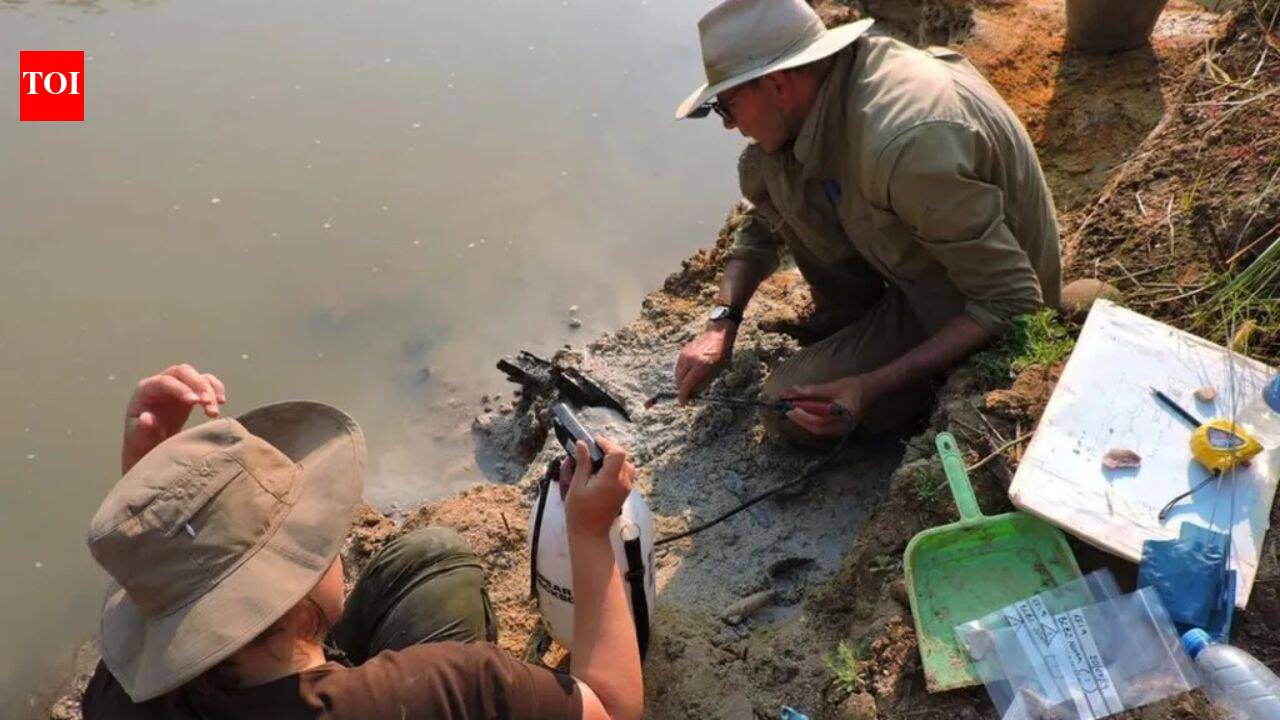
For decades, an oddly shaped log buried beneath Zambia’s Kalambo Falls hovered on the brink of an archaeological mystery. When archaeologist J. Desmond Clark discovered it in the 1950s, the wood had tapered ends and a deliberate-looking notch cut into its surface, suggesting that someone had shaped it rather than leaving it to the river. But Clark had no reliable way to establish which date it belonged to. Radiocarbon dating could not go far enough, while an early uranium series estimate produced an uncertain age. More than half a century later, archaeologists returned to the site and found additional pieces of wood with matching cut marks. This time, luminescence dating of the surrounding sand provided the answer: the wooden structure was at least 476,000 years old. It is one of the earliest known evidence of people deliberately shaping and joining wood, offering a rare glimpse into a technology that almost never survives in the archaeological record. A wooden clue that refused to fit into the log Clark was working on a site below Kalambo Falls, a 235-metre waterfall on the Kalambo River. The excavation was producing the kind of evidence expected of a Paleolithic occupation: stone artifacts, animal bones and traces of activity from a distant human past. Then there was the wood. The trunk had been tapered towards its ends and had a carefully made notch. Its shape did not fit comfortably with the idea of a branch simply altered by flowing water. Clark believed someone had worked it, probably using stone tools. However, archeology in the 1950s had a serious problem when it came to such old material. Recognizing an artifact was one thing. Establishing his age was quite another. As reported, radiocarbon dating was of little use. Its practical range stopped at about 50,000 years, well below what the Kalambo material seemed to represent. Clark’s sample result effectively said he was beyond the limit of the method. An attempted uranium series gave a figure of around 180,000 years. It was an intriguing number, but not one that would resolve the matter. The evidence was too uncertain and Clark never had the opportunity to see the issue resolved. The second excavation brought the Clark mystery to life. Decades later, archaeologists returned to the same area as part of the Deep Roots of Humanity project. The work, led by Larry Barham of the University of Liverpool, brought modern excavation and dating techniques to a site that had already challenged a previous generation of archaeologists. The new dig produced something particularly useful: more wood. Several pieces lay in overlapping positions and some had notches that corresponded with the shape and arrangement of the wood around them. The resemblance to Clark’s earlier find made the ancient discovery much harder to dismiss as an isolated piece of unusually shaped wood. There was also evidence on the surfaces themselves. Scraped areas and marks similar to those produced by adze-type tools appeared around the notch, while the adjacent wood had V-shaped cuts. Together, the marks suggested that people had deliberately altered the wood and fitted one piece against another. The question that had stopped Clark was now ripe for a different kind of answer. PC: BBC Age came from sand, not wood. The team did not need to date the wood directly. Instead, researchers turned to the sediment in which it had been buried. The method is known as luminescence dating. It acts on mineral grains, such as those found in sand. While exposed on the surface, these grains are reset by sunlight. Once they are buried, small amounts of natural radiation accumulate inside them. Measuring that stored signal can provide an estimate of how long beans have been away from daylight. The study published in Nature, titled ‘Evidence for the earliest structural use of wood at least 476,000 years ago’ revealed that at Kalambo Falls, the surrounding sediment produced an age of at least 476,000 years, with an uncertainty of approximately 23,000 years. That result placed the wooden structure well beyond the limits of dating techniques available when Clark excavated the site. It also made the old uranium series estimate look dramatically too young. The wood was not simply old. It belonged to a time almost half a million years ago. What the builders actually did remains uncertain. Excavated pieces show that two sections of wood were molded and joined together. This is significant, but it does not reveal the full form of what was once there. There is no roof, wall system or entire floor left to justify confidently describing it as a house. Instead, researchers have suggested several possible uses. The joined beams could have formed part of a platform or walkway. It could have provided a raised surface to keep objects off the wet ground. It could also have been associated with a larger structure whose other components were made of materials that did not survive. The distinction matters. Archeology often works with fragments, and a fragment can demonstrate a technique without revealing the entire object. What can be said with much greater confidence is that the wood was intentionally selected and modified. Someone had to choose the right wood for the job, cut it, shape it, and make the pieces work together. Why did wood survive when so much else disappeared? The same river environment that helped people use the landscape also helped preserve evidence of what they did there. The wood had been buried in permanently waterlogged sediments, where oxygen levels were low. Decomposition is slowed under such conditions, allowing organic material to survive for periods that would be nearly impossible in a dry, exposed archaeological site. It creates a strange imbalance in the record of early human technology. Archaeologists may look at thousands of stone artifacts from a particular period and assume that the stone tells most of the story. In reality, it may simply be the part of the story that survived. The wood could have been widely used to make handles, platforms, shelters, containers, traps, tools, and other everyday objects. Most of the vestiges would have disappeared. Kalambo offers a rare glimpse into that lost material world. The people who built it are not identified. The age of the structure is clear enough to place it deep in the Middle Pleistocene, but the excavation does not identify the hominid species responsible for the construction. Researchers have been careful on this point. The evidence does not provide a certain species attribution, and the article does not attempt to link the structure to a particular hominid group. That restriction is important because human evolution was not a simple sequence in which one species clearly replaced another. Several hominid populations existed in Africa during the period in question, and the archaeological record is often too incomplete to connect a particular artifact to a particular species. What the Kalambo material does provide is behavioral evidence. Whoever made the structure was able to select the wood for a purpose, alter its shape with tools, and join separate pieces together. Those actions required more than simply choosing a naturally useful branch. Clark had seen the same evidence, but not his age. Clark’s original interpretation was not necessarily incorrect because his dating was incorrect. He had recognized a deliberate shape in the wood, but the technology at his disposal could not establish when that work had been done. Modern excavation did not transform a natural log into an artifact. It provided a more solid archaeological context and a dating method capable of delving much deeper into the past. In that sense, the most important change occurred outside the riverbed. The evidence had been waiting there for decades. The discovery also shows the extent to which archaeological interpretation can depend on preservation. Normally it would be almost impossible to find a wooden structure from almost half a million years ago. In Kalambo, the river kept him sealed in the mud. No written records survive from this period, no above-ground buildings or a full explanation of what the structure was for. There is wood with simple shapes, tool marks, sediments and footprints left by people who lived in a very different landscape. And that distinction is perhaps the most revealing part of Kalambo’s discovery. The oldest known wooden structure is not a carefully preserved ancient building waiting to tell its story. It is a small, damaged piece of evidence of a much larger world that has largely disappeared.