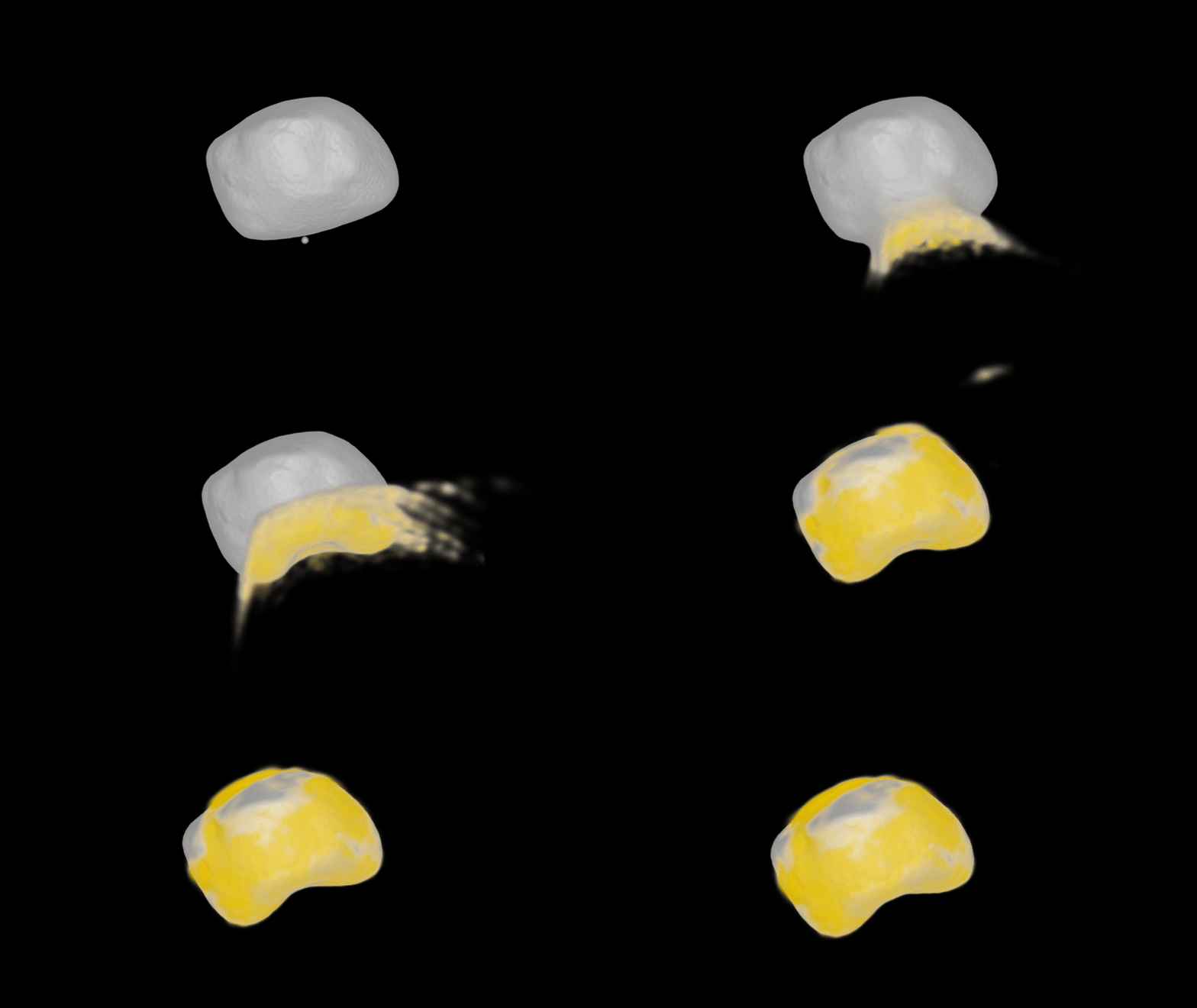
Mars has two small moons that lack a confirmed origin story for how they came to orbit the red planet, but new research may explain some of the mysteries surrounding the outermost satellite Deimos. Deimos, named after the son of the Greek god Ares, which means dread in ancient Greek, is a small, lumpy potato-shaped rock. Ares is also known as Mars in Roman mythology. The moon is about 14,913 miles (24,000 kilometers) from the Martian surface, and orbiters have observed it since the 1970s, including a recent flyby by the European Space Agency’s Hera mission in March 2025. Hera is en route to study the fallout from NASA’s DART mission that intentionally crashed a spacecraft into a small moon orbiting a larger asteroid. Orbital images have shown that unlike its cratered sister moon Phobos, which means fear in ancient Greek, Deimos is much smoother and covered in a disconcerting layer of dust and debris called regolith. Deimos, which is approximately 12 kilometers (7.5 mi) in diameter, also has an identifying feature, a 10-kilometer (6.2 mi) wide impact basin at its south pole, which resembles a dramatic drop similar to those seen in mountain ranges. Scientists have long questioned what created the crater and led to the dust layer. By comparing Hera flyby images with impact simulations, the authors of a new study published Tuesday in the journal Nature Astronomy suggest that the impact of a large asteroid reshaped Deimos, resulting in the moon’s spectacular polar crater and global dust cap. The study offers a prediction that could be tested by the Japan Aerospace Exploration Agency’s Martian moon exploration mission, known as MMX, expected to launch by the end of the year. The mission aims to capture unprecedented, detailed observations of both moons to help determine how and when they formed and even return samples collected from Phobos to Earth. “Our study provides important and concrete predictions for this Japanese MMX mission,” said the study’s lead author, Dr. Sabina Raducan, scientific program director at the International Institute of Space Sciences and principal investigator at the Free University of Brussels. “This gives MMX a clearer picture of what its instruments and, ultimately, sample collection can expect.” The researchers began by creating impact scenarios for Deimos using a computer code called Bern Smoothed Particle Hydrodynamics, or SPH. This code, developed at the University of Bern in Switzerland over two decades, is designed to simulate collisions between asteroids, comets and planets, and analyze the impact by observing millions of individual particles involved in each scenario. This breakdown allows researchers to understand the different variations and factors involved during an impact, such as the density, gravity, and compositional strength of rock bodies. “We carried out about a hundred simulations; each one took about a week,” said Raducan, who is also one of the chairs of the Impact Physics Working Group of the Hera science team. The size, speed and impact angle of the asteroid that could have hit Deimos varied in each simulation, as did the internal structure of the moon. The team then compared the data from their simulations to nearby observations of Deimos made by Hera. The researchers focused on the most likely scenario that an asteroid measuring about 320 meters (1,050 feet) across hit Deimos at a 45-degree angle, creating the south pole crater and dust cap. The impact released a large amount of debris across Deimos’ lumpy surface, effectively covering many of its surface features up to 656 feet (200 meters), and making it appear much smoother than Phobos. “Our simulation thus shows that a single impact was enough to decisively shape the current landscape of Deimos,” said study co-author Dr. Martin Jutzi, senior researcher at the Division of Space Research and Planetary Sciences at the University of Bern. “The impact was violent enough to redistribute the material globally, but not so strong that it would have shattered the Moon.” In images of Hera you can still see outlines of ancient craters beneath the Deimos dust layer. If Deimos were more solid, the shock waves from the impact would have resonated off the moon and altered or even erased surface features. Instead, Deimos’ fractured interior cushioned the force of the impact, according to the study authors. The authors did not include a suggestion of when this ancient impact on Deimos occurred, only that it must have occurred long after the moon formed. Scientists have long questioned whether Phobos and Deimos are chunks of rock that were dislodged from Mars by an impact, or whether they are space rocks that were captured by the red planet’s gravity. Observations and computer models suggest that Deimos’ internal structure is very porous, making it more like an asteroid pile of debris (clumps of space rocks loosely held together by gravity) than Earth’s moon. “But that doesn’t necessarily mean that Deimos is actually an asteroid. It could also have formed from material ejected during impacts on Mars,” Raducan said. The MMX mission is expected to collect data that could definitively solve the mystery of the origins of Phobos and Deimos, as well as provide a window into the early history of our solar system, when the gravity of the largest planets caused space rocks to crash into the planets and each other. The mission will reach the moons in 2027, spending two years mapping Phobos and selecting a landing site to take samples before turning back to observe Deimos. A sample of Phobos is expected to reach Earth in 2031. Interest in Deimos and Phobos is growing as more orbiters capture images of the enigmatic moons, said Dr. Terik Daly, a planetary scientist at the Johns Hopkins University Applied Physics Laboratory. Daly was not involved in the study but is a member of the MMX scientific task force. “The paper describes a viable model for the unusual shape of Deimos, based on long-standing questions about its origin and evolution,” Daly wrote in an email. “Like many modeling studies, there are assumptions that future observations will need to test, and the Japanese Martian moon exploration mission is expected to make observations that could provide an opportunity to evaluate the ideas presented in the paper.” Subscribe to CNN’s Wonder Theory science newsletter. Explore the universe with news about fascinating discoveries, scientific breakthroughs and more.