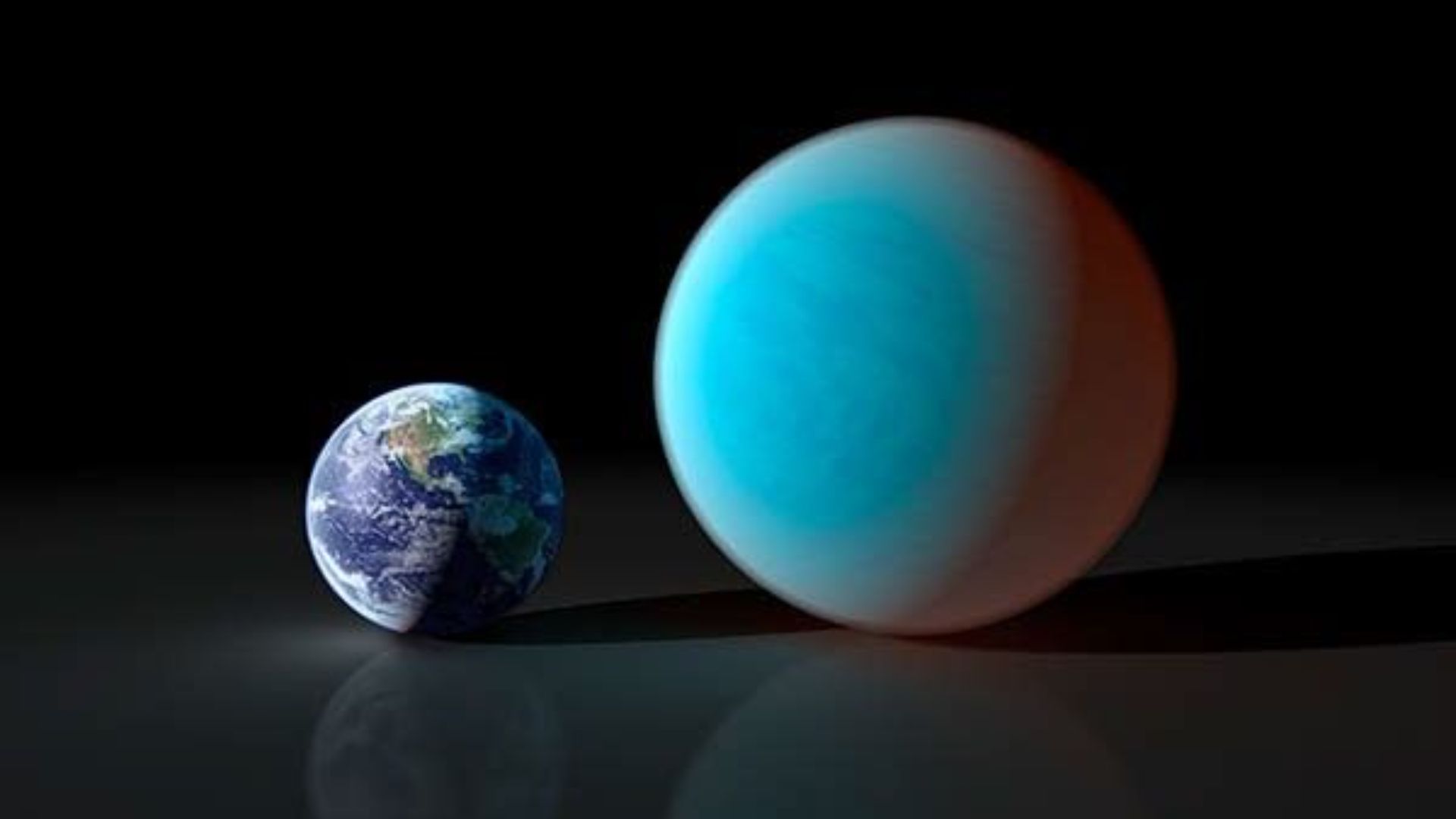
Astronomers have discovered an unusually massive and dense exoplanet that challenges conventional ideas about how rocky planets form. Called GJ 523b, the exoplanet is about 2.5 times wider than Earth, but has about 23 times the mass of our planet in that relatively compact size. Worlds this large and dense are sometimes called “mega-Earths,” an informal term for unusually massive and predominantly rocky planets. The high density of GJ 523b suggests that it contains relatively little atmosphere despite being large enough that astronomers would normally expect it to have built up a substantial gas envelope, according to a statement from the University of Wisconsin-Madison. “This is not what we expected at all,” Max Kroft, lead author of the study, said in the statement. “Dense planets like this are not uncommon, but they are usually small rocky planets similar to Earth or Mercury. This planet is two and a half times larger than Earth.” GJ 523b was initially identified as a candidate by NASA’s Transiting Exoplanet Survey Satellite (TESS), which looks for periodic dips in starlight caused when planets cross or transit their host stars. The researchers continued with observations from the 3.5-meter WIYN ground-based telescope at Kitt Peak National Observatory in Arizona, using a spectrograph to measure the planet’s gravitational pull on its star. Combining those observations, the team calculated that GJ 523b has a mass about 23.5 times that of Earth, a radius 2.55 times that of Earth, and a density of about 126.82 grams per cubic inch. It rotates around its star every 17.75 days. According to the study, the planetary system is also relatively young, with an estimated age of almost 170 million years. You may like That combination of size, mass and youth poses a puzzle for planet formation models. Planets begin by forming cores of rock and metal, which can then extract hydrogen and helium from the disk of gas and dust surrounding a young star. In our own solar system, giant planets like Jupiter and Saturn are thought to have begun rapidly accreting their enormous gaseous envelopes once their growing cores reached about 20 times the mass of Earth. GJ 523b is already about 23 times the mass of Earth, putting it beyond that threshold. However, rather than becoming a gas-rich world, its unusually high density suggests it has relatively little gas and remains predominantly rocky, raising the question of why it followed such a different path. “The question is, why didn’t this planet do that, if it’s 20 times the size of Earth?” Kroft said in the statement. One possibility is that GJ 523b initially formed with a thick atmosphere that was later removed. Another is that it formed through a collision between two planets, creating a larger rocky world while expelling much of its gaseous envelopes into space, according to the statement. Astronomers have used the term “mega-Earth” for more than a decade to describe exceptionally massive rocky worlds, although it has never represented a formally established class of exoplanets. Finding more examples like GJ 523b could help reveal whether these unusual worlds are rare exceptions or part of a broader population. “It’s difficult to infer things about planet formation in general from a sample size of one,” Kroft said in the statement. “We’re not going to get to 10,000 of these overdense planets, but if we can get to 20 or 30, maybe some trends will emerge.” The findings have been submitted to The Astronomical Journal and are currently available on the arXiv preprint server and have not yet been peer-reviewed.