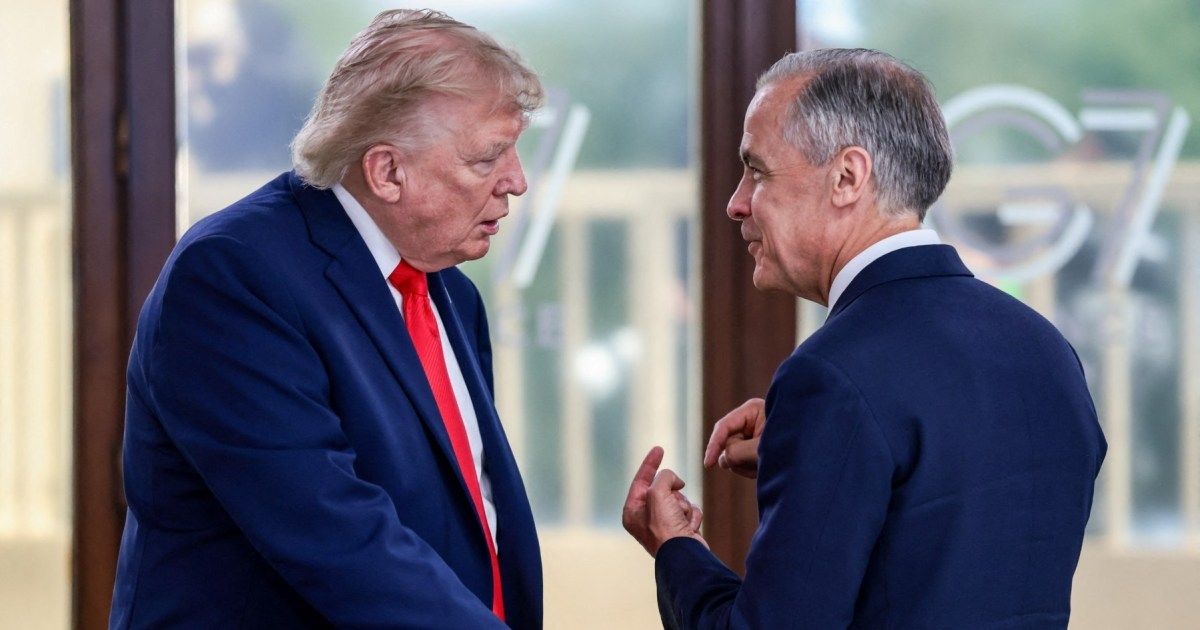
The United States and Canada reached a last-minute deal to delay steep tariffs on billions of dollars of Canadian goods, giving a temporary reprieve to exporters fearful of a new trade war between the trading partners. US President Donald Trump made the announcement shortly before the 50 percent tariff took effect at midnight. The last-minute breakthrough came after Trump and Carney held talks Tuesday aimed at finding common ground after weeks of tense trade negotiations. The tariffs would have been applied to Canadian exports worth about $20.2 billion, affecting products ranging from electronics and industrial machinery to furniture, dairy products and wine. The Keystone XL pipeline, which has faced strong opposition and numerous delays since it was first proposed in 2008, would transport around 830,000 barrels of crude oil each day between Alberta, Canada, and Nebraska, US. Former US President Joe Biden revoked a key permit for the US leg of the pipeline in 2021 on environmental and economic grounds, effectively killing the project. “The great Keystone XL pipeline, killed long ago by Sleepy Joe Biden, may be awakened from the grave!” Trump said in his social media post. People walk on the Canadian side of Maple Beach at low tide, with the international boundary line marked by a cement tower to the left, as seen from Point Roberts, Washington, United States, March 18, 2025 [Lindsey Wasson/AP]Carney said that while “substantial progress” had been made in the negotiations, there was still “important work to be done.” “As we continue this work, Canada remains focused on building a stronger, more independent and more competitive domestic economy,” Carney said in a statement provided by his office. Andreas Schotter, a professor of international business at Ivey Business School in London, Ont., said that while the announcements contained few details, the inclusion of the Keystone XL pipeline in the negotiations appeared to be an attempt to play on Trump’s ego. “Not because of the benefits of oil shipping, but because it was President Biden who really stopped it, and this, among many things, pushed the hardest of the multitude of big red ‘ego’ buttons with President Trump,” Schotter told Al Jazeera. “Let’s see if we actually come to an agreement by Friday or if we go back to Groundhog Day time,” Schotter said. The pause in tariffs will be a welcome relief for Canadian exporters, who depend on American consumers more than anyone else. About 70 percent of Canadian exports go to the United States, while the United States sends about 30 percent of its exports to Canada. Trump announced the tariffs, invoked with the first use of Section 338 of the Tariff Act of 1930, last month in response to Ottawa’s “discriminatory treatment” of American automobiles, dairy products and alcoholic beverages. While Trump has announced a series of punitive trade measures against Canada since his re-entry, according to the White House, the latest proposed tariffs are notable for applying to goods that qualify for tariff-free treatment under the United States-Mexico-Canada Agreement. Exceptions in the tripartite agreement, which was ratified during the first Trump administration, have allowed a vast majority of trade between the United States and Canada to remain tariff-free until now. Canadian officials have spent weeks in Washington trying to persuade the Trump administration to remove the tariffs in exchange for trade concessions. Carney has openly acknowledged the tense nature of the deal. negotiations, describing the conversations as “unpleasant,” “delicate,” and “intense.” An aerial view shows a vehicle crossing the $4.7 billion Gordie Howe International Bridge, which connects Windsor, Ontario and Detroit, Michigan, in Windsor, Ontario, Canada, on July 28, 2026. [Carlos Osorio/Reuters]Ottawa’s efforts have been complicated by the need to involve the country’s provinces in any agreement. Eight of Canada’s 10 provinces have blocked sales of American-made alcoholic beverages since early last year in retaliation for Trump’s trade salvos, which Washington has cited as justification for the latest tariffs. establishes production and import quotas for dairy products, eggs and poultry. Carney also faces a public mood that has soured his neighbor to the south. In an opinion poll conducted by Nanos Research in July, 69 per cent of Canadians indicated they were not likely to buy American alcohol even if authorities lifted their bans. In a poll released by the Angus Reid Institute earlier this month, 48 percent of respondents said they had an unfavorable opinion of Americans, compared to 45 percent who had a positive impression. professor of political science at the University of British Columbia, said there is a strong sense of defiance among Canadians in response to Trump’s trade threats. “The damage from new tariffs would be significant in specific sectors, and I think Canadians are aware of that and concerned, but there is also a sense of a kind of national pride, which Mark Carney and the prime ministers also need to take into account,” Perst told Al Jazeera. “The majority of Canadians want to see our sovereignty defended and are not interested in trade peace at any price.”