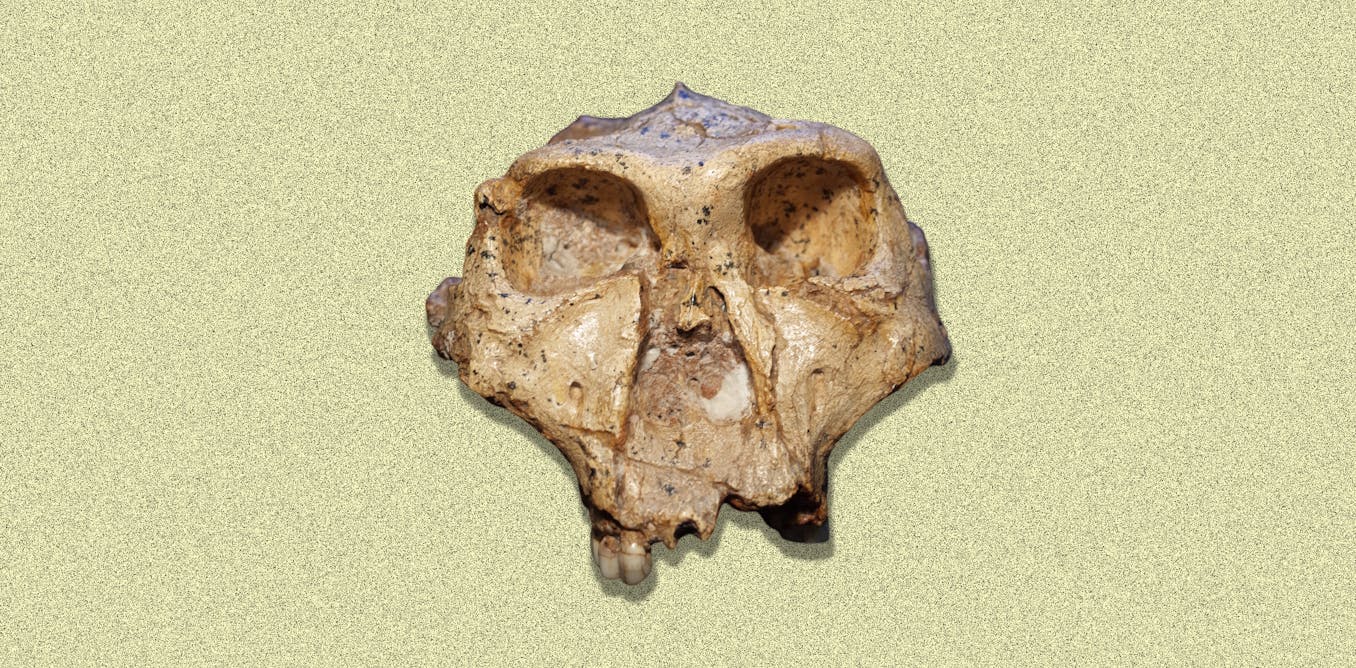
The family tree of humanity is long and tangled. Scientists classify our ancient relatives into three family groups: Homo, Australopithecus, and Paranthropus. Each of them is a “genus,” the rank just above a species. (In Homo sapiens, Homo is the genus and sapiens is the species). These names dominate the way we talk about human origins. But new fossils, advances in genetic analysis, and more rigorous methods for determining who is related to whom show that these groups don’t really reflect the true shape of our family tree. Is it, therefore, time to devise a new way of classifying humans and our closely related extinct relatives? As I argue in a new article published in the American Journal of Biological Anthropology, the current system should have already been revised. Finding family branches The central problem is that current groups often do not represent real family branches, what scientists call “clades.” A clade is a common ancestor and each of its descendants. There is also a second problem. Ideally, a genus should also tell us something about the behavior, key traits, or way of life shared by all its member species. Australopithecus (which includes the famous “Lucy” skeleton) is the clearest case. Large-scale analyzes consistently find that this genus is not a real family branch at all. The problem goes back to how gender was originally defined: not by shared ancestry, but by shared lifestyle or appearance. Recent fossils show traits such as brain size and gait, as well as diet and behavior, that do not clearly correspond to the actual family tree. It is difficult to find distinctive human traits. Homo has his own problems. Traits once thought to define our genus, such as large brains, tool use and dietary changes, and committed full-time terrestrial bipedalism, have been undermined by more recent discoveries. Species such as Homo naledi and Homo floresiensis (the so-called “hobbit” species) combine small brains and other “primitive” characteristics with traits typical of other Homo species. It is now difficult to name a single characteristic shared by all species of Homo that is not also found in some species of Paranthropus or Australopithecus. This is because different parts of the body evolve at different rates and directions, in what is called mosaic evolution. Traits also tend to evolve more than once, independently, in different, closely related lineages that face similar pressures. What’s more, the key behaviors we associate with being human emerged much later than gender itself. The earliest members of Homo, as currently defined, include species with very small brains that may even have evolved independently from different lineages of Australopithecus. The later surviving small-brained species mentioned above may also have surprisingly deep and far-flung roots. Even Paranthropus, arguably the most physically distinctive of the three, known for its heavy jaws and huge molars, is not safe. Those traits have long been interpreted as adaptations to eating hard foods like nuts, but evidence now suggests that the East and Southern African species ate very differently from each other, and none relied heavily on hard foods. Some researchers argue that the group may not even be a single lineage, but rather two independent regional groups that evolved large teeth, meaning that Paranthropus would not be a true family branch either, although most researchers today think that this group is the most likely to be a genuine clade of the three. Taken together, there is now little anatomical, behavioral, or ecological evidence to justify maintaining these three genera. Why classification is important This may seem like an abstract semantic question. But when genus names don’t reflect actual relationships, they can obscure patterns of ancestry, exaggerate differences between groups, and reinforce outdated “primitive versus advanced” thinking. With a rapidly growing fossil record and better methods for reconstructing family trees, the gap has become too large to ignore. Hominid family tree showing proposed changes for an expanded Homo genus. Dashed lines represent alternative hypotheses for the relationships of these taxa within the broader tree. Ian Towle, CC BY One solution is to merge Australopithecus and Paranthropus into a single, much larger genus Homo, which would represent a true, complete branch of the family tree. This would solve the “not a real clade” problem, align our classification with how we treat non-human species, and better account for interbreeding between closely related lineages over the past few million years. Changing the classification would have costs. We would lose some intuitive distinctions that researchers rely on, especially the ecological and physical uniqueness of Paranthropus and, later, large-brained Homo. Language must keep pace with understanding The fossil record increasingly appears to show a large, branching burst of evolution that began about 4 million years ago, with diet, brain size, movement, and tooth size varying substantially between groups in ways that do not necessarily correspond clearly with their true relationships. Such a large and complex group, shaped by migration and repeated rapid bursts of evolution in particular traits and behaviors, is best captured under a single genus. Our everyday language is also changing. Humans were only formally recognized as great apes in recent decades – in the sense of being placed in the same family as chimpanzees, gorillas and orangutans (Hominidae) – however, the term “ape” in casual use still excludes humans. Similarly, the “monkey” is often assumed to be a genuine evolutionary group, but it is not. New World monkeys are more distantly related to Old World monkeys and apes than those two groups are to each other. Someone who constantly hears “monkeys, apes, and humans” may reasonably draw erroneous conclusions about our evolutionary relationships. We are therefore in a period of transition in the way we discuss our place in the primate family tree, both in science and in everyday language. As biology increasingly embraces a taxonomy that reflects genuine evolutionary relationships, perhaps it is time for our terminology and the way we talk about ourselves to catch up.