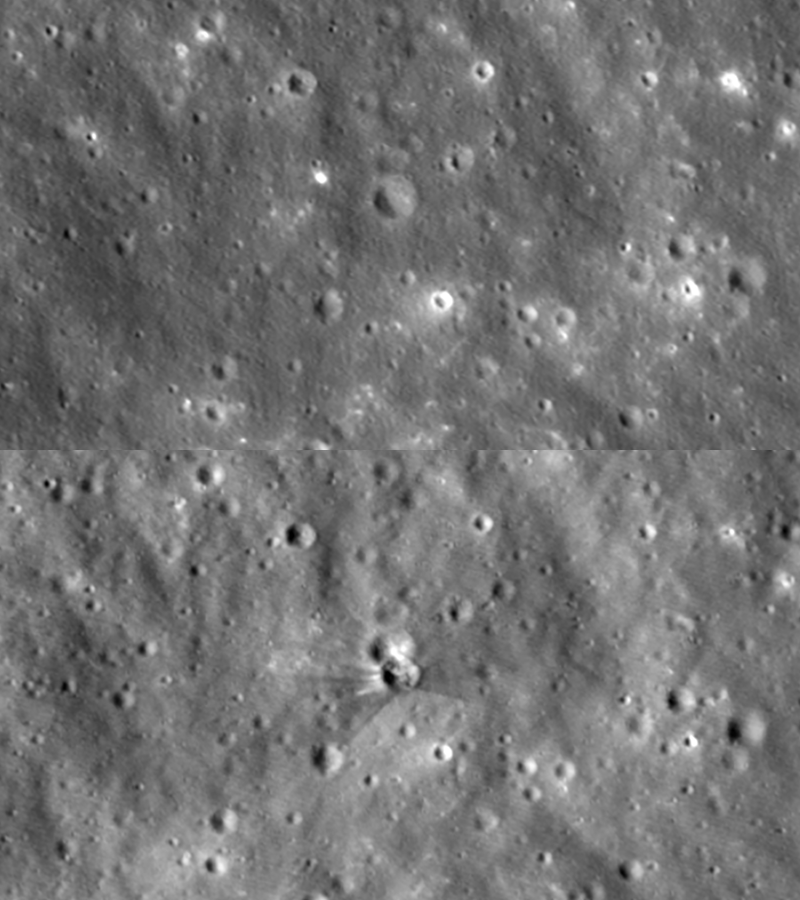
New images from a NASA satellite orbiting the Moon reveal a new 60-foot-wide crater formed by a wayward SpaceX rocket that crashed into the lunar surface earlier this month. The accident involved the upper stage of a Falcon 9 rocket that originally launched on January 15, 2025 and was carrying two commercial lunar landers. As the rocket’s first stage, the booster used for liftoff, returned to Earth, its second, or upper, stage continued to propel the robotic landers on their way to the Moon. After the rocket’s mission was complete, SpaceX intentionally jettisoned the upper stage into space, but it later became clear that quirks of orbital dynamics had pushed the booster onto a collision course with the moon. Researchers and space agencies scrambled to capture images of the rover’s landing site after it crashed into the moon on August 5. The European Southern Observatory’s Very Large Telescope, located at the Paranal Observatory in Chile, was one of the first to detect the impact. And the Korean Pathfinder lunar orbiter, named Danuri, shared images on social media shortly after the collision. NASA said it worked together with the Korea Aerospace Administration (KASA) and used the preliminary data Danuri collected to guide a narrow-angle camera aboard NASA’s Lunar Reconnaissance Orbiter (LRO) and capture clearer images, which NASA released on Tuesday. “To capture images of the impact, engineers tilted the spacecraft so that its cameras pointed toward the crater each time the LRO passed about 60 miles above the Moon, traveling at 1 mile per second,” the Sapce agency said in a news release Tuesday. “The orbiter orbits the Moon from pole to pole every two hours, while the Moon slowly spins beneath it.” It took six days for LRO’s orbital path to align with the impact site, NASA said, and additional time to process the images. Taking images of the impact site required extreme precision, the space agency said, as even a 10-second delay in taking a photo could cause the newly created crater to drift up to 10 miles out of frame. Although the rocket collision was unplanned, NASA researchers said the event did not pose a threat to anyone on Earth or the lunar surface. “This is not something we’re really concerned about. It’s actually a technically accepted and safe method of disposing of hardware in low lunar orbit,” NASA lunar scientist Kelsey Young said in a video posted to social media. “The Moon is always getting hit by things: meteorites, asteroids, comets.” In fact, Young said, scientists are using observations of the collision to learn more about the moon’s surface and to “prepare to protect astronauts and any future infrastructure sent there.”