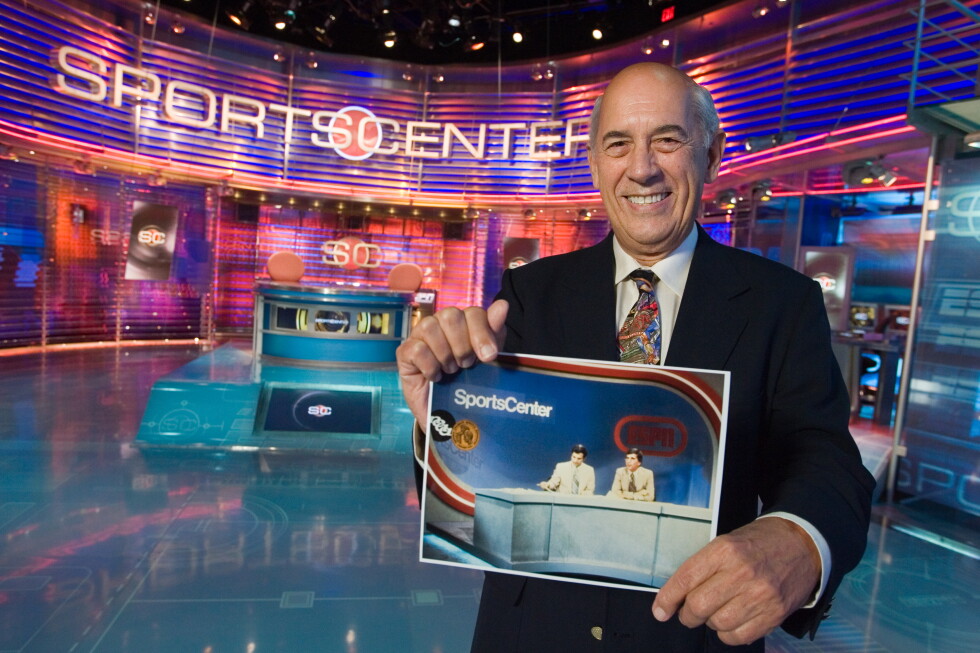
LAND O’ LAKES, Fla. (AP) — Bill Rasmussen, who co-founded television sports giant ESPN after hatching the idea for the world’s first all-sports cable network with his son, died Tuesday. He was 93 years old. ESPN historian Mike Soltys said Rasmussen died at his Florida home from the effects of Parkinson’s disease. Rasmussen announced in 2019 that he had been diagnosed with the degenerative disease in 2014. “Bill was an extraordinary man, a visionary and innovator who conceived the idea of a network entirely dedicated to sports,” ESPN president Jimmy Pitaro said in a statement. “Simply put, none of us would be here today if it weren’t for Bill’s passion and all the hard work and entrepreneurial spirit he put into creating ESPN in the late 1970s, key aspects of our company culture that still endure to this day.” Rasmussen and his son Scott came up with the idea of a network that would broadcast sports 24 hours a day and would revolutionize Americans’ television viewing habits. But the Rasmussens didn’t stay long. They were ousted after just one year by ESPN’s majority owner, Getty Oil. Cable operators initially scoffed at Rasmussen’s concept. Bill Rasmussen’s original idea was a cable channel covering only Connecticut sports. Many cable operators in the state were skeptical, but someone suggested purchasing satellite time to reach a national audience. ESPN launched on September 7, 1979. George Grande welcomed viewers to the first “SportsCenter” broadcast before the network’s first live event, a slow-pitch softball game between the Kentucky Bourbons and the Milwaukee Schlitz. “In those days, we didn’t know if we would last four weeks, four years, much less 40-something, but we knew it was special,” Grande said. “The bottom line was that Bill Rasmussen was the true purveyor of the original American dream, and he gave us all something very special that we still have today.” The Rasmussens obtained financial backing from Getty Oil and a rights deal with the NCAA, and built a studio in Bristol, Connecticut, still under construction when ESPN went on the air. Getty’s investment and the agreement with the NCAA occurred on the same day. “When someone tells you you can’t do something, you want to prove them wrong,” said Bill Rasmussen. “Many, many people told us there weren’t enough sports to make a 24-hour channel. I didn’t argue with anyone. I just thought they were wrong and I was right.” When the Rasmussens were ousted from ESPN in 1980, Getty owned 85% of the network. Texaco, which had acquired Getty, sold its stake in ESPN to ABC in 1984. ESPN helped bring a lot of sports to cable. In 1980, just a few months after its debut, ESPN began televising the NFL draft. The network premiered the ESPY Awards in 1993 and launched the X Games competition in 1995. The college football landscape underwent massive changes. Games were spread out throughout the week to accommodate television audiences, and the number of postseason bowls skyrocketed. ESPN has had exclusive broadcast rights to the College Football Playoff since it began after the 2014 season. In 2024, the network agreed to a new six-year, $7.8 billion contract for the playoffs through the 2031-32 season. While CNN found its footing in the news arena, ESPN struggled with the major networks to bring the NFL and college sports to cable audiences that had been on the airwaves for decades. ESPN was also a pioneer in financing and broadcasting women’s sports, particularly college basketball, volleyball, and the World Series of softball. Rasmussen was courted again by ESPN years later. Bill Rasmussen and ESPN were separated until 1999, when company executives invited him to their 20th anniversary celebration. Since then, it has been embraced and recognized for its vision of creating an exclusively sports network. He toured the country in 2019 for the 40th anniversary and gave speeches at Walt Disney Co. and ESPN events. “Bill was our George Washington and a good friend,” said veteran anchor Chris Berman, who joined ESPN three weeks after the network launched in 1979. “He was a very grateful person and every sports fan can be grateful for Bill. He wasn’t a glass-half-full guy; his glass was always overflowing with optimism. He greeted everyone with a smile and we can all smile knowing Bill’s legacy.” ESPN’s debut came after Rasmussen was fired from a previous job. Born in Chicago, Rasmussen earned degrees from DePauw University in Indiana and Rutgers University and served in the Air Force. He started an advertising services business, then worked in radio and television as a broadcaster during the 1960s. He was hired in 1974 as public relations director for the New England Whalers of the World Hockey Association in Hartford, Connecticut. The entire team management was fired in 1978, and Rasmussen soon turned his attention to brainstorming with his son about creating sports on cable television with the help of a $9,000 credit card advance. “There was a lot of chutzpah and a lot of vision, and their credit cards were maxed out. It’s the American dream,” said Bob Ley, one of the network’s original hosts. Broadcasting Hall of Fame in 2025. Rasmussen was predeceased by his wife of 56 years, Lois, in 2011 and is survived by two sons, Scott Rasmussen and his wife, Laura, and Glenn Rasmussen, his daughter Lynn Van Hollebeke and her husband, Louie, seven grandchildren, one great-grandson and one great-granddaughter. In addition to his wife, Bill was predeceased by his brothers Robert and Donald Rasmussen, his sister Vivien and a grandson.___See complete AP sports coverage here