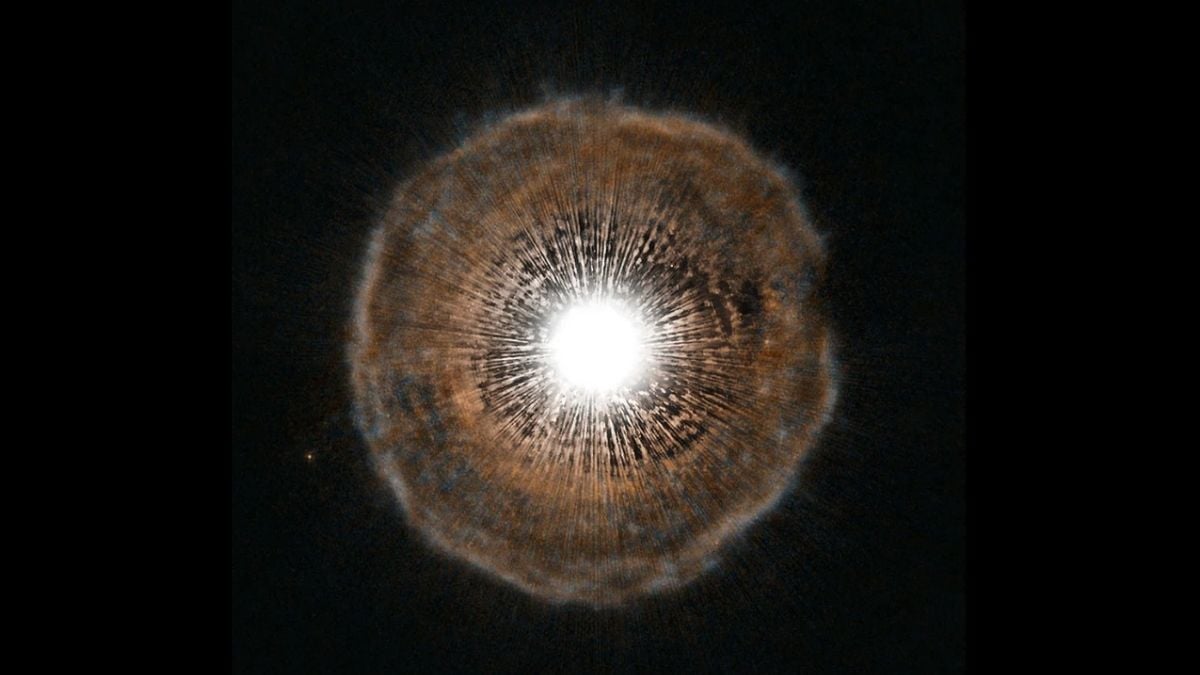
At the center of our galaxy hides a supermassive black hole: a voracious object capable of devouring matter that gets too close. However, new observations from JWST suggest that right in that black hole’s cosmic neighborhood, a dying star is still spewing matter back into space. Not all stars are massive enough to die as explosive supernovae that eclipse entire galaxies like shiny cosmic disco balls. Instead, stars born with up to eight times the mass of our Sun become puffy, reddish and cold, gradually losing their outer layers into space before becoming zombified white dwarfs, and perhaps even ‘diamonds’ in the sky. Yet whether it’s the violent chemical enrichment of supernovae or slowly withering suns, death gives life: including us, because, as Carl Sagan said, “we’re made of star stuff.” The field containing the evolved and dying star IRS 3, captured with JWST’s NIRCam (Near Infrared Camera) and MIRI. (ESA/Webb/NASA/CSA/F. Peißker/J. Lu/F. Yusef-Zadeh/NB Sabha/C. Chan)Now, using JWST, astronomers have detected some of the most important stellar elements of all, including water, dust and other oxygen-based chemicals, in some of the most inhospitable conditions imaginable. “Galactic centers are among the most extreme environments, so it is necessary to understand whether stars can continue to enrich their surroundings there.” automatic; clipboard writing; encrypted media; gyroscope; web-share” referrerpolicy=”strict-origin-when-cross-origin” enablefullscreen> Researchers looked at the inner parsec (a 3.26 light-year swath) of the Milky Way using JWST’s Mid-Infrared Instrument (MIRI), focusing on a predominantly bright dying star called IRS 3. It’s an IR source, not an IRS tax bracket, it’s an asymptotic giant. (AGB), which means you are in a late stage of life. The star’s powerful stellar winds hurl its outer layers into space at estimated speeds of 15 kilometers (9 miles) per second. This has surrounded it with an immense envelope of dust extending 10,000 astronomical units (AU), where one AU represents the ~150 million kilometers between Earth and the Sun. IRS 3 is located just 0.55 light years from Sagittarius. A*, the 4 million solar mass monster at the sparkling, energetic heart of the Milky Way. The central region of our Milky Way, part of the most detailed view of our galactic center ever observed, courtesy of the Euclid Space Telescope (ESA/Euclid/Euclid Consortium/NASA, CFHT, image processing by J.-C. Cuillandre and E. Bertin (CEA Paris-Saclay)). The agony enriches the cosmos with dust, but astronomers have long wondered whether this process can unfold so close to a supermassive black hole. So they performed multiple simulation variations to reconcile JWST observations with stellar models over a range of temperatures, luminosities, and chemical compositions. An image in mid-infrared wavelengths showing IRS 3 among the confusion of our galactic center (Peißker et al., A&A, 2026) Based on models and observations, including the arc shock created when the dying star’s envelope crashes into interstellar space, the researchers deduced its most notable statistics. IRS 3 may have been born up to 16 light-years away from the galactic center and migrated inward. It could be about six times the mass of the Sun and be about 72 million years old, a baby compared to our Sun’s expected lifespan of 10 billion years. Although IRS 3 may have an effective temperature of “only” 2,800 K (about 4,600 degrees Fahrenheit or 2,500 degrees Celsius), compared to our Sun’s surface temperature of 5,500 °C, it can shine 60,000 times brighter. Importantly, this work demonstrates that these types of stars can continue to supply chemically rich space dust and water to galactic centers, despite the harsh conditions. “The mid-infrared spectrum has been collected for this star, allowing us to detect the characteristics of the silicate dust and discover the true chemical identity of the star,” says Macarena García Marín, ESA scientist for Webb’s MIRI instrument and one of the study’s co-authors. referrerpolicy=”strict-origin-when-cross-origin” enablefullscreen> In fact, as the star pulses in its death throes, it “spits out” its swollen outer layers, creating a set of doll-like shells at intervals of hundreds of years, potentially dating back as far as 5,000 years ago, according to a previous study. “The detection of water is especially exciting because it shows that molecular material can survive in an environment dominated by intense radiation,” says García. Marin.Related: There may be 170 million black holes lurking in the Milky Way’s graveyardAnd when you mix water from stars and other stellar substances with radiation, letting the ingredients ‘prove’ like a cosmic sourdough, who knows what otherworldly products may manifest. “This tells us that even near a supermassive black hole, stars can continue to contribute material to their surroundings,” concludes García Marín. This research was published in Astronomy & Astrophysics. This article was fact-checked by Clare Watson and edited by Rebecca Dyer. While we take pride in our process, we are human. If you spot an error, please let us know.