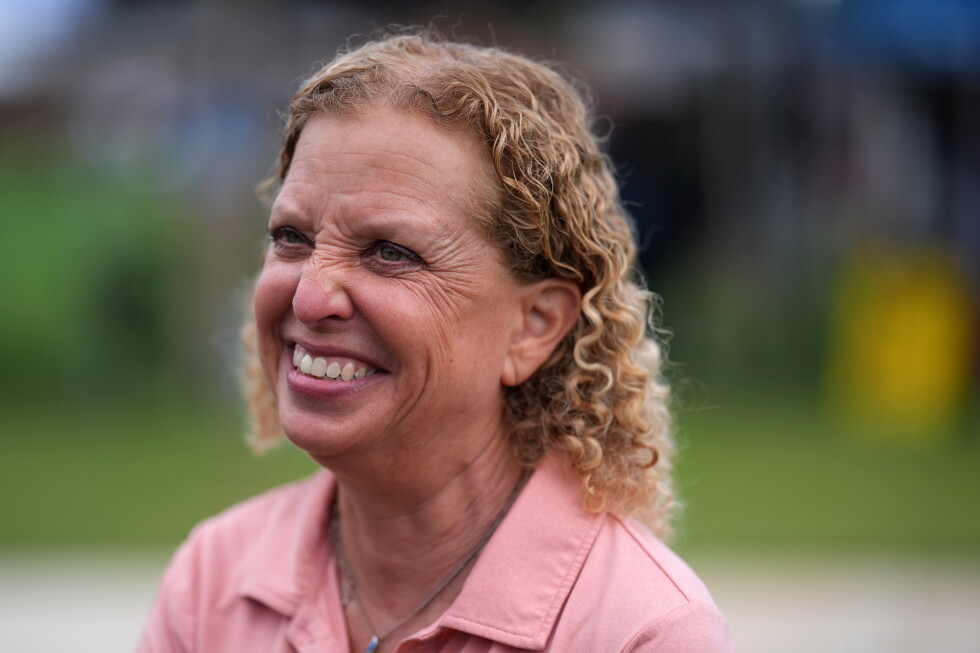
TAMARAC, Fla. (AP) — Greeting voters before Tuesday’s Florida primary in red, white and blue sneakers, Rep. Debbie Wasserman Schultz smiles and tells them she is “running for re-election to Congress.” That’s true, with one caveat. Wasserman Schultz is seeking his 12th term by running in a new district after Republicans altered the state’s congressional map earlier this year. The fallout pushed Wasserman Schultz, a former national party chairwoman with powerful ties in Washington, to cross district lines from her exurb of Fort Lauderdale and be the only white candidate in an area of Broward County that has helped send black Democrats to Congress since 1992. That led to an awkward fight after the U.S. Supreme Court. decision that gutted provisions of the Voting Rights Act that upheld the strength of the minority vote and effectively authorized states of the Old Confederacy, including Florida, to redraw House districts. “For her to get there like this is just another Broward seat, it’s a complete erasure of our history, of our fight for Black access,” said former Rep. Sheila Cherfilus-McCormick, 47, who resigned the seat in April while facing an ethics investigation but now wants it back. Another candidate, progressive organizer and substitute teacher Elijah Manley, 27, said Republicans’ redistricting strategy is not Wasserman Schultz’s fault. But she “had other options,” Manley added, including running in her new home district, which was gerrymandered to include the more conservative Gulf Coast. “Instead, he stabbed us in the back, trying to take away black representation from us,” Manley said, pointing to warnings from the Congressional Black Caucus that it could lose more than a quarter of its more than 60 members this fall. Wasserman Schultz, 59, is by far the best-funded of five Democratic candidates and benefits from Florida rules that do not require a majority to win primaries. She argued that she can ably advocate for the entire region after representing broad swaths of Broward as a state and federal legislator for three decades. “I’m not going to drop the ball in this district,” he told The Associated Press. “I have represented diverse communities. I know how to adapt my service to them and represent a district more broadly.” A Wasserman Schultz victory would be a rarity. President Donald Trump began pressuring Republican-governed states to redraw House boundaries last year to help preserve the party’s fragile majority. Florida Gov. Ron DeSantis responded with an effort bringing together Southeast Florida Democrats, seeking to reduce five Democratic seats to three. Broward, the state’s most Democratic county, situated between Miami-Dade and Palm Beach, now has only one presumptively Democratic district anchored in and around Fort Lauderdale. Nationally, white lawmakers typically hold some of the more than 115 House seats where the voting-age population is overwhelmingly nonwhite. Wasserman Schultz does so in his current north Broward-Palm Beach district, which according to the 2020 census was 42% Hispanic, 18% Black and about 6% Asian American. White voters make up the remaining third. But a white legislator is a rarity in majority or plurality black districts, like Florida’s New 20th. The district is 42% black, 23% Hispanic and 4% Asian, the rest white. The proportion of blacks includes a large Caribbean population, especially Haitian Americans. In early November, an Associated Press analysis found that Wasserman Schultz is the only white Democrat positioned to represent any of the remaining black majority or plurality districts. Cherfilus-McCormick said she can win, despite losing the black voters she previously represented in Palm Beach County. She dismissed concerns about federal criminal charges accusing her of stealing $5 million in federal disaster funds. He pleaded not guilty and denied alleged violations of House rules. The criminal case and the redistricting fit together, he insisted, and “people see what is happening: They are trying to silence the only Haitian member of Congress and take away our voice.” Manley, however, was more circumspect about Wasserman Schultz’s favorite status. He mused Tuesday about upsetting the veteran congresswoman but looked ahead to the 2028 elections, hoping black Democrats will unite around one candidate instead of four. The current field also includes former 2 Live Crew rapper Luther “Uncle Luke” Campbell and real estate broker and former local elected official Dale Holness. Von Howard, a black Plantation resident, said the election was heartbreaking. He declined to reveal his vote, but said he wanted someone who “understood the entire district.” “If you’re not from the town and you just want this to have influence, in some cases that could be a turnoff,” the 47-year-old said. Broward NAACP President Marsha Ellison was more direct and did not endorse any candidate. “The whole mission was to take power away from Black people, so we have no representation to understand our lived experience,” she said. “That may not be important to Debbie, but it certainly is to us.” There is a debate about what representation means. Wasserman Schutlz said he occasionally hears those concerns from voters. His answer is that “lived experience matters, but overall experience matters too.” He highlights his position on the Appropriations Committee, which could be even more influential if Democrats win the majority in the House. He recalls the programs that impacted Black communities that he helped create and fund from his early years in the Florida Legislature. “I fight every day to help improve the life experience of the people I represent,” he said. Wasserman Schutlz also said he has worked to connect across races and cultures in Broward. Because of the makeup of his current district, “I spent six years learning Spanish,” to converse with individuals and at town halls, press conferences and interviews broadcast on Spanish-language stations. “Out of respect,” he said, “anything you can do to inspire people with confidence that the person representing them understands them.” Wasserman Schultz is a recognizable figure. Several times outside early voting sites, black, white and Hispanic voters waved or stopped to talk to the congresswoman. Among them were Broward County sheriff’s deputies who wanted photos and a trio of women who lamented being dragged into a new Republican-leaning district. Yusdefs Delgado, a naturalized citizen of Colombia, told Wasserman Schultz that he enjoys his social media posts but wants to hear more about policies and less about the president. “We know Trump sucks,” he told her, smiling and confirming that he voted for her. “I don’t agree with her on everything, but she’s the closest to where I am and I trust that she will try to do what’s right for us,” Delgado later explained. Cherfilus-McCormick and Manley said that’s not enough, given the environment following the Supreme Court decision, Trump’s attacks on diversity initiatives and his push to rewrite how the United States tells its story about race and racism. “We’re not in a place in this country where we can be completely color-blind politically,” Manley said. “We’re just not.” Wasserman Schultz said the new district “is drawn so that the plural population has the ability to elect the person of their choice,” language that alludes to the now diminished Voting Rights Act. Voters, he said, can “consider all the qualities that matter to them.” As for getting back on the ballot, he didn’t apologize. “Trump and DeSantis did this to our community,” he said, adding, “I’ll be damned if I’m going to allow them to steal Broward’s political power, disunify us, and prevent us from standing up for our community’s values.” ___ Associated Press writer Matthew Klein contributed from Washington.