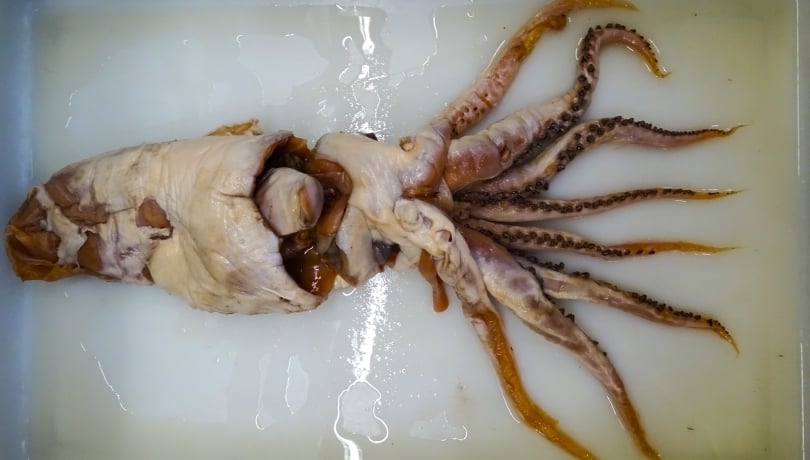
A preserved squid removed from the stomach of a sperm whale in 1955 or 1956 turned out to be much more unusual than its label suggested. The animal, considered for decades an example of the sharp-eared oenope squid Ancistrocheirus lesueurii, is now the only known representative of Mobydickia poseidonii and a newly created family, Mobydickidae. The description appeared in the Zoological Journal of the Linnean Society in July 2025. Sam Arnold, David Nos, Raquel Sáez-Liante and Fernando Ángel Fernández-Álvarez were reviewing the diversity of Ancistrocheirus when an ancient specimen refused to fit. Its anatomy differed enough from that of all recognized families of oceanic squid that the authors erected a family, genus, and species for it. This is a taxonomic study based on an incomplete specimen, not a complete account of a living population. No one has seen Mobydickia alive, its precise habitat is unknown, and the study does not report a DNA sequence of the holotype. What it establishes is a distinctive anatomical form preserved in a public collection. The whale was harvester Malcolm Clarke collected the squid from the stomach contents of a male sperm whale during the 1955-1956 whaling season. Surviving records place the whale somewhere in a broad Antarctic or sub-Antarctic zone encompassing the Bellingshausen Sea, Drake Passage, and the Scottish Sea. They do not identify an exact capture point. Clarke kept the specimen in his research collection. After his death in 2013, that collection passed to the Natural History Museum in London. It was eventually loaned to the Marine Biology Reference Collections of the Institut de Ciències del Mar in Barcelona, where Arnold and Fernández-Álvarez examined it as part of a broader review. The path to science matters. Ocean squid are difficult to harvest intact. Nets can damage their soft bodies and many species spend their lives beyond ordinary observation. Sperm whales, however, hunt squid in large volumes of deep water. The whale in this story took samples from an animal that researchers have not yet collected by any other route. Why the old identification failed The specimen has a dorsal mantle 175 millimeters long, a soft, gelatinous and pale body and a short tail. It lacks the photophores, or light-producing organs, expected from the squid family to which it had been assigned. Its fins extend less than half the length of its mantle, while its beak, inner shell, and arm hooks have a combination of features that are inconsistent with other recognized families of oceanic squid. The hooks are especially distinctive. A large central cusp is accompanied by smaller accessory claws, producing a shape that reminded the authors of a trident. That image provided the species name poseidonii, after the Greek sea god Poseidon. The genus name Mobydickia has two references. The squid comes from the belly of a sperm whale, the species made famous by Herman Melville’s Moby-Dick, and its preserved body is unusually white because it has little pigmentation. The name is memorable, but the classification is based on comparative anatomy, not literary association. A new family is a bigger claim than a new species. A newly described species is placed within an existing genus when its defining differences are relatively narrow. A new gender marks a deeper separation. A family again occupies a higher place, grouping together related genera that share an underlying anatomical plan. Therefore, the creation of Mobydickidae says that this specimen is not simply an odd member of a familiar species. The authors considered it to represent a separate structural lineage among oegopsid or open-ocean squids. The article calls it the first new family of oceanic squid created since Magnapinnidae, the largefin squid family, was described in 1998. That rarity explains why the specimen attracted attention after the article appeared and why the World Register of Marine Species later included the Poseidon squid among its ten most notable marine species of 2025. The family range should not be confused with a claim about abundance, behavior or ecological importance. Taxonomic rank describes a pattern of difference and relationship. From a partially digested animal, researchers can’t tell how common the species is, how big the adults grow, what depths it prefers, how it reproduces, or whether it is threatened. The broader review finding more hidden diversity in Mobydickia was an unexpected result within a broader investigation of Ancistrocheirus. The researchers examined the morphology of 46 individuals and combined those observations, when the material allowed, with DNA barcodes. Their analyzes indicated at least six species in a group that had often been treated as a single accepted species. Contrast is important. DNA helped separate several cryptic lineages within Ancistrocheirus, but the ancient Antarctic specimen could not provide the same molecular evidence. Their separation into Mobydickidae depended on a set of anatomical differences: the absence and arrangement of the luminous organs, the proportions of the mantle and fins, and the shapes of the beak, hooks, radula and gladius. That also explains why the taxonomy can be left unfinished after a major revision. Some specimens were damaged, immature or not linked to usable DNA. The authors resurrected Ancistrocheirus alessandrinii and identified additional probable species, but were unable to formally resolve all lineages. A museum drawer may contain evidence, but the evidence does not always arrive in the condition necessary for a clean family tree. The collections preserve questions and answers The ICM-CSIC discovery story describes the specimen’s path from Clarke’s collection to the Museum of Natural History and then to Barcelona. That chain of custody is not an administrative background. This is what made a new exam possible. A preserved specimen may survive the assumptions attached to its label. New comparison material, revised terminology and molecular tools can make old differences visible. Even when DNA is not available, standardized measurements and high-resolution images allow researchers to ask questions that the original collector could not ask. This is particularly valuable in the deep ocean, where direct sampling is scarce. Space Daily recently examined an estimate that, even with 1,000 vehicles each visually surveying several square kilometers per year, a single visual pass over the deep seafloor would take more than 100,000 years. A whale’s stomach is not a controlled study, but it reaches moving prey through parts of the ocean that research vessels rarely visit. What is still unknown Only the holotype is known. The document offers a broad region based on whaling records, not a verified habitat map. The sex of the specimen is unknown, and digestion and long preservation complicate any attempt to reconstruct its appearance in life. Its white color may partly reflect limited natural pigmentation, but preservation also changes animal tissue. The absence of known photophores is unusual among related deep-sea squid, but alone does not tell us where the animal lived. The stomach of a sperm whale also does not provide a capture depth. Whales move vertically and horizontally after feeding, so the place where a whale was killed does not have to be the place where it caught each prey. Finding another specimen would allow researchers to test which traits are stable between individuals. Fresh tissue could provide DNA evidence, and live observation could reveal color, posture, movement and depth. Until then, Mobydickia poseidonii is a name associated with an animal and a carefully substantiated anatomical diagnosis. That moderation does not make the discovery small. A squid was eaten, preserved, misidentified and displayed in collections for almost seven decades. When someone looked again, not only did the label of a species change, but also the outline of the squid family tree. The animal was there the entire time; what changed was the precision of the question being asked.