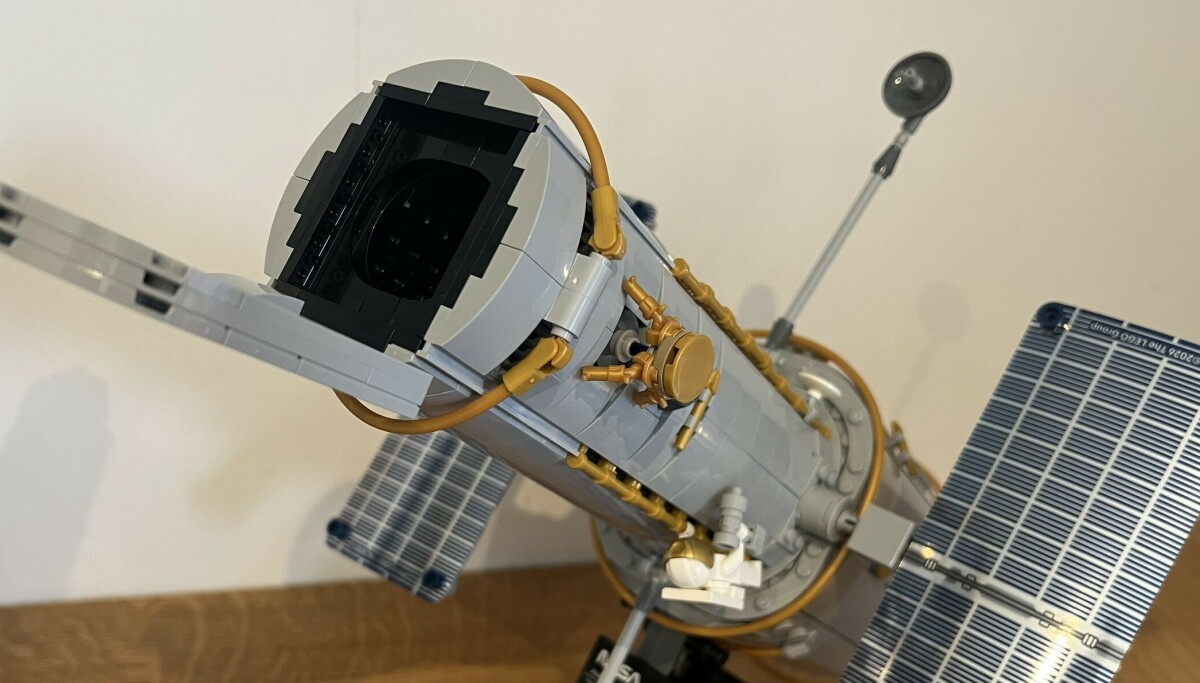
EXTRAORDINARY Excellent internal details cannot completely disguise some costly decisions. Lego has released its largest Hubble Space Telescope yet: a model built to roughly minifigure scale that dwarfs the observatory included with its space shuttle Discovery set. The first thing to say about this set is that there is a lot of gray. This is perhaps the biggest weakness of an excellent set and feels a little stingy on the part of the annoying Danish brick. Lego has produced several versions of the Hubble over the years. There’s a version that fits in the payload bay of their large Space Shuttle Discovery set, and a much smaller incarnation on a pedestal in the Women of NASA set. Both are retired, so scratching the Hubble itch with a current official set means spending £119.99 on the Icons Hubble Space Telescope. It’s a big set. According to Lego, the 1,252-piece set measures 32cm high, 38cm long (with the door open) and 38cm wide. An astronaut minifigure is included to indicate the approximate scale of the model (a shame there was only one, as the service missions had a couple of spacewalkers) along with a power tool. There is also a booth featuring some of Hubble’s iconic images and a plaque with more information, including dates of space shuttle service missions. Lego has not included replacement instruments to recreate the various service activities. Inside are Lego representations of Hubble’s instruments and systems, including its gyroscopes, primary mirror, and secondary mirror. On the outside there are articulated antennas and solar panels, along with an opening door. Some parts are a little complicated and the set is aimed at those over 18 years old. That seems a little high, but it’s not something you’d want a little kid trying to build. The level of detail is impressive, considering the nature of the Lego components, but it’s hard to avoid all that gray plastic. The Hubble Space Telescope included with the Space Shuttle Discovery icon set uses silver bricks, making the choice of gray plastic look cheap by comparison. And then there are the stickers. Fortunately, there aren’t too many, but printed pieces are available and Lego uses their own, so why force builders to line up the stickers? And then there are the solar panels, which are single-sided and look a little cheap compared to the panels on some of the MOCs The Register has built over the years. Still, these are minor hiccups in what would otherwise be a fun build that lasts between 6 and 12 hours. The set is an excellent addition to the Icons range, but the affection for Hubble is such that the details matter. The set also recognizes Hubble’s 35th anniversary, celebrated in April 2025, with a “35” sticker on the back of the astronaut minifigure. The real object remains in orbit, although its days are probably numbered. The Lego version will likely endure until a careless elbow knocks it off the shelf, or a creative builder decides to repurpose its components for an orbital animal amusement park. Which, after all, is what it’s all about. ®