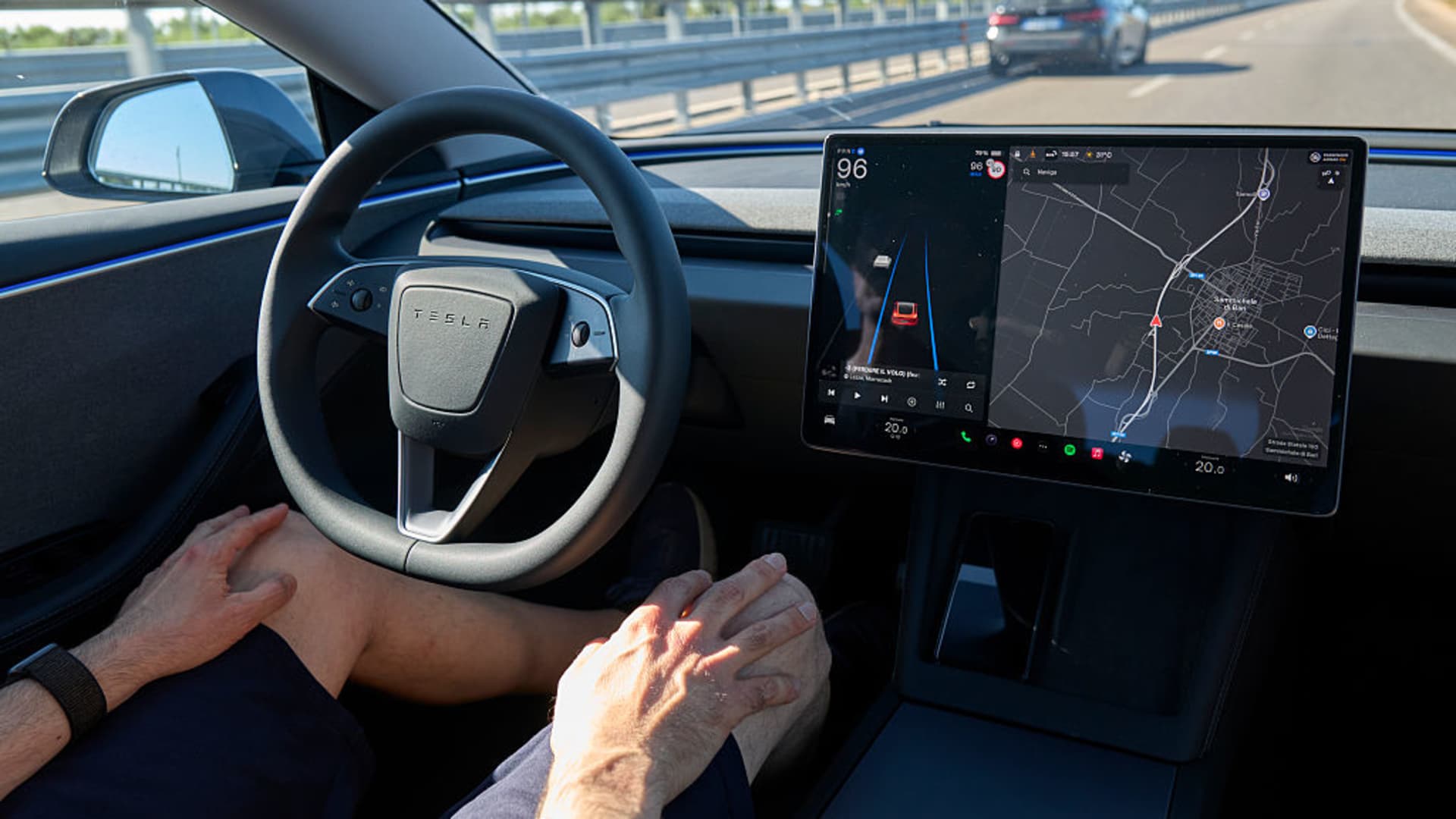
Americans are keeping their cars longer than ever, with the average age of vehicles in the United States increasing to 12.8 years, according to Mobility Global. But some industry analysts and forecasters worry that highly complex, software-defined vehicles will age more like smartphones. These vehicles rely on sophisticated computers and software to control many functions that were once strictly mechanical or managed by simpler technology. They can also receive software updates over the air and are typically connected to the Internet or communications networks, allowing automakers to diagnose some problems remotely, make some fixes, and add new features. “A software-defined vehicle is truly a vehicle that is no longer obsolete over time. It is a vehicle that continues to improve over time through over-the-air updates,” said Wassym Bensaid, chief software officer at Rivian. “What we like to say at Rivian is that the least capable Rivian you’ll receive from us is on the day you purchase, and then it will continue to get better and better over time.” A Rivian R1T is seen outside startup Rivian Automotive’s electric vehicle factory in Normal, Illinois, on April 11, 2022.Kamil Krzaczynski | ReutersThe rise of these high-tech vehicles has implications for the entire automotive world. A vehicle costs, on average, almost $50,000 in the United States (a much larger investment than a smartphone), but as they age, some features may become unavailable due to outdated hardware or discontinued product support. Constantly changing and often patented technologies raise questions about a vehicle’s long-term repairability. “Honestly, we don’t know how long these vehicles will last,” said Sam Fiorani, senior vice president of vehicle forecasting at AutoForecastSolutions. “We’re already seeing issues with hardware not being able to handle the new software.” Obsolete technology This is not the first time that vehicle owners have faced technological losses. In 2022, AT&T was the first telecommunications company to shut down its 3G wireless network, leaving millions of vehicles across a host of brands without access to features like emergency response services and some navigation and infotainment options. The vehicles were still operational, just without the benefits that had been included when the owners purchased their vehicles. Meanwhile, Tesla said in 2016 that all vehicles it produced had the hardware necessary for fully self-driving, or FSD, and CEO Elon Musk reaffirmed in 2019 that the company’s then-new Hardware 3 computer would support this feature. But in April of this year, Musk said Hardware 3 vehicles would need upgraded computers and cameras for “unsupervised” FSD. Tesla said qualifying customers could receive a hardware upgrade or a discounted trade-in. Tesla did not respond to a request for comment. Rivian’s Bensaid said the company is trying to build up enough hardware capacity, what he calls “headroom,” to handle seven to 10 years of software updates. “There’s a distinction between feature updates, which is additional new functionality that you can get after launch and after you buy the car, and then security updates,” he said. “Our commitment to our owners is safety and safety upgrades will be supported by Rivian indefinitely. Your vehicle will remain fully functional and completely safe regardless of the length of ownership.” Long-term concernsThe interior of a Tesla Model 3 with full self-driving activated.Nurphoto | Getty Images Sam Abuelsamid, vice president of market research for Telemetry, expects it to be common for features to be updated for a few years and then disappear as software outperforms hardware. But automakers will likely continue to provide a basic level of support, especially in the form of security patches and bug fixes. “From a product liability and safety perspective, they have an incentive to fix those issues as much as possible,” he said. But software costs money to maintain, while hardware can break down and require replacement. The loss of 3G services in those cars in 2022 raised the question of whether resale value would fall as a result. Fiorani said a higher proportion of customers are turning to used cars and he is concerned about the long-term availability of affordable used vehicles. Software-defined vehicles are unlikely to “fundamentally change the used car market,” said Alex Yurchenko, vice president of data analytics at JD Power. However, the market could be divided into two categories: vehicles with continuous wireless support that better retain their value and those that do not. Manufacturer-certified pre-owned programs could become more important as customers might prefer peace of mind, he said. “Valuation remains a challenge,” he said. “There are no widely accepted standards for evaluating software-enabled features, and buyers may have concerns about [advanced driver-assistance system] calibration, feature availability, data privacy, and long-term availability of subscriptions or connected services.” Used Tesla electric vehicles on the Plug-In Auto sales lot in West Covina, California, March 30, 2026. Justin Sullivan | Getty Images Fiorani, a classic car fan, wonders what the rise of software-defined vehicles will mean for car culture, including collectors, restorers and other enthusiasts. “Beyond that, when those vehicles are become classics, what are they going to be like? Will they be maintained and how will they support after-sales care? ” he said. Older cars can bring their own challenges: obscure parts and hard-to-locate service manuals, to name a few. A vehicle running on a proprietary software platform presents a different set of challenges, and maintaining them can require specialized skills, tools and access to vehicle data. So-called right-to-repair laws that give consumers more access to repair their phones, cars and other technology have begun to spread across the U.S. More vehicle access to comply with these laws. “One of the upcoming updates we’ll have is actually unlocking what we call the service menu inside the car and really allowing our owners to take further actions in accordance with the right to repair regulations,” he said. “But then we want to go even further and really allow that ability for owners inside the car to do a full diagnostic check using our AI assistant, using the on-screen menus, and then do some of the basic repairs, and then walk them through some of the certified third parties. “If we go down that path, we will really ingrain the right to repair as something that everyone has access to, so, yes, I’m more optimistic than before,” he said. Choose CNBC as your preferred source on Google and never miss a moment from the most trusted name in business news.