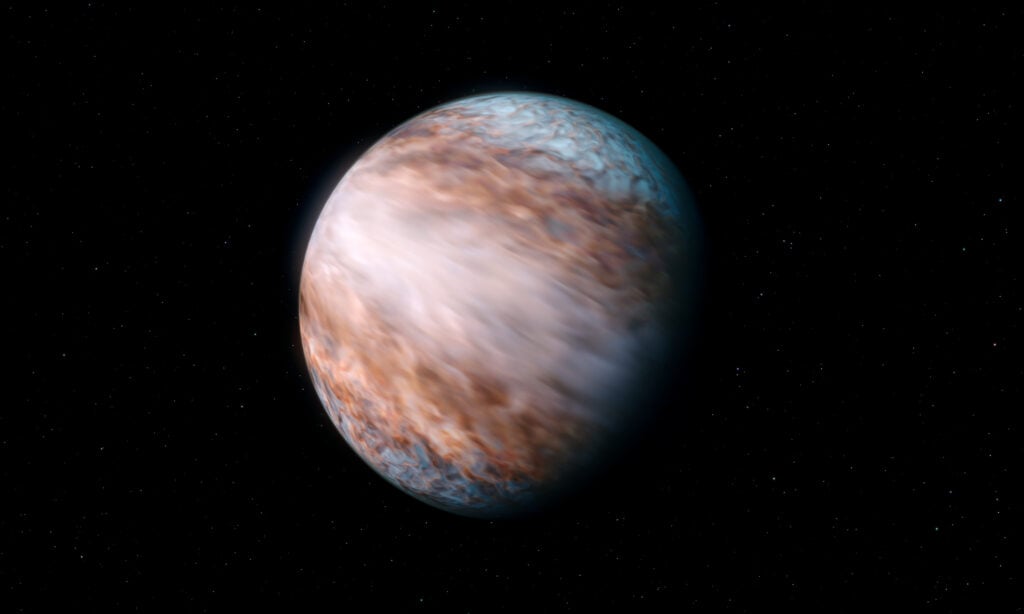
Astronomers have measured atmospheric motion around WASP-127b’s equator at about 9 kilometers per second, about 33,000 kilometers per hour. The giant exoplanet is approximately 520 light-years away, but its climate left a velocity signature precise enough to separate gas moving toward Earth from gas moving away. The result, obtained with the Very Large Telescope of the European Southern Observatory in Chile, is the fastest jet stream movement of its kind measured on a planet. ESO compared it to winds of 1,800 kilometers per hour on Neptune, the Solar System wind record holder. At that reference point, WASP-127b’s maximum equatorial speed is more than 18 times greater. No telescope photographed clouds racing around the distant world and no probe carried an anemometer into its atmosphere. The measurement came from Doppler shifts in the spectral signatures of water vapor and carbon monoxide during a single transit. A model then connected those changes to a rapidly rotating equatorial jet. There is also a distinction hidden within the top speed of 33,000 kilometers per hour. The peer-reviewed paper calculates a wind speed of 7.7 plus or minus 0.2 kilometers per second after subtracting the planet’s expected rotation. The top figure describes the maximum atmospheric motion at the equator when jet and rotation are combined. WASP-127b is big, light, and close to its star. WASP-127b was announced in 2016 and belongs to the loose family of intensely heated giant planets, often called hot Jupiters. NASA’s Exoplanet Archive places its star about 159.5 parsecs away, which is approximately 520 light years away. The planet completes an orbit every 4.178 days at a distance of close to 0.05 astronomical units. It is slightly wider than Jupiter but has only a fraction of Jupiter’s mass. The values adopted by the archive give a radius of approximately 1.31 times that of Jupiter, a mass close to 0.165 Jupiter masses and an average density of around 0.097 grams per cubic centimeter. That makes WASP-127b an exceptionally inflated world with an extended atmosphere. A large atmospheric scale height is useful to astronomers. As the planet passes in front of its star, some of the starlight filters through the gas around its edge before reaching Earth. Atoms and molecules eliminate narrow sets of wavelengths from that light. Its movement also shifts those features toward shorter or longer wavelengths through the Doppler effect. Two molecular peaks revealed opposite movements. The team used CRIRES+, a high-resolution infrared spectrograph mounted on one of the 8.2-meter units of the Very Large Telescope. The observations covered a transit in the infrared K band, where the researchers searched the changing spectrum for expected patterns of different atmospheric molecules. Water vapor and carbon monoxide were detected. Instead of producing a broad velocity peak, each molecule generated two distinct peaks. One part of the atmosphere was approaching observers at high speed, while another part was receding at a similar speed. That’s the signature expected when a fast equatorial flow crosses the two edges of the planet visible during the transit. One end transports the absorbing gas partly towards the Earth and the opposite end carries it away. The peer-reviewed analysis in Astronomy & Astrophysics used a two-dimensional recovery model to infer an eastward supersonic jet and weaker contributions from the poles. Geometry is more informative than a simple estimate of wind speed. The two peaks correspond to the morning and evening terminators, the boundaries between the permanent day and night hemispheres. The polar signal was muted, which could mean that the poles are much colder or that high clouds are blocking the molecular signatures there. The evidence also tentatively favors a morning terminator about 175 kelvin colder than the afternoon terminator, although the uncertainty is large enough that the temperature difference is not a firm detection. How 7.7 km/s becomes a title of 33,000 km/h Researchers expect WASP-127b to be tidally locked, meaning that one rotation takes the same 4.178 days as one orbit. This expectation has not been confirmed by a direct measurement of turnover. Using the estimated radius of the planet and its orbital period gives an equatorial rotation speed of approximately 1.6 kilometers per second. The atmospheric recovery found a total equatorial velocity close to 9.3 kilometers per second. After removing the expected rotation, the team calculated that the jet itself was 7.7 plus or minus 0.2 kilometers per second, equivalent to about 27,700 kilometers per hour. The ESO announcement rounded the maximum motion to 9 kilometers per second, or about 33,000 kilometers per hour, and described it as the speed reached by the jet’s winds. That is the source of the widely reported figure. It captures the maximum speed at which atmospheric material moves around the equator, while the paper’s value of 7.7 kilometers per second isolates the flow relative to the supposed rotating planet. None of the numbers were read directly from an offset line. The researchers removed Earth’s atmospheric features and the star’s contribution, correlated the remaining spectra with molecular templates, and fitted the matched signals with an atmospheric model. The unusually clear separation of the two peaks is what makes the inference powerful. The “18 times Neptune” comparison uses 1,800 km/h. ESO set the value at 33,000 kilometers per hour along with a Neptune wind speed of 0.5 kilometers per second, or 1,800 kilometers per hour. Dividing one by the other gives you approximately 18.3, which supports the “more than 18 times” comparison in the title. Planetary wind figures are usually rounded and different authoritative summaries use slightly different values. NASA describes that Neptune’s winds exceed 2,000 kilometers per hour. Using 2000 as the denominator produces a ratio of approximately 16.5. Therefore, the comparison depends on which rounded Neptune reference point is chosen. The physical conclusion has not changed. Neptune has the fastest measured winds in the Solar System, and the inferred equatorial motion of WASP-127b is much faster. Comparing the spectrum of a remote exoplanet to the clouds tracked by Voyager also involves different methods, so the multiplier is better understood as scale than laboratory precision. The planet was not resolved spatially. An artist’s illustration may show a globe enveloped in a bright equatorial band, but the observations did not resolve WASP-127b into surface features or clouds. The planet and star remain essentially point sources. The researchers separated the atmospheric regions by their different velocities, not viewing those regions as pixels. That limitation is also the achievement. A high-resolution spectrum encoded enough information to distinguish the two terminators and infer that the poles contribute less strongly. The report from the University of Göttingen emphasizes that the result offers a new test of exoplanet global circulation models. It also confirms water vapor and carbon monoxide in an atmosphere where previous studies had disagreed on the carbon monoxide signal. The word “supersonic” needs a similar context. The relevant speed of sound depends on the local atmospheric composition and temperature. It is not a comparison to the sound that travels through air at room temperature on Earth. The study’s classification refers to the expected speed of sound in WASP-127b’s hot, hydrogen-rich atmosphere. From a record to a method for mapping alien climate SpaceDaily’s initial report on WASP-127b’s winds covered the record when the result appeared in January 2025. The deeper significance is what the observation demonstrates: atmospheric geography can be recovered from a planet too distant to be visualized as a disk. Ground-based instruments currently have an advantage for this work because they can deliver the extremely fine velocity precision required. ESO hopes that the Extremely Large Telescope and its planned ANDES spectrograph will resolve even finer patterns and extend the method to smaller planets. WASP-127b is an unusually favorable target, with a vast atmosphere and a very short orbit. Rocky worlds will be much more difficult. Still, the double peaks show a path from molecule detection to circulation reconstruction. The speed record is astonishing, but the ability to separate the morning, evening, equator and poles on an unresolved exoplanet is the most lasting result.