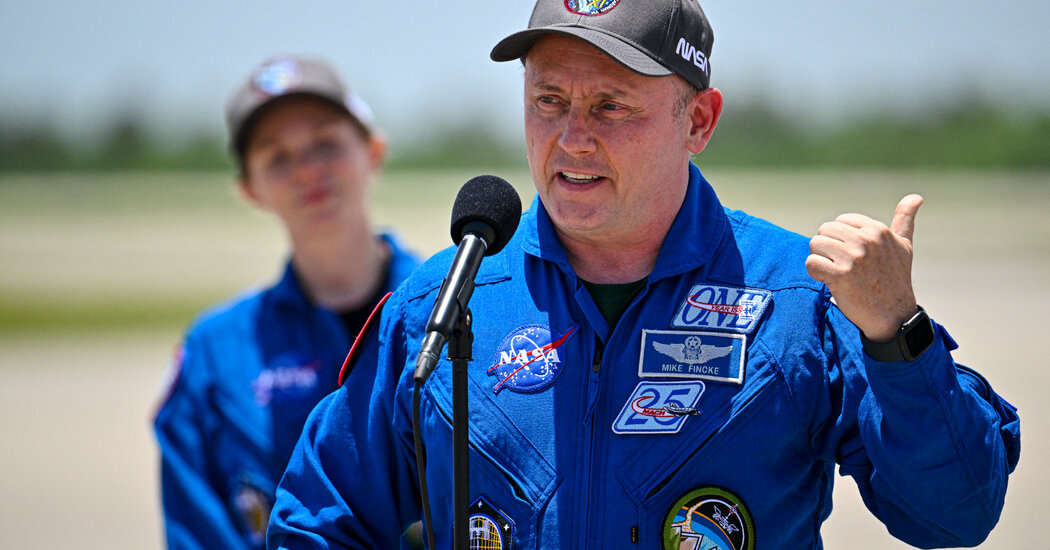
NASA announced this Wednesday the retirement of Michael Fincke, an astronaut who spent a total of 549 days in space, making him the fourth astronaut with the longest time there in the history of the space agency. He also became the first person to require evacuation from the International Space Station, as a result of a medical situation. During his 30-year career with the agency, Fincke, 59, served as commander, mission specialist and flight engineer on its four missions to the space station, as well as chief of maintenance. “Few people have had the opportunity to shape as many chapters of NASA history as Mike Fincke,” NASA Administrator Jared Isaacman said in a press release on Wednesday.Mr. Fincke said he would “carry those lessons forward and help prepare the next generation of engineers, explorers and leaders.” “NASA gave me the extraordinary privilege to serve alongside notable people, fly and help develop spacecraft, and contribute to the International Space Station from its earliest days through command in orbit,” he said in a statement. Beginning in August 2025, Mr. Fincke served as a pilot on NASA’s Crew-11 mission to the space station, which launched on a SpaceX Dragon vehicle and returned to Earth in January. That mission ended a month early due to a medical episode involving Mr. Fincke. Five months into his stay, on January 7, Mr. Fincke said he was having dinner when he suddenly couldn’t speak. The episode lasted about 20 minutes, he said. Neither NASA nor Mr. Fincke have revealed what caused the episode. But tests ruled out a heart attack or stroke, he said. While Mr. Fincke’s condition was stable, NASA officials decided the safest path was to evacuate Mr. Fincke and his three companions back to Earth, leaving the space station with only three astronauts on board instead of the typical complement of seven. It was the first time astronauts were forced to return early due to a medical issue in the space station’s more than 25-year history. Fincke is originally from Emsworth, Pennsylvania. He graduated from MIT and also studied cosmonautics in the Soviet Union through an exchange program with the Moscow Aviation Institute. He earned master’s degrees in aeronautics and astronautics from Stanford and in planetary geology from the University of Houston-Clear Lake. He is a retired U.S. Air Force colonel who accumulated more than 2,000 flight hours in more than 30 types of aircraft. “Mike approached each task with expertise, humility and an unwavering focus on the mission,” said Scott Tingle, chief of the astronaut office at Johnson Space Center in Houston. He added: “His legacy is woven into the way we fly today.” As an astronaut, Mr. Fincke is often credited for his leadership. When a machine designed to recycle astronauts’ sweat, urine and wastewater into drinking water failed aboard the station in November 2008, astronauts led by Mr. Fincke as mission commander did the difficult job of repairing it. (It was known as the “coffee machine” because, as one astronaut said, “it’s ‘Well, I don’t want to spoil anything,’ he said, ‘but I think up here we feel like the appropriate words are ‘yippee!'”