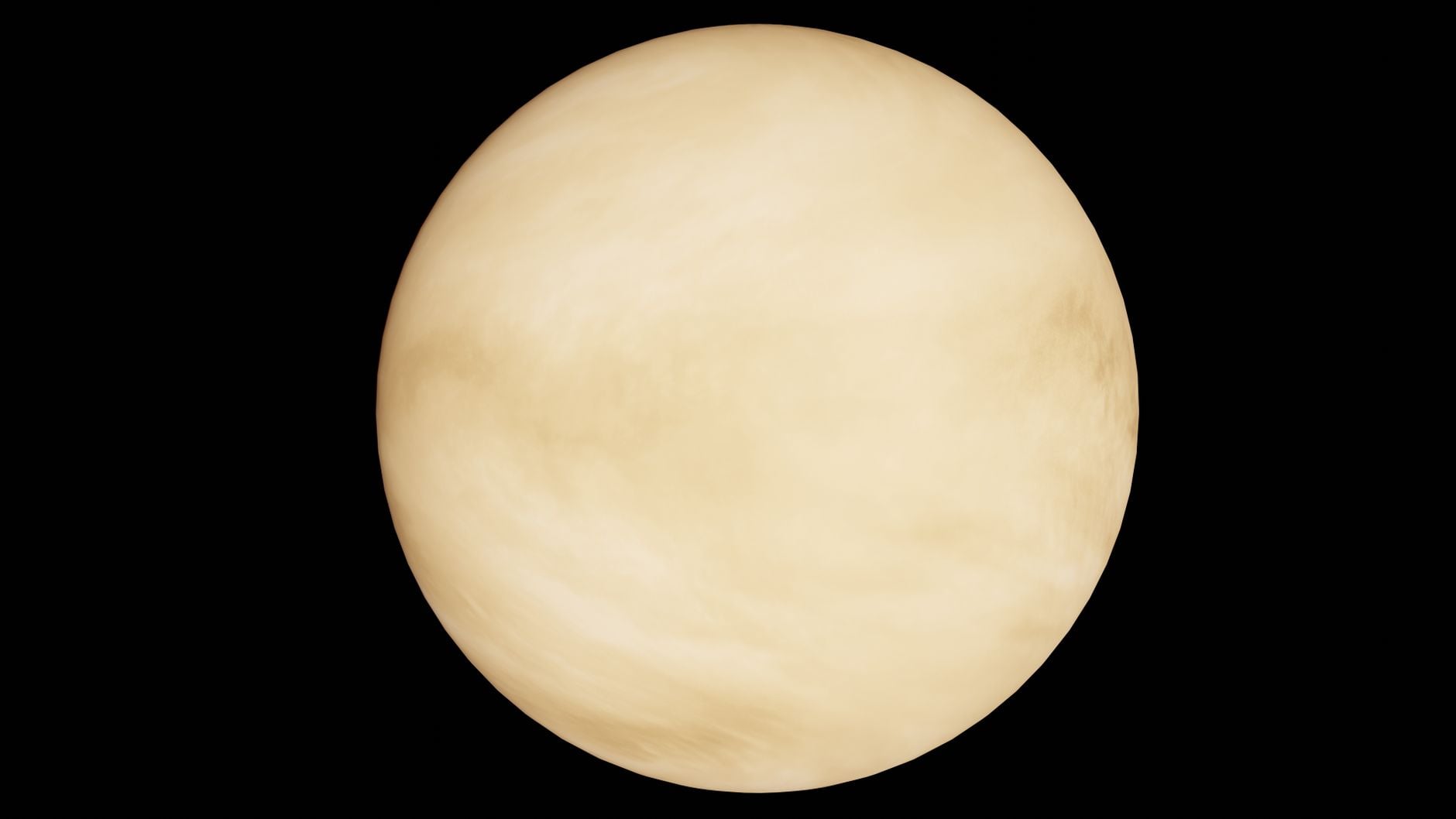
If we put Earth and Venus side by side, the family resemblance is unusually close. Venus has about 95 percent of Earth’s diameter, 81.5 percent of its mass, and about 90 percent of Earth’s surface gravity. A 75-kilogram person on Earth would press down on the ground with about the same force as a 68-kilogram person on Venus. Everything else has gone in another direction. Earth’s high mountains are home to snowfields and glaciers. Radar observations suggest that parts of the Venusian highlands may have a thin, electrically unusual layer. Candidates include lead sulfide, bismuth sulfide, and related compounds. The word “may” matters. No lander has collected this material. The spacecraft measured radar reflectivity and microwave emission and the researchers then proposed chemical explanations for the pattern. Metallic frost is a serious hypothesis, not a confirmed description of Venusian soil. The twin comparison is more than a slogan. NASA places the equatorial diameter of Venus at 12,104 kilometers, compared to 12,756 kilometers for Earth. Its mass is 0.815 times that of Earth and its surface gravity is close enough that the difference is immediately noticeable but hardly disorienting. Both planets have rocky crusts, hot mantles, and iron-rich cores. Those similarities make the current contrast difficult to explain as a simple matter of scale. The atmosphere of Venus is composed mainly of carbon dioxide. The pressure at the surface is about 93 times the sea level pressure on Earth, and the average surface temperature is close to 467 degrees Celsius. Clouds are largely made up of sulfuric acid droplets. The planet has no oceans, no plate tectonic system known as Earth’s, nor an internally generated global magnetic field. Venus is also a strange clock. It rotates so slowly and in a retrograde direction that its sidereal day lasts longer than its year. Each difference can feed the others through climate, atmospheric circulation, interior cooling and water loss. The radar found a boundary, not a mineral label. Venus’ opaque clouds prevent an orbiter from photographing the surface in ordinary visible light. Instead, NASA’s Pioneer Venus and Magellan spacecraft examined it with radar and microwave measurements. In many mountainous regions, the surface becomes more radar reflective above a particular elevation and its microwave emissivity decreases. A 1999 analysis of observations from Magallanes and Arecibo described altitude-dependent changes in the highlands and found that surface scatter played an important role in radar returns. Candidate explanations have included unusual rock textures, chemical weathering, ferroelectric minerals, and conductive or highly dielectric materials deposited on the surface. This is why a radar-bright mountaintop is not equivalent to a chemical test. Radar reveals how a surface interacts with radio waves. Various combinations of composition, roughness, and structure can produce similar signals. However, the abrupt relationship with elevation suggests that temperature and atmospheric chemistry help set the limit. How a Mountain Can Acquire Metallic Frost Although Venus is intensely hot everywhere at ground level, the temperature drops with altitude. Its mountains are not cold by Earth standards, but the plains are. That difference could create cold chemical traps for substances transported as gases through the lower atmosphere. Laura Schaefer and Bruce Fegley tested that possibility with chemical equilibrium calculations. His 2004 Icarus paper considered approximately 660 compounds and proposed galena, the mineral form of lead sulfide, bismuth, the mineral form of bismuth sulfide, or lead-bismuth sulfosalts as possible contributors to the highland signal. In the model, volcanic degassing supplies trace metals to the atmosphere. Metal-containing gases circulate and react with sulfur-containing species. At elevations where temperature and pressure cross the relevant chemical threshold, solid compounds can deposit on the rock. The analogy with frost comes from condensation on a colder surface. It doesn’t involve frozen water, a white coating, or flakes floating in the air. The authors also found complications. Some of the higher terrain again has radar properties more like bare rock. Fresh lava could bury or vaporize a deposit, and alternative mineral reactions could produce other patterns. Their proposed lead and bismuth compounds have adequate electrical properties, but only direct measurements of the composition could identify the coating. Venus may have had more than one possible past. The same caution applies to the story of how Venus and Earth drifted apart. Current conditions show that the divergence occurred. They do not preserve a complete date-stamped sequence. One class of climate models starts with a magma ocean that cools relatively quickly, allowing atmospheric vapor to condense on surface water. Venus’s slow rotation can generate a thick layer of reflective clouds over the sunlit side in simulations, limiting warming even though the planet orbits closer to the Sun. NASA models have explored scenarios in which Venus retained moderate conditions for a substantial part of its history, perhaps billions of years. Another kind starts with a magma ocean that stays hot much longer. In that sense, Venus may never cool enough to establish a lasting ocean. Water remains in a vapor-rich atmosphere, ultraviolet light breaks up the molecules, and light hydrogen escapes into space. Both general scenarios can help explain a dry modern planet, but they assign the decisive transition to very different eras. An uncontrolled or wet greenhouse is only part of the problem. Researchers must also take into account volcanic degassing, the absence of Earth-like tectonic plates, the evolution of Venus’s rotation, atmospheric escape, and the increasing brightness of the young Sun. It is possible that no switch has transformed the planet. Why has the answer survived for so long? Earth’s rocks contain a long and repeatedly reworked record of oceans, climates, and life. The Venus record is much more difficult to read. Volcanism and deformation have resurfaced large areas, while the atmosphere blocks clear optical vision. The landers that reached the ground sampled the basaltic plains and survived for minutes or hours, not the high ground implied by former habitation or metallic frost. NASA’s DAVINCI mission is designed to address some of that shortfall. Their probe will descend through the atmosphere and take images of Alpha Regio, a mountainous region of tiles that may preserve very ancient crust. Noble gases, isotope ratios, trace chemistry and high-resolution images could limit how much water Venus once had, how its atmosphere formed, and whether the highlands differ in composition from volcanic plains. Those measurements will still require interpretation. An isotope ratio can constrain a story without selecting a single story, and an aerial image cannot replace a returned rock sample. Profit is a much smaller set of possibilities than the limited existing data allows. The next maps should prove both stories. NASA’s VERITAS mission, scheduled to launch no earlier than 2031, aims to create high-resolution global maps and investigate surface composition. Repeated radar observations can also look for active deformations. Such data should help separate the effects of roughness, rock type, recent lava, and surface coatings in the highlands. The question of metallic frosts and the question of climate history operate on different time scales, but they lie at the same boundary: the exchange of material between the interior, surface and atmosphere of Venus. A current mineral deposit could reveal what volcanoes release and how it is transported by the lower atmosphere. Ancient highland rocks may hold clues to before much of the planet resurfaced. Therefore, Earth and Venus offer a controlled comparison that astronomy rarely achieves. Their global properties are similar, but their surfaces, atmospheres and histories are not. If the mountains of Venus really are covered in frost containing lead and bismuth, the finding would sharpen that contrast. If other material explains the radar signal, the most important question remains unchanged: how two almost twins acquired such different worlds and when their paths stopped coinciding.