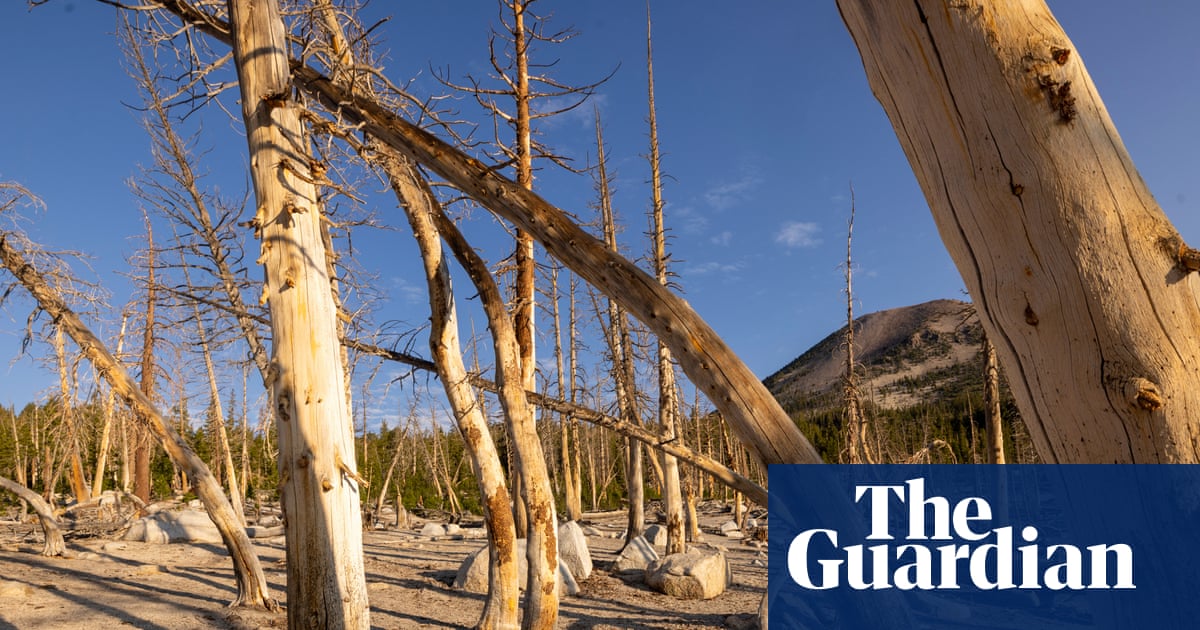
Adding huge amounts of carbon dioxide to the atmosphere will cause Earth’s forests to wither and die rather than flourish, according to a new study that contradicts erroneous claims that fossil fuel pollution will green the planet. An analysis of fossilized leaf cells from a period known as the Paleocene-Eocene Thermal Maximum (or PETM), which occurred about 56 million years ago, has helped reconstruct how the world’s forests responded when previously planet-warming gases were released at a rapid rate. The galloping pace of carbon emissions from burning fossil fuels is unparalleled in historical and prehistoric records, but the PETM, when huge amounts of carbon were released over a period of 130,000 years and the world warmed by up to 8°C (14°F), is the closest comparison. The authors of the new paper discovered that this prehistoric change caused a retreat in the forests that covered the Paleocene-Eocene world, causing them to die as the Earth browned instead of greening, a finding they say has “chilling implications” for today’s world. Fossilized leaf fragments like these helped the authors recreate forest canopies from 56 million years ago. Photo: Dr. Regan Dunn “What we see is that as carbon dioxide increased, the forests became very dense but then collapsed, opening up dramatically,” said Regan Dunn, a researcher at the La Brea Tar Pits and the Los Angeles County Museum of Natural History, who led the study. “About 60% of the biomass of standing vegetation disappeared; it was a huge loss. This should be a concern because the rate of carbon release has never been as high as it is now.” “Forests are some of our best friends and allies, but we are already seeing them dying, being cut down and consumed by wildfires. It’s happening quickly; every summer the change seems faster and faster.” Plants like trees need carbon to build their structures and, along with water and sunlight, provide food. Once the world began burning coal, oil and gas in enormous volumes beginning with the industrial revolution, the amount of carbon dioxide emitted increased at an unprecedented rate, with atmospheric concentrations of CO2 increasing by more than 50% in just over a century. This increase in carbon initially helped fuel some plant life, a change that has been seized upon by those who question the facts of climate science. Prominent figures in Donald Trump’s administration have argued that burning fossil fuels is good for the environment. “CO2 was never a pollutant,” Interior Secretary Doug Burgum told Fox Business earlier this year, as the federal government moved to erase its own power to address the climate crisis. “When we breathe, we emit CO2. Plants need CO2 to survive and grow. They thrive on more CO2.” On the same television network last year, Chris Wright, Trump’s energy secretary, said global warming had “advantages” as well as disadvantages. “A warmer planet with more CO2 is better for growing plants,” Wright said. The authors compared the cuticle structure of modern leaves (pictured above under epifluorescence microscopy) with the cuticles of fossil leaves to create a model of canopy cover. The scale bar is 50 microns (0.05 mm). Photograph: Dr Regan Dunn Experts have previously rejected such claims as false, and the new research paper, published in Science, shows that Earth’s past experience shows that trees need much more than CO2 to thrive. The extra carbon dioxide traps more heat, causing trees to struggle amid extreme temperatures and a lack of key nutrients. Warmer conditions can also trigger outbreaks of pests and diseases, further weakening trees and drying out vegetation that then explodes into huge wildfires, like those that have devastated much of Canada and Western Europe this summer. The shift from green forests to darkened forests occurred around the year 2000, the new paper states, when the impacts of drought and heat stress outweighed the benefits of additional CO2. Since then, evidence has accumulated of increasing global tree mortality, including trees in the tropics dying from dehydration. Skip Newsletter Promotion Subscribe to Down to Earth The biggest stories on the planet. Get all the week’s environmental news – the good, the bad and the essential after the promo in the newsletter “Once the weather gets too hot, plants can’t handle it – it affects their physiology and their relationship with water,” Dunn said. “Once they can’t survive because the CO2 and the temperatures are too high, that’s when you see the forests die.” There is currently “quite a bit of tree mortality” occurring in Europe, North America and the Amazon, Dunn said, requiring rapid cuts in carbon emissions to ensure the world doesn’t go down the same path as it did 56 million years ago. “There is still time to avoid the worst outcomes and the best we can do is keep fossil fuels in the ground,” he said. “It’s important for people to understand that once we pass thresholds, it takes a long time to recover from them. The 130,000 years of PETM change on human time scales is basically forever.” Dunn and his colleagues determined the extent of ancient forests by analyzing fossilized leaf cells called leaf cuticle fragments. This allowed them to determine the density of forest cover during the PETM, allowing them to calculate the advance and retreat of forests over time. Field crew excavating a trench through PETM strata in Hanna Basin, Wyoming. Photo: Marieke Dechesne, USGS In that bygone era, forests covered a much larger area of the world than they do now, with no ice at the poles and much higher seas than today. But while changes in the PETM occurred over many thousands of years through carbon released by the natural forces of volcanic activity, current climate change is much more rapid and is caused by our deliberate burning of fossil fuels. The paper is a “genuine breakthrough” and provides a record spanning tens of thousands of years showing the knock-on impacts of forest clearing, according to Trevor Keenan, a scientist at the University of California, Berkeley, who was not involved in the new research. “The headline is that he won the warm-up,” Keenan said. “Carbon dioxide increased significantly, and any benefit they provided to the forests was not enough to prevent the tree canopies from opening and staying open for tens of thousands of years.” This is worrying given the pace of change today, he added. “Ancient carbon release occurred over thousands of years; ours is occurring over decades,” he said. “Faster forcing gives ecosystems less room to adapt.” Second, those forests faced climate change alone. Today’s forests face the same warming while being fragmented, logged, converted to agricultural use, and exposed to altered fire regimes. “If forests declined under the slower, cleaner version of this experiment, that is not a reassuring precedent.”