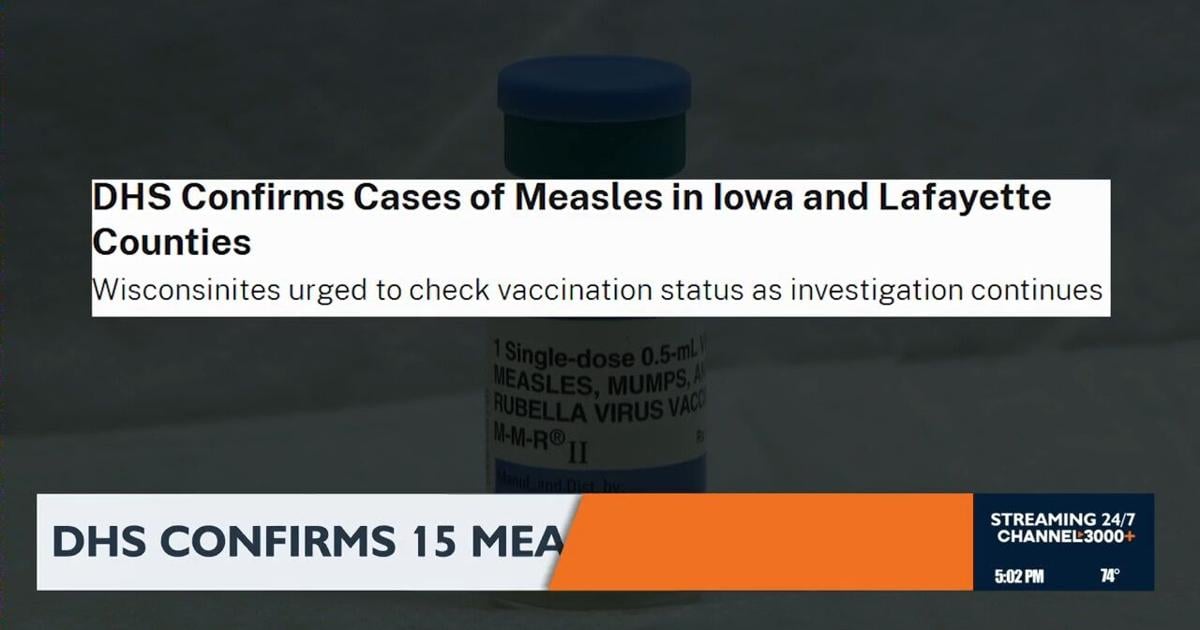
MADISON, Wis. — The Wisconsin Department of Health Services on Thursday confirmed more measles cases in Iowa and Lafayette counties.The DHS said the number of confirmed cases rose from two on Tuesday to 15 as of Thursday morning, and that there were also six probable cases.Measles is a highly contagious disease that can be spread from person to person through the air and can stay in the air for two hours after a sick person coughs or sneezes.Data provided by the DHS shows that 23 measles cases have been confirmed in the state since the beginning of the year. About 60% of cases were confirmed in children younger than 18 years old, and all but one case was confirmed in people who were unvaccinated.Dr. Ryan Westergaard, chief medical officer for the department’s Bureau of Communicable Diseases, said finding more people who were exposed to measles or additional cases can help health officials prevent further spread.“We expect that we will learn about more exposures and potentially more cases,” Westergaard said. “When we identify additional exposed people or additional cases, that’s a good thing in the sense that now we have more information that we can use to try to prevent the spread.”A major challenge is Wisconsin’s low rate of measles, mumps and rubella, or MMR, vaccination. Public health experts recommend a 95% vaccination rate to help prevent measles outbreaks.The most recent DHS data show that MMR vaccination rates among people 18 and younger in Iowa and Lafayette counties remain below that threshold.The effort comes as measles cases rise nationwide amid growing vaccine skepticism.A major challenge is Wisconsin’s low rate of measles, mumps and rubella, or MMR, vaccination. Public health experts recommend a 95% vaccination rate to help prevent measles outbreaks.The most recent DHS data show that MMR vaccination rates among people 18 and younger in Iowa and Lafayette counties remain below that threshold.The effort comes as measles cases rise nationwide amid growing vaccine skepticism.This week, President Donald Trump signed an executive order recommending that the MMR vaccine be separated into three individual shots. DHS Secretary Kirsten Johnson said the order will not change the department’s approach.“We are deeply concerned about the lack of scientific evidence in statements from top federal officials, and potential implications for the health of children in our state,” Johnson said in a statement.Westergaard said surveys indicate people are more likely to trust vaccine guidance from their doctors than from government agencies.“My best recommendation is to talk with your health care provider, who knows you and who you trust, and who can listen to your concerns and find out what they recommend,” he said.Residents should know the symptoms of measles and call a health care provider if they develop symptoms, even if they are not aware of a specific exposure. Symptoms of measles typically appear approximately 10 to 21 days after being exposed to the virus, and include:Runny noseHigh fever (may be greater than 104°F)TirednessCoughRed, watery eyes, or conjunctivitis (pink eye)A red rash with raised bumps that starts at the hairline and moves to the arms and legs three to five days after symptoms beginAnyone developing symptoms of measles should stay home (not go to work, school, social gatherings, shopping, or use public transportation) and call a doctor’s office or clinic before visiting so they can take precautions to ensure other patients are not exposed to the virus.Measles can be prevented with the measles, mumps, rubella vaccine (MMR).COPYRIGHT 2026 BY CHANNEL 3000. ALL RIGHTS RESERVED. THIS MATERIAL MAY NOT BE PUBLISHED, BROADCAST, REWRITTEN OR REDISTRIBUTED.