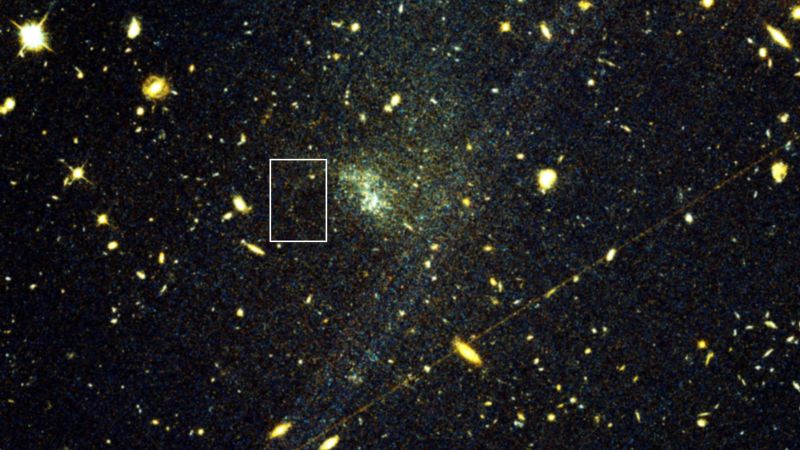
A faint ribbon of stars in a distant galaxy has led astronomers to a discovery that could reveal secrets about one of the biggest mysteries in our universe. Hidden within archival data from the Hubble Space Telescope, researchers found the barely visible trail of stars: the first stellar stream from a globular cluster detected outside the Milky Way. The celestial phenomenon, located in a galaxy approximately 115 million light years from Earth, is the remnant of a dense ball of stars that the gravity of its host galaxy is slowly pulling apart. As the cluster loses stars, the debris forms a long, narrow stream. Astronomers have found dozens of stellar streams within the Milky Way, but because these traces are faint and difficult to detect, it is likely that many more remain to be discovered. Now, with evidence that they occur in other galaxies, astronomers could use them as cosmic tracers to better understand how galaxies form and evolve. The finding, detailed in a study published Wednesday in the journal Nature, also allowed the team of astronomers to map the galaxy (known as UGC 9050-Dw1) and its gravitational field by modeling the current. Because the galaxy’s gravity influences the shape and motion of the stellar stream, the researchers used star trails to track the galaxy’s gravitational field. Through their modeling, they were also able to estimate the total mass of the galaxy, how much of it is made up of visible objects, such as stars, and how much of it is made up of dark matter, a mysterious form of matter that can’t be seen but has gravity. When the study team began to realize that they had found a stellar stream beyond our galaxy, “it was very exciting,” said co-senior author Julie Kiel Holm, a doctoral fellow at the Niels Bohr Institute at the University of Copenhagen in Denmark, who studies globular clusters and the formation of stellar streams. “And then we look at each other and ask, ‘Where do we go from here?’” Dark matter intrigues scientists because they don’t know what it is, but they can see its gravitational influence on stars and galaxies. “We think that 80% to 85% of our universe is dark matter, so it’s very, very attractive to try to figure out what it is,” Kiel Holm added. Stellar streams have been used to help scientists map dark matter within our own galaxy. Now, those same tools can be used to help better understand the composition and structure of dark matter from other galaxies that share the universe. The newly discovered stream is located within an ultradiffuse galaxy, an extended and extremely faint galaxy, which likely made the stellar stream easier to detect, the study authors speculated. “At the same time, these ultradiffuse galaxies are thought to be very massive, and you need to be massive to be able to extract stars from that main cluster,” said co-senior author Sarah Pearson, an associate professor at DTU Space, the National Space Institute at the Technical University of Denmark. “So those two things together (the fact that it provides a faint background, but also has a tidal field strong enough to extract stars from the cluster) is a great combination if you want to find one of these,” he added. When trying to identify these streams, astronomers look for thin, elongated structures in their telescopes. Currents can also be followed through their movement across the sky; However, doing so requires a telescope to be in the same position over time, and so far the technique has only been able to find stellar streams in the Milky Way. “The area that Hubble can see is actually not that big. So you have to be very, very lucky to be able to see this, and we don’t really know where to look to basically target them,” said study co-author Tjitske Starkenburg, an assistant research professor at the Center for Interdisciplinary Exploration and Research in Astrophysics at Northwestern University in Evanston, Illinois. The study’s authors predict that future telescope advances will allow greater detection of these clusters inside and outside our galaxy. Starkenburg pointed to NASA’s Nancy Grace Roman Space Telescope, which is expected to launch at the end of the month and will have a wider field of view, “like 100 Hubbles in one image.” Detecting a weak stellar stream in a galaxy outside the Local Group (our galactic neighborhood consisting of more than 50 gravitationally bound galaxies) is remarkable, David Martínez-Delgado, an astrophysicist and researcher at the nonprofit ARAID foundation at the Aragon Center for Cosmos Physics Studies in Teruel, Spain, said in an email. Martínez-Delgado was not involved in the new study. “I had previously thought that detecting globular cluster tidal tails in external galaxies would be extremely difficult, given their small angular size and extremely low surface brightness,” he added. “This result demonstrates that, with sufficiently deep and high-resolution observations, such structures can be detectable well beyond the Local Group.” Stellar streams can act as records of a galaxy’s past, giving astronomers clues about how galaxies change over time. When a larger galaxy pulls apart a smaller dwarf galaxy, the dwarf’s stars can spread out to form a stream, a cosmic trail of crumbs from that encounter. Globular cluster streams, like the one described in the study, preserve that history on a smaller scale, revealing how the cluster has traveled through its host galaxy and how the galaxy’s gravity has gradually pulled it apart. By tracing that history, researchers can learn how the galaxy’s mass is distributed, including the invisible dark matter that shapes its gravitational field. The observation of the first stellar stream from a globular cluster outside the Milky Way opens the door to detecting more of these phenomena in galaxies throughout the universe. The study’s authors said they hope future detections will help reveal more secrets about other galaxies, as well as the dark matter within them. One feature that deserves further investigation, the authors noted, are gaps or clumps in stellar streams that scientists theorize develop when small concentrations of dark matter pass through them. “But there are other things that could cause some of those similar effects,” Starkenburg said. Finding more streams, perhaps in other galaxies, and seeing if they have similar gaps or clusters, “is a much stronger argument to believe that it has to be dark matter,” Starkenburg added. Pearson noted that many questions remain about dark matter even though its existence has been known for almost a century. “It’s really just one of the biggest open questions in physics,” he said. “What is the nature of dark matter? Is it one particle? Are there many of them? Is it something completely different? We don’t know.” Taylor Nicioli is a freelance journalist based in New York. Subscribe to CNN’s Wonder Theory science newsletter. Explore the universe with news about fascinating discoveries, scientific breakthroughs and more.