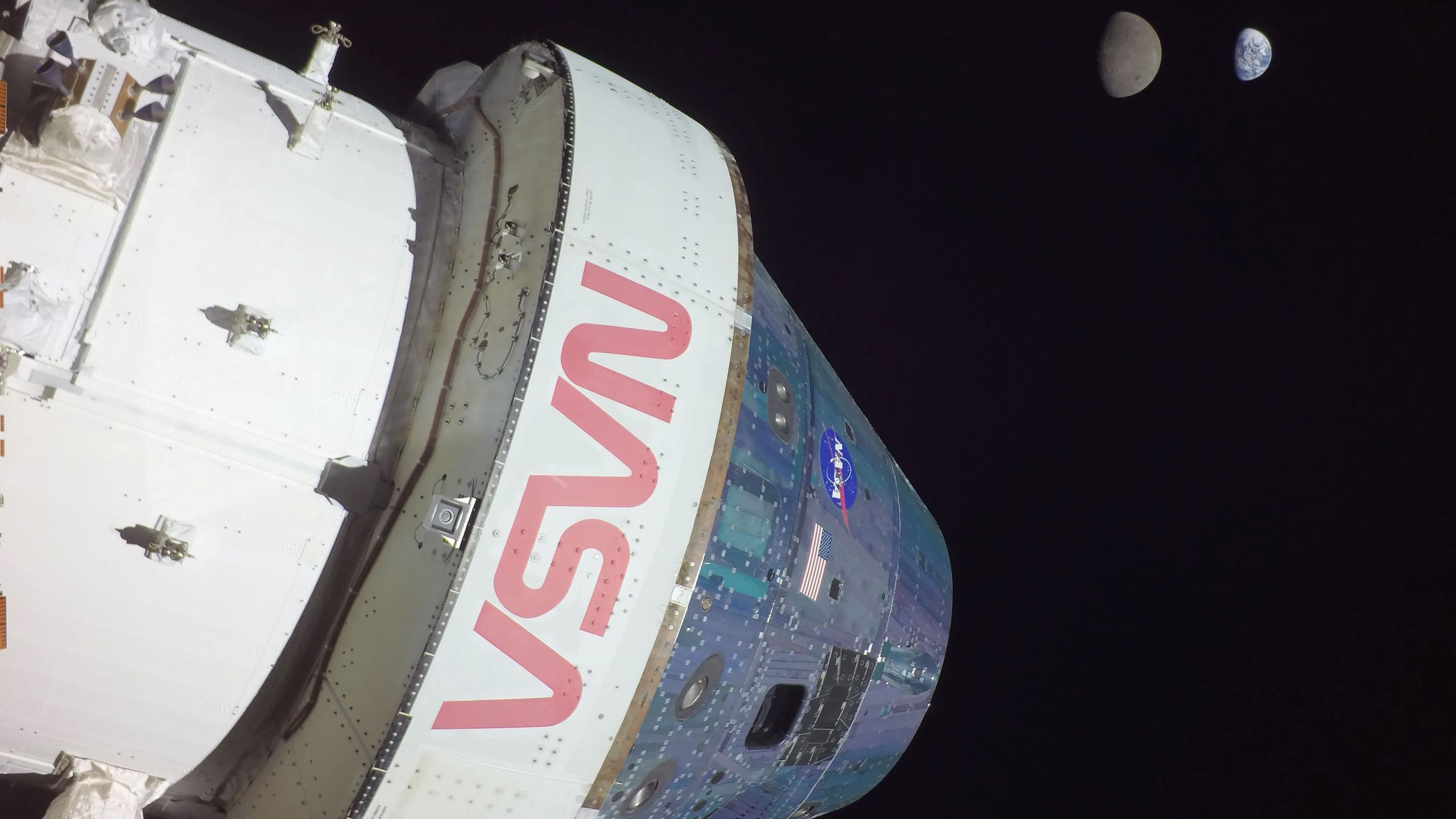
A radiation protective vest could one day protect astronauts from dangerous, random blasts from the sun, according to a new study. More than 50 years after the last Apollo mission, NASA’s Artemis program aims to return humans to the moon. To be successful, this project must protect astronauts from solar radiation, especially the intense and unpredictable radiation from solar storms. Coating an entire spacecraft in a significantly thick layer of radiation protection remains impractical due to weight limitations, but wrapping astronauts in protective clothing may help. In the new study, researchers experimented with the AstroRad vest, which was designed by Israeli startup StemRad with support from the Israel Space Agency and aerospace giant Lockheed Martin. The garment was created to protect astronauts from the sun’s explosions known as solar particle events. The “ghosts” Helga and Zohar inside the Orion spacecraft in NASA’s Vehicle Assembly Building before the launch of Artemis I. Zohar, right, was wearing the AstroRad vest while Helga was not. (Image credit: NASA/Lockheed Martin/DLR) “Radiation in space is inevitable, and a single major solar particle event can make a substantial contribution to an astronaut’s lifetime risk of radiation-induced cancer,” study co-author Oren Milstein, CEO and co-founder of StemRad, told Space.com. “By significantly reducing that contribution, personal protection could be particularly important for future missions to the Moon and Mars.” When it comes to radiation protection, lead is excellent at blocking dangerous forms of light, such as x-rays and gamma rays. However, lead is much less effective at fending off the types of dangerous particles that can travel through space. For example, when fast, high-energy electrons known as beta particles collide with dense lead atoms, they can unleash a shower of X-rays that are more damaging than the beta particles themselves. And if neutrons hit lead atoms, they can release a spray of neutrons from the atoms’ nuclei, worsening the impact of the radiation. You might like Instead, AstroRad is based on a high-density, hydrogen-rich plastic. Among elements, hydrogen has the highest density of electrons per atom, which can help create a dense shield to protect against incoming particles. At the same time, hydrogen atoms do not normally have neutrons, so if neutrons hit them, they cannot generate the type of dangerous neutron aerosols that can occur with lead atoms. Additionally, AstroRad plastic is much lighter than lead. This makes it easier to move around in clothing that incorporates plastic and more practical for space missions where weight is a major limitation. Scientists combined thousands of rigid plastic hexagonal rods like scales to create a flexible garment. In total, each vest weighed about 57 pounds (26 kilograms). Scientists developed a vest instead of a full-body suit or helmet because “different organs and tissues have very different sensitivities to radiation, so protecting each part of the body equally is not the most effective approach,” study co-author Jordan Houri, senior space exploration scientist at StemRad, told Space.com. “At the same time, a full-body suit would be much more difficult to put on and move around.” The thickness of the AstroRad vest’s shielding was based on the radiation sensitivity of the underlying organs. This strategy provides about a 30% greater reduction in the radiation dose a person receives compared to distributing the same amount of protection evenly throughout the body, Houri said. What to read next The researchers tested their vest during NASA’s unmanned Artemis I lunar mission in late 2022 using a pair of extraordinarily complex mannequins called phantoms. These artificial torsos were constructed of plastics that mimicked the density of human tissue, bones and organs, and each was equipped with more than 5,600 radiation sensors on and in them. The two ghosts were designed to be adult women, as previous research found that breasts and ovaries are especially susceptible to radiation damage. “Women are predicted to face an increased risk of radiation-induced cancer,” Milstein said. “Specific shielding could help reduce the risk difference between male and female astronauts.” Since the ghosts imitated women, they were given women’s names, Zohar and Helga. “Helga was contributed to the experiment by the German Aerospace Center, and Helga is a traditional German name,” Milstein said. “Zohar was contributed by the Israel Space Agency, which selected the name through a public outreach campaign. Zohar is a traditional Hebrew name meaning ‘radiance,’ which we thought was particularly appropriate.” Assembling the Zohar Phantom with the AstroRad vest at the Kennedy Space Center before the launch of Artemis I. (Image credit: NASA/DLR) Zohar and Helga flew seated in NASA’s Orion spacecraft; Zohar was equipped with an AstroRad vest, while Helga was not. Although Orion did not encounter a significant solar flare during its 26-day mission to lunar orbit and back, researchers were able to extrapolate how much solar radiation astronauts might experience based on what the ghosts encountered as they passed through the inner Van Allen radiation belt that surrounds Earth. When scientists analyzed past solar particle events, they found that the AstroRad vest would have significantly reduced a person’s radiation dose during those bursts, for example, by almost 60% for a solar particle event that occurred in August. 1972. “We had originally anticipated something closer to 45%, so when we first saw the result, we thought we needed to go back and find a bug,” Houri said. “Instead, detailed analysis showed that AstroRad’s approach of providing targeted protection to the most radiation-sensitive organs and tissues was even more effective than we had projected.” Such a reduction could save astronauts the equivalent of up to 193 days of exposure to deep space radiation. “The most important implication is that AstroRad could help overcome one of the major health challenges limiting long-duration human exploration beyond Earth,” Milstein said. 3D rendering of the Matroshka AstroRad Radiation Experiment (MARE) during NASA’s Artemis I mission, showing the two radiation dosimetry phantoms, Helga and Zohar, inside the Orion spacecraft. (Image credit: NASA/Lockheed Martin/DLR/StemRad) AstroRad is not something astronauts would use continuously for an entire mission, Houri said. “AstroRad was developed as an emergency countermeasure for solar particle events, so astronauts would only use it when radiation levels are high, typically for periods of hours or days,” he explained. Still, “although it’s not something astronauts should wear for an entire mission, we designed the vest to remain usable for many hours at a time,” Milstein said. During testing of the vests on the International Space Station, “several crew members even slept with them on.” The level of radiation protection provided by the AstroRad vest was similar to that provided by the storm shelter aboard the Orion spacecraft, “allowing the astronaut wearing it to exit the shelter and continue with mission-critical tasks,” Houri said. “AstroRad can be used alone or in conjunction with a shelter, but one of its main advantages is that an astronaut can remain protected while moving around the cabin and performing mission-essential operations rather than remaining inside the shelter.” Scientists are now investigating whether it is possible to manufacture radiation shielding in space using onboard materials. For example, in collaboration with Florida aerospace company Redwire, “we have already demonstrated that it is possible to 3D print AstroRad components from recycled polyethylene aboard the International Space Station,” Milstein said. The scientists detailed their findings online today (Aug. 12) in the journal Science Advances.