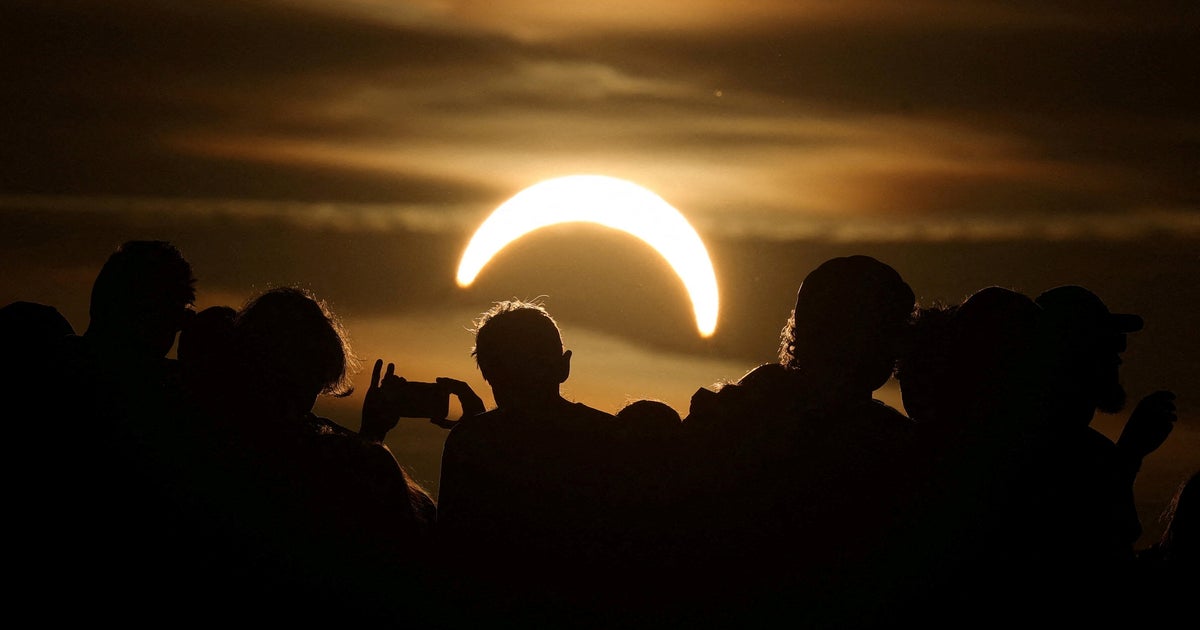
The only total solar eclipse of 2026 brought darkness to a swath of the Northern Hemisphere on Wednesday. Crowds gathered throughout Europe to see it, with northern Spain being a privileged place to observe it in the path of totality. First, if you have never had the opportunity to see a solar eclipse, what you are seeing is the moon passing in front of the sun. It occurs somewhere on Earth approximately every 18 months, but in any particular location in the world they could occur hundreds of years apart. The moon partially covers the sun during the solar eclipse, as seen from Berlin, Germany. Fabrizio Bensch / REUTERS Here’s what you need to know about the total solar eclipse: Where was the solar eclipse visible? Many places along the path of the total solar eclipse are uninhabited, such as northern Greenland. But western Iceland and northern Spain are also in the path for a maximum eclipse experience. Spain had not experienced a total solar eclipse since 1905. This NASA animation shows the path of totality of the eclipse, along with the time it passes through those areas: Your browser does not support the video tag. Although totality only reached a relatively narrow portion of the hemisphere, a partial solar eclipse was visible over a much wider area. About 230 million people live in areas covering 90% of the population, according to demographic data from the Center for International Earth Science Information Network at Columbia University. That includes most of Europe’s major cities, including Madrid, London and Paris. The sun peeks out from behind the moon during the total solar eclipse, as seen from Caspe, Spain. Jose Breton/Pics Action/NurPhoto via Getty Images A view of the total solar eclipse behind the Cathedral-Basilica of Our Lady of Pilar, in Zaragoza, Spain. Jakub Porzycki/NurPhoto via Getty Images A person views the partial solar eclipse at Glastonbury Tor in Glastonbury, Great Britain. Toby Melville / REUTERS The Eiffel Tower in Paris is silhouetted as the moon partially covers the sun during the solar eclipse. Sarah Meyssonnier / REUTERS Even some parts of North America got the chance to see a partial solar eclipse, although it won’t be as impressive as when the US was able to see a total eclipse in 2024. Best place to see it in the US: Fairbanks, Alaska, hit 37% total. Boston was on track for 16% total, while New York City hit about 9% total, Toronto about 8%, and Philadelphia about 7%. What time did the eclipse occur? Since the eclipse crossed only the northern part of the globe, the path of totality was quite short from start to finish, about an hour and 45 minutes. The first glimpse of the total eclipse became visible in the far north of Russia at 17:00 UTC, which is 1:00 pm Eastern Time. It arrived northeast of Greenland at 1:30 pm ET and western Iceland at approximately 1:45 pm ET. After crossing the North Atlantic for 45 minutes, when it was best visible in the United Kingdom, with London peaking at 91% at 2:13 pm ET (7:13 pm local time), totality reached northern Spain at approximately 2:30 pm ET (exactly 8:32 pm local time in Valencia). 2:45 pm Eastern Time. The path of totality of the 2026 solar eclipse will pass through parts of Greenland, Iceland and northern Spain. NASA For those in North America who saw a partial eclipse, it was maximum in Toronto at 1:40 pm and in New York City at 1:54 pm local time. In Fairbanks, people could see its peak at 8:27 a.m. local time. See the eclipse in person If you were lucky enough to be in one of the places where the solar eclipse reached totality, casting darkness in the mid-afternoon, it lasted about two minutes. Enthusiastic spectators came out to see it all over Europe, with most seeing a partial but still dramatic view. People wear protective glasses to observe the partial solar eclipse in Prague, Czech Republic. Eva Korinkova / REUTERS Wearing solar eclipse glasses is essential to protect the retina from damage when viewing an eclipse. It is only safe to remove your glasses during the brief period of totality. During a partial eclipse, you should keep those glasses on at all times to avoid eye damage. A man wears protective glasses to observe the solar eclipse in Berlin on August 12, 2026. Fabrizio Bensch / REUTERS When will the next total solar eclipse be in the US? If the total solar eclipse in Europe gets you excited for the next one in the US, you have some time to wait. The next total solar eclipse over the US will be in 2044, but it will only be visible in three states: Montana, North Dakota and South Dakota. Next year, there will be another opportunity visible in many states as it moves from coast to coast. The eclipse will begin in Northern California and move in an arc toward the east, ending in Florida, similar to one in 2017. There will be numerous U.S. cities where eclipse watchers will be able to view the total eclipse, including Reno, Nevada; Colorado Springs; Tulsa, Oklahoma; Little Rock, Arkansas; Jackson, Mississippi; and Orlando, Florida. There will be another in 2052 that will cross the Southeast, including Florida, Georgia and South Carolina. To see a total eclipse in the northeastern US, you’ll have to wait until May 1, 2079. Go deeper with The Free Press at: