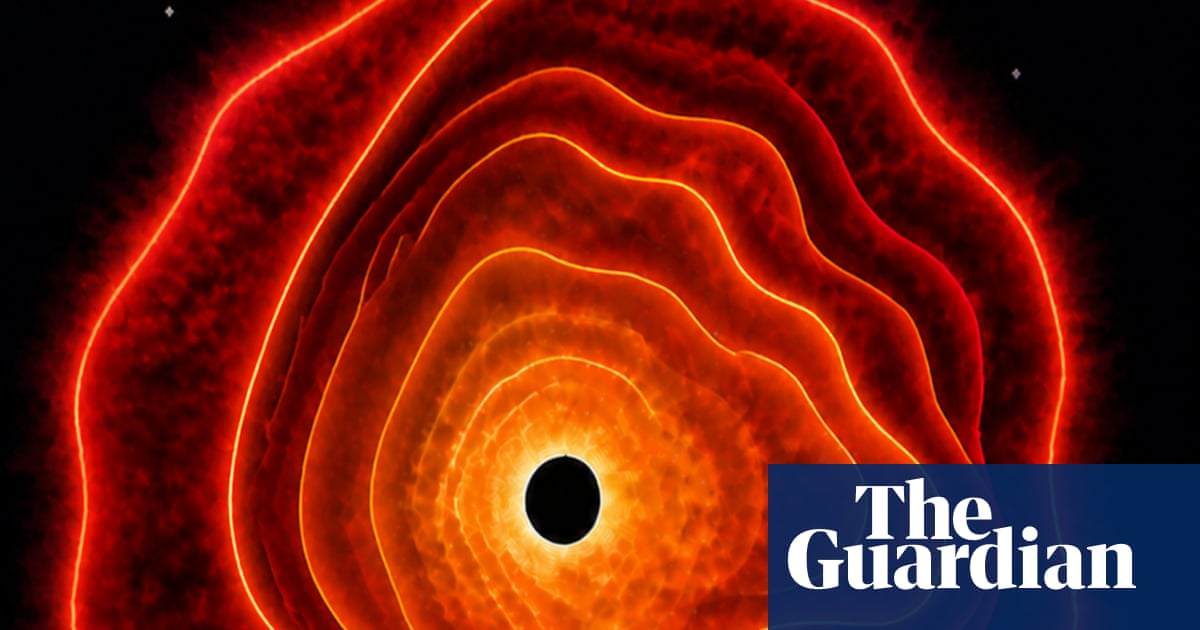
Astronomers claim to have discovered a new type of cosmic object, a black hole “star” that is the size of the entire solar system and shines with bright red light. The international team made the breakthrough after focusing their attention on a mysterious red spot in images of the early solar system captured by NASA’s James Webb Space Telescope. The object was lurking in the constellation of Cetus, the Whale, billions of light years from Earth. It is believed to have formed 660 million years after the Big Bang, astronomers’ leading theory for how the universe began. Measurements of the exotic body found that, while it resembles an immense star, it releases 100 billion times more energy than any known star can produce. The energy production is much closer to that observed in black holes than in stars. “We have found a new type of astrophysical object, a black hole star,” said Dr. Rohan Naidu of the Kavli Institute for Astrophysics and Space Research, part of the Massachusetts Institute of Technology. “It shines with the energy typically associated with black holes, but at the same time carries signatures classically associated with stars,” he added. Scientists made this breakthrough after focusing their attention on a mysterious red spot in images captured by NASA’s James Webb Space Telescope. Photo: NASA, ESA, CSA, STScI, DAWN JWST Archive Scientists were using the James Webb Space Telescope to find the most distant galaxies in the known universe. After having success with a galaxy called Mom-z14, which formed just 280 million years after the Big Bang, they turned their attention to other cosmic objects. In Nature, the astronomers describe how they focused on an extremely bright red dot known as MoM-BH*-1, the reddest object in the telescope’s image archive. “Computer simulations showed that rather than being a huge star fueled by nuclear fusion, the object is a black hole so shrouded in veils of dense gas that it radiates like a star. If astronomers are right, this suggests that dozens of other mysterious Small Red Dots, or LRDs, that appear in almost every deep space image taken by the James Webb Space Telescope, are also black hole stars. Naidu suspects that black hole stars play an important role in the evolution of black holes. galaxies. They could be the seeds of today’s supermassive black holes, like the one at the center of the Milky Way “For decades we have anticipated that something spectacular must be afoot in the early universe. Black hole stars can be ‘something spectacular’. They may be the nascent, enveloped phase that marks the beginning of the journey of almost all supermassive black holes,” he said. Supermassive black holes are found at the centers of almost all galaxies, such as the Milky Way, and are believed to determine the fate of those galaxies. “They can determine when stars can form and when they stop forming, setting the course of everything that follows star formation: the birth of planets, the rise of life, the rise of species that some One day they could reconstruct this whole story,” Naidu said.