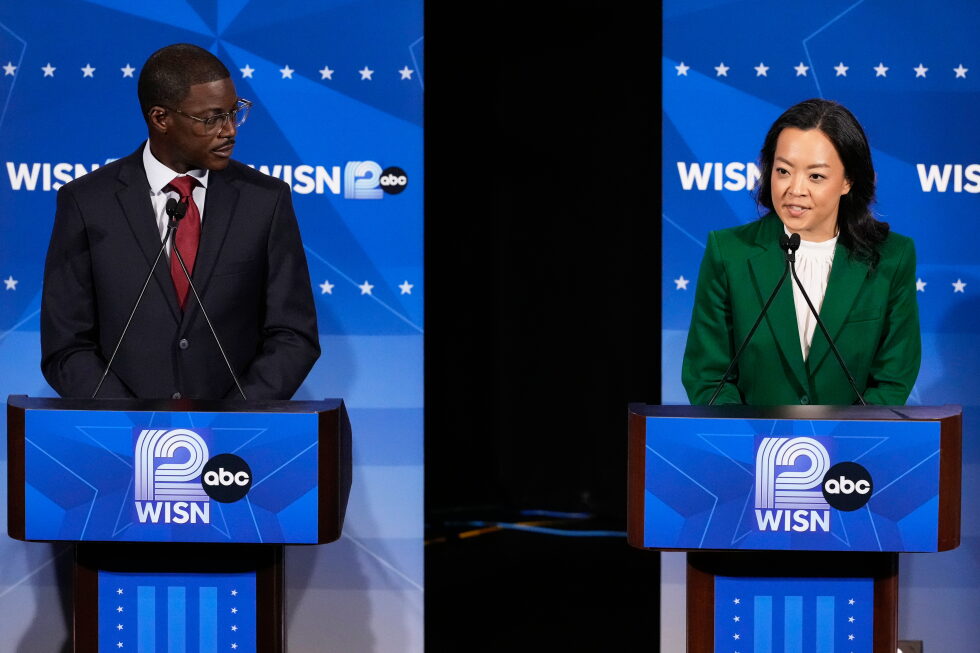
While Tuesday’s primaries provided another glimpse of Democrats’ struggle between the ideological left and center, they also showed that in some states, for some races, experience was rewarded. For Republicans, the race to replace the late Sen. Lindsey Graham pitted his sister, Darline Graham, against far more experienced candidates. But he also had the backing of President Donald Trump and secured a spot in a runoff election later this month. Most attention was focused on the Democratic nomination for governor of Wisconsin, where the insurgent candidacy of socialist Francesca Hong was causing upheaval among the party’s more traditional leaders. The outcome of that race was unclear Tuesday night. Below we present some of the first conclusions of the night’s elections. Last name + Trump approval = Graham’s runoff spot in South Carolina Darline Graham advanced to a runoff Tuesday night in the primary for her brother’s seat. She was appointed to fill the remaining months of his current term after his death last month. While little was known about her, her surname and goodwill toward her brother fueled her candidacy. Trump then endorsed her in the GOP primary to fill the seat for the next six years. He also praised her Tuesday night after returning to Washington. The role Trump chooses to play in the next two weeks could be decisive in a state where he is quite popular. A who’s who of conservative South Carolina politicians also competed for the rare prize of a Senate seat, and Rep. Ralph Norman, a longtime conservative who finished second, will face Graham in two weeks. Both candidates will need to consolidate the votes of the other rivals to win. Another veteran Democrat falls in the race for generational change. Connecticut Rep. John Larson became the latest Democratic stalwart to lose his primary. The 78-year-old, who served 14 terms in the House, was defeated by former Hartford Mayor Luke Bronin. Larson’s loss did not have the ideological overtones that have dominated some other Democratic House primaries, where younger socialist candidates unseated veteran House members in Denver and New York City. But there was a distinct generational cast, with his 47-year-old challenger arguing that voters deserved a different election in the overwhelmingly Democratic district. Larson is the 10th House member to lose a primary this year, in a sign of bipartisan fury with veterans of each party. While that count includes three Republicans, the rest are Democrats. After Joe Biden’s collapse during the 2024 presidential election (and the deaths of four Democratic members of the House of Representatives in the last 18 months), it’s clear that Democratic voters are looking very critically at older members of the party. But many eyes are on Wisconsin. Trump won Wisconsin in 2024 and its state legislature has long been in GOP hands, but Democrats have been optimistic about reversing that trend. The biggest concern many in the party have is Tuesday’s primary. Hong, a self-proclaimed democratic socialist with a history of previous controversial statements and social media posts, has been the front-runner for the party’s gubernatorial nomination. His main opponent is Milwaukee County Executive David Crowley, backed by the state’s current Democratic governor, Tony Evers. Democratic strategists fear Hong could drag down the rest of the field in November and fight Republican nominee Rep. Tom Tiffany, who is backed by Trump and won handily on Tuesday. There is a lot at stake in Democratic elections nationwide, not just for Wisconsinites. Democrats hope to gain control of the state legislature, and the governor’s mansion would give them the ability to redraw Wisconsin’s map to counter the advantage the GOP built in redistricting this summer. Without that, his path to a House majority in 2028 becomes challenging. Democrats will also likely need to win Wisconsin to retake the White House in 2028, and the governor will play a key role in certifying the election winner. In 2020, Trump attempted to claim Wisconsin even though Joe Biden won, but was partially blocked by Evers. Tiffany supported the president’s attempt to overturn the election. There are similar concerns for Democrats in Minnesota, a state they won reliably during the Trump years, but by increasingly slim margins. Moderate Rep. Angie Craig and liberal Lt. Gov. Peggy Flanagan are locked in a heated battle over the party’s nod for the Senate seat Klobuchar vacated. Republican strategists hope the fight will be divisive enough to provide an opportunity for their preferred candidate, sportscaster Michele Tafoya. Experience and resume still mattered in some races. While much of this year’s midterm campaign cycle has been buoyed by new candidates with provocative progressive messages and the fact that being an incumbent seemed like a burden, Democratic voters in Connecticut and Minnesota gravitated toward the familiar in their respective gubernatorial races. Two-term Connecticut Governor Ned Lamont defeated his progressive rival in the state’s Democratic primary, while Senator Amy Klobuchar, who first won her seat 20 years ago, easily won the nomination for governor of her state. Their victories bucked any trend toward younger, more progressive candidates who had scored surprising victories in several House primaries and, particularly, in the Democratic Senate primary in Michigan last week. Lamont began his political rise as an insurgent challenger to incumbent Sen. Joe Lieberman, but is now considered establishment. Klobuchar has a reputation as a bipartisan consensus builder.