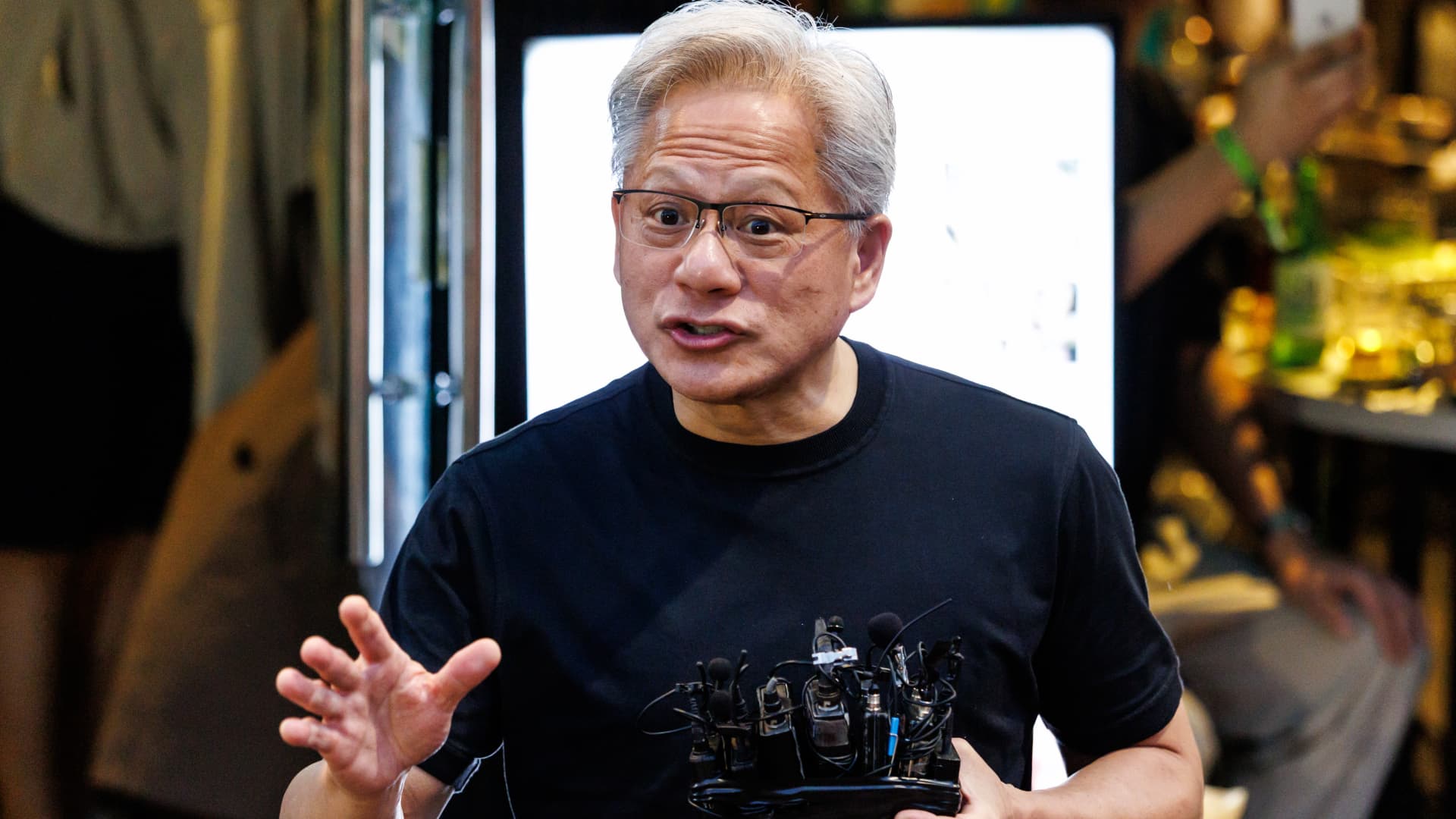
Nvidia CEO Jensen Huang speaks to members of the media outside a restaurant in the Hongdae district of Seoul, South Korea, on June 5, 2026.SeongJoon Cho | Bloomberg | Getty ImagesJensen Huang built the world’s most valuable company by pioneering the specialized computer chips behind the rise of artificial intelligence. To keep his vision of the future within reach, Nvidia’s founder is now trying a different kind of engineering: convincing Wall Street investors that those chips are long-term financial assets akin to commercial real estate or toll roads. Their bet depends on surpassing AI developments in China. This week, Nvidia unveiled agreements with six of the world’s largest asset managers: BlackRock, Blackstone, Apollo, KKR, Brookfield and Goldman Sachs. The goal was to assemble a $500 billion portfolio to finance the construction of data centers and GPU clusters for companies that lack the credit rating or cash to purchase millions of dollars of silicon directly. Key to his plan, which Huang announced during a CNBC segment flanked by the leaders of the six Wall Street firms, is a crucial assumption: that Nvidia’s graphics processing units will maintain their value over time, behaving more like traditional hard assets than rapidly depreciating consumer electronics. an investable asset, an infrastructure asset,” Huang said. “The reason for this is that it is productive, it generates income, it is fungible, it is used by almost all cloud service providers and it runs all AI models.” In standard asset-backed finance, a bank lends money because if a borrower defaults, the bank can repossess the asset (such as a building, warehouse or cargo ship) and sell it to recover its money. Those physical assets have established secondary markets and can last for decades. But the productive lifespan of cutting-edge GPUs are far from established. While new chips drive training on frontier models, after a few years they are relegated to lower-margin inference work, a shift that directly impacts their resale and collateral value. “Depreciation is the only key risk here,” said Ben Emons, founder of FedWatch Advisors, who structured similar asset-backed loans for IndyMac before joining Pimco as a portfolio manager. Nvidia chips “could. depreciate faster than expected,” he said. High yield rates? In particular, Emons said he believes the biggest threat to Nvidia’s financing model comes from China, which is rapidly increasing domestic computing capacity and could choose to flood the market with low-cost silicon in a price war. If Chinese production pushes hardware prices into free fall, the collateral backing hundreds of billions in private loans could erode much faster than the terms of the debt itself, leaving investors exposed to losses, according to Emons. To at least partially offset that risk, Emons estimates that investors will treat GPUs like high-depreciation equipment rather than real estate, demanding high-yield yields in the range of 11% to 17% depending on where they are in the capital structure. On top of that, borrowers are likely to be non-investment grade companies excluded from traditional debt markets, including AI startups and neoclouds. according to a note from Bank of America Securities. If those riskier borrowers fail, Wall Street fund managers will be forced to salvage and resell used chips in a potentially falling market. Whatever risks China poses, they won’t become reality any time soon. Huawei, the dominant supplier of Chinese AI chips, has been on the US Commerce Department’s Entity List since 2019. And in May, the US government said Ascend AI chips. of Huawei violate US export controls, preventing any US company from using them. Meanwhile, Nvidia remains by far the largest supplier of AI chips in the US, with more than 75% market share by most estimates. And for now, the economics continue to move in Huang’s favor. Driven by shortages as hyperscalers compete to build capacity, leasing rates for Nvidia’s H100 chips rose from approx. Crucially, Nvidia argues that its CUDA software layer, which allows developers to run AI workloads on their GPUs, continually improves hardware performance after deployment, allowing older chips to remain productive and generate performance longer than traditional accounting models predict. of billions of dollars in investor money may depend on who is right. CNBC’s Ari Levy contributed to this report Choose CNBC as your preferred source on Google and never miss a moment from the most trusted name in business news.