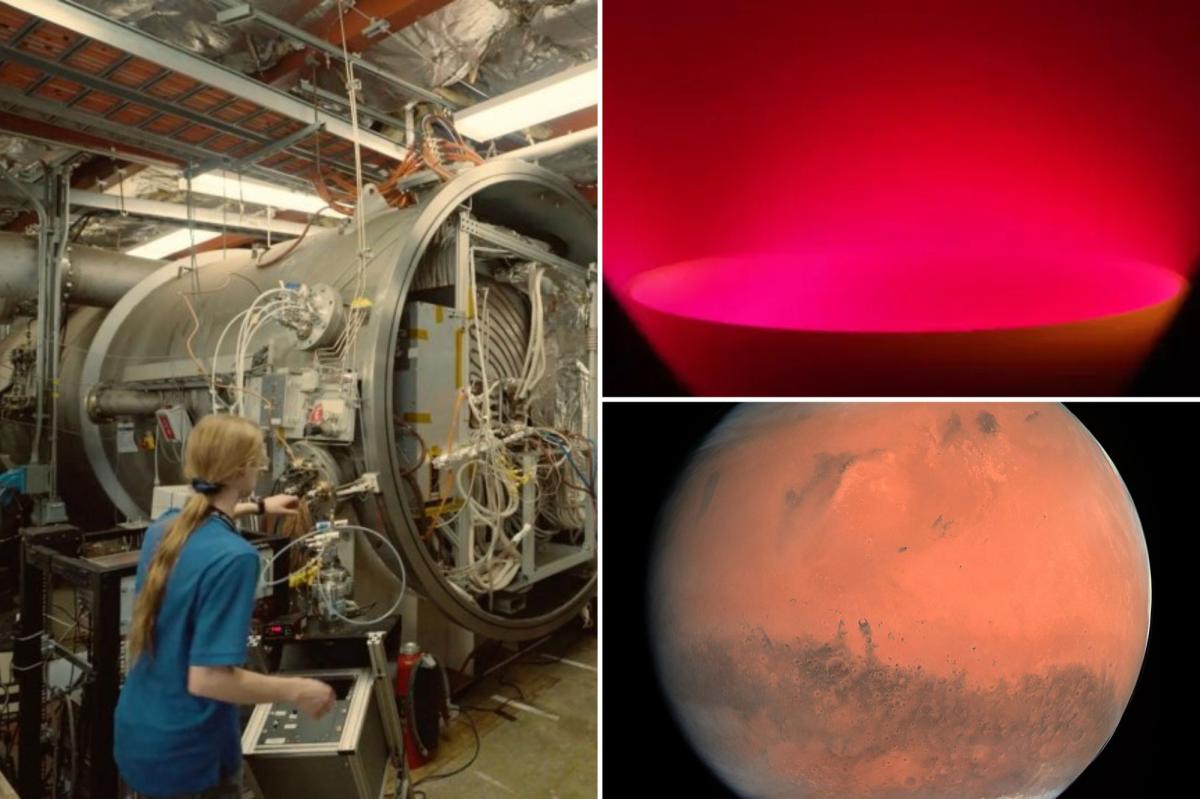
Space scientists say they have reduced travel time to Mars. NASA’s Marshall said Monday that the agency recently completed testing of a lithium-powered electromagnetic thruster, achieving more than five times the power of existing electric propulsion systems. Combined with a nuclear power source, the new technology could significantly shorten the time it takes to reach the Red Planet, potentially shaving months off the trip. Current rockets are estimated to achieve a round-trip travel time of around nine months to Mars. JPL Senior Research Scientist James Polk observes the Condensable Metal Propellant Vacuum (CoMeT) facility at JPL’s Electric Propulsion Laboratory on Tuesday, August 11, 2026. NASA/JPL-Caltech/SWNS However, an expected long stay on Mars of around 18 months would make the mission last up to three years. The new thrusters could reduce travel time to the Red Planet to three months and make the round-trip mission take about two years in total. NASA’s Marshall said Monday that the technology was “powering the next giant leap to Mars” and, by using a nuclear power source, “this technology could reduce the travel time of manned missions to the Red Planet.” New high-power electric drive technology could significantly shorten travel time to Mars. NASA/JPL-Caltech / SWNS The technology, which could also propel robotic spacecraft throughout the solar system, was put to the test at NASA’s Jet Propulsion Laboratory in Southern California. The electromagnetic thruster powered by lithium metal vapor was tested at power levels that exceeded any previous test conducted in the United States. During the test, the team achieved power levels of up to 120 kilowatts, more than 25 times the power of the thrusters on Psyche, which currently operates the highest-powered electric thrusters of any NASA spacecraft. A prototype of a powerful new lithium-powered electric thruster is tested at NASA’s Jet Propulsion Laboratory on Tuesday, August 11, 2026. NASA/JPL-Caltech / SWNS In the vacuum of space, the force provided by Psyche’s thrusters eventually accelerates the spacecraft to 124,000 mph. During five firings, the tungsten electrode in the center of the propellant glowed bright white, reaching more than 5,000 degrees Fahrenheit (2,800 degrees Celsius). NASA Marshall said: “This prototype achieved power levels higher than the highest-powered electric boosters on any of the agency’s current spacecraft. Current rockets are estimated to achieve a travel time of around nine months each way to Mars and back. ESA/MPS et al. / SWNS The new boosters could reduce travel time to the Red Planet to three months and make the round-trip mission about two years in total. NASA/JPL-Caltech / SWNS “The Valuable data from the first burn of this booster will help inform an upcoming series of tests.” NASA Administrator Jared Isaacman said, “At NASA, we work on many things at once and we haven’t lost sight of Mars. The successful performance of our booster in this test demonstrates real progress toward sending an American astronaut to set foot on the Red Planet. “This is the first time in the United States that an electric propulsion system operates at such high power levels, reaching up to 120 kilowatts. We will continue to make strategic investments that will drive that next big leap.”