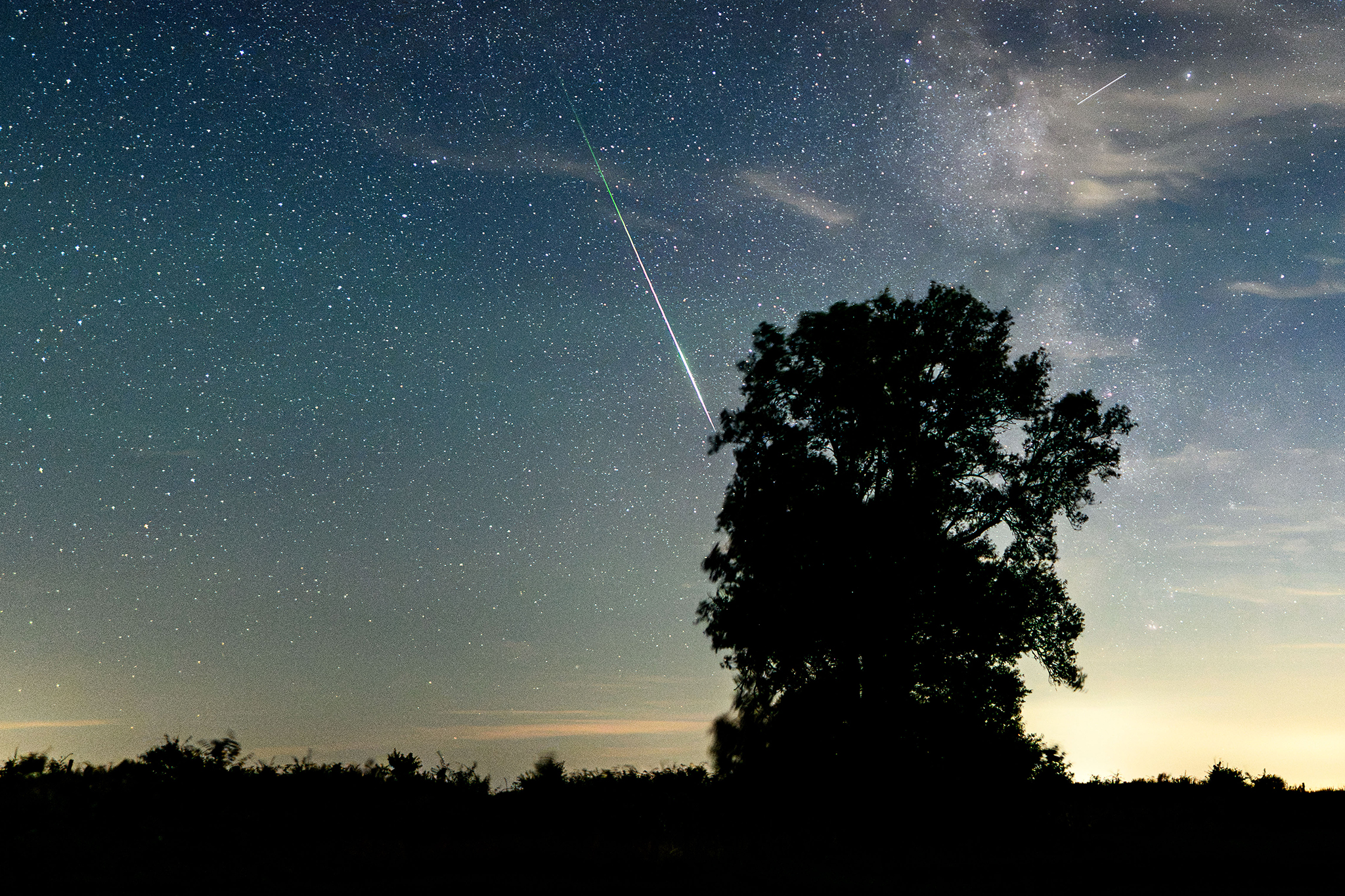
By chance, Wednesday’s new moon leaves California skies completely dark, setting the stage for one of the best sky shows of the year. If the weather cooperates, astronomers recommend staying up all night: The Perseid meteor shower peaks this week from the evening of Wednesday, August 12 to the early morning of Thursday, August 13. The annual phenomenon originates from comet 109P/Swift-Tuttle and can produce not only 50 to 100 streaks of light in the sky per hour, but also “fireballs,” or exceptionally bright meteors. “What’s happening is that the Earth is crossing the path of a very ancient comet that, over the course of its life, has left this trail of little fragments of ice and dust in the sky,” Bruce Macintosh, director of the University of California Observatories and professor of astronomy and astrophysics at UC Santa Cruz, told SFGATE. “As the Earth crosses that path, some of them hit the atmosphere and burn up… It’s everyone’s best chance to see small meteors, big meteors and fireballs streaking across the sky.” It is best to lie down with a full look at the sky, and binoculars and telescopes are unnecessary. NASA recommends giving your eyes 30 minutes to adjust. “One of the nice things about these big meteor showers is that they don’t have to be incredibly dark: going a little way into the hills or a park a little away from the city lights is more than enough,” Macintosh said. “But you have to be patient and just look up at the sky.” Patience will be key, especially if you live in the Bay Area, which is forecast to be locked in a pattern of clouds and fog this week from the evenings into the mornings, according to Matt Mehle, a meteorologist with the National Weather Service’s San Francisco office. “What also complicates things is that we also have a weak disturbance sliding up the central coast south of San Francisco,” he told SFGATE. “Usually the rule of thumb is inland or up in elevation. But we’re still going to have to deal with some mid- and upper-level clouds flowing overhead, so midweek meteor viewing will still be difficult.” In the Sierra Nevada, the forecast calls for 50% to 60% sky coverage Wednesday night, according to Reno meteorologist Chris Johnston. But smoke from active wildfires could pose another barrier. On Wednesday night, there are several viewing parties throughout the Bay Area, including the Chabot Space & Science Center in Oakland, the Lawrence Hall of Science in Berkeley, the Robert Ferguson Observatory in Napa County, and Sugarloaf Ridge State Park in Sonoma County. In the case of the fog in Oakland, “we actually have the ability to simulate a meteor shower in our planetarium,” Gerald McKeegan, associate astronomer at Chabot Space & Science Center, told SFGATE. Additionally, NASA will stream the meteor shower starting Wednesday at 9 p.m. Pacific Time on YouTube.