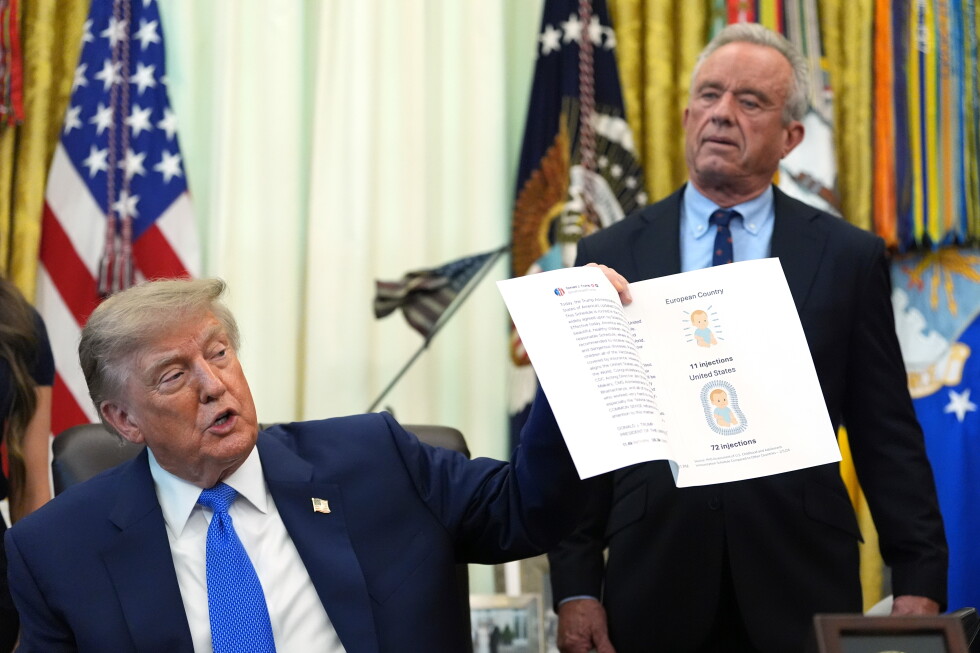
WASHINGTON (AP) — President Donald Trump on Monday signed an executive order calling for renewed recommendations on childhood vaccines that promote his long-standing but debunked theory that childhood vaccines should be spaced out over separate doctor visits. The order advocates separating the measles, mumps, and rubella (MMR) vaccine into three different shots for a single disease and administering all childhood vaccines at separate appointments whenever possible. It also directs the country’s health department to improve research on vaccines, which are already widely studied, and present a plan to offer separate measles, mumps and rubella vaccines for children, since that is not currently an option in the United States. The renewed focus on vaccines marks a shift away from recent efforts by the Trump administration to emphasize less controversial health policies related to healthy eating, drug price negotiations and crackdowns on medical fraud ahead of November’s midterm elections. Public health experts have expressed concern that spacing out shots, as Trump suggests, could lead to a higher risk of children becoming infected with a vaccine-preventable disease before returning for another visit. Childhood vaccines (and how and when to give them in combination) go through rigorous studies, and safety monitoring continues for years as the shots are used. Trump called the announcement a “major victory for parental rights, religious and constitutional rights, and for science as the gold standard.” Speaking about the order in the Oval Office on Monday, Trump repeatedly suggested that the number or timing of vaccines could play a role in rising rates of autism spectrum disorder, even as scientific consensus and decades of studies have firmly concluded there is no link. The order also includes several changes to the childhood vaccination schedule that his health department already attempted, but which have been blocked by a federal judge. A White House official who insisted on anonymity to brief reporters said Trump was within his rights to provide his own recommendation through the executive order and said the lawsuit blocking the health department’s timeline was a separate issue. Dr. Andrew Racine, president of the American Academy of Pediatrics, said the announcement sows uncertainty, fear and confusion where “there need be none of that.” He disputed Trump’s recommendations and said the previous ones should stand. “The science on vaccines and their effectiveness has not changed,” he said. “The distribution of viruses and other pathogens in our environment has not changed. Children in this country have not changed in the last 48 hours.” Bill Cassidy, Republican chairman of the Senate health committee, criticized the executive order in a social media post, saying the vaccines are safe and do not cause autism. “I am a doctor. This executive order is wrong,” the Louisiana senator wrote. “The president does not have the experience to make these changes.” Who is in charge of vaccine policy? Even when the order requires revised vaccine recommendations, states, not the federal government, have the authority to require vaccines for schoolchildren. The order advises states with school vaccination mandates to consider updating their laws to reflect the administration’s preferred schedule, according to a White House fact sheet. Last December, Trump directed the Department of Health and Human Services to review how peer countries approach vaccine recommendations and consider revising US guidelines accordingly. The department responded by reducing the number of vaccines it recommends for each child, a move that has since been blocked in court. Changes to federal childhood vaccine recommendations typically require approval from the director of the Centers for Disease Control and Prevention. Dr. Erica Schwartz, the CDC director recently confirmed by the Senate, oversaw policies promoting vaccination of service members while she held a leadership position in the US Coast Guard. However, public health law expert Lawrence Gostin of Georgetown University said the Supreme Court’s interpretation of Trump’s power may allow her to replace Schwartz if she does not accept new recommendations. “This is clearly the first test for Dr. Erica Schwartz,” Gostin said in an email. “The president is putting her in an untenable position.” When asked on a call with reporters why the president was advocating splitting MMR into three vaccines for a single disease, the White House official did not provide any studies to support the decision. They said that was Trump’s long-held view and that some countries provide individual measles vaccines in certain circumstances. Kush Desai, a spokesman for Trump, told The Associated Press that the president is “one of countless parents who have raised questions and concerns about the combined MMR vaccine” and said the plan to develop vaccines for a single disease “would give parents more options about timing and frequency for their children,” ultimately increasing vaccine acceptance. Studies of infants and toddlers in the US have shown that the use of combination childhood vaccine injections, rather than single doses, increased the likelihood of completing all recommended vaccinations by age 2 years. The announcement follows other vaccine actions by the Trump administration. Health Secretary Robert F. Kennedy Jr., an anti-vaccine activist before entering politics, set out to overhaul immunization guidelines at DHS in the first year of Trump’s term. He fired an entire 17-member vaccine advisory committee and installed replacements who made much more restrictive recommendations that have since been put on hold by a federal judge. He also personally ordered the CDC to abandon its position that vaccines do not cause autism, without providing any new evidence to support the change. Throughout his second term, Trump has been obsessed with connecting autism to vaccines. Pressure has recently increased on Kennedy to identify the cause of autism, something Kennedy had promised to do with new research revealed last year. Trump publicly pressed the Health Secretary for an update on autism research at a Cabinet meeting last month. “How are you doing with autism research?” Trump asked. “We will have an answer for you,” Kennedy said. Scientific consensus and decades of studies have firmly concluded that there is no link between childhood vaccines and autism. Racine reiterated that point on Monday, noting that the potential link had been studied in “more than 40 methodologically well-designed studies in more than seven countries involving more than 5 million children.” “I’m not sure anything has been looked at as thoroughly as this issue,” he said. “And the answer is emphatically no.” In the Oval Office, Kennedy repeated his claim that he believes an unknown environmental factor is to blame for the rise in autism diagnoses and said his department will deliver research results “as soon as they are ready.” Doctors have expressed concern that Trump’s falsehoods about vaccines could fuel vaccine hesitancy. Federal data show vaccination rates in U.S. kindergartens have been declining, and the share of children with exemptions rose to an all-time high in the 2024-25 school year.___Associated Press writers Laura Ungar and Mike Stobbe contributed to this report. Swenson reported from New York.