Earth’s metallic core contains almost all of the planet’s gold, including enough, by one widely cited calculation, to spread a layer about 50 centimetres deep across every continent. None of that makes the core a mine. It begins roughly 2,900 kilometres down.
What changed in 2025 was not the accessibility of that gold, but the idea that the core and mantle are completely chemically isolated. A team led by University of Göttingen geochemist Nils Messling measured a ruthenium isotope signal in Hawaiian volcanic rocks that points to material from the core entering the mantle and eventually being carried towards the surface.
This is one study, not settled consensus about every pathway between Earth’s core and mantle. It also did not detect a stream of gold rising through a volcano. The direct measurement concerned ruthenium, a precious metal whose isotopes can reveal where the material came from.
The measurement was ruthenium, not gold
The study, published in Nature, examined extremely small variations in ruthenium and tungsten isotopes in rocks associated with mantle plumes. Its samples included basalts, picrites and related rocks from Hawaii, as well as material linked to Iceland, Réunion and the Galápagos.
Ruthenium is strongly attracted to metal. When dense iron sank to form the core, almost all of Earth’s original ruthenium followed it. The modest amount now in the mantle is generally attributed to meteorites that arrived later.
Those two reservoirs should carry slightly different isotope signatures. The core reflects material incorporated throughout Earth’s main growth, while the mantle’s ruthenium is dominated by the later addition. Messling’s team developed procedures precise enough to resolve a difference measured in only a few parts per million.
The Hawaiian samples contained a small but measurable excess of ruthenium-100 compared with the upper mantle. Together with their tungsten patterns, this made the core the most viable source.
Why Hawaii can carry a signal from 2,900 kilometres down
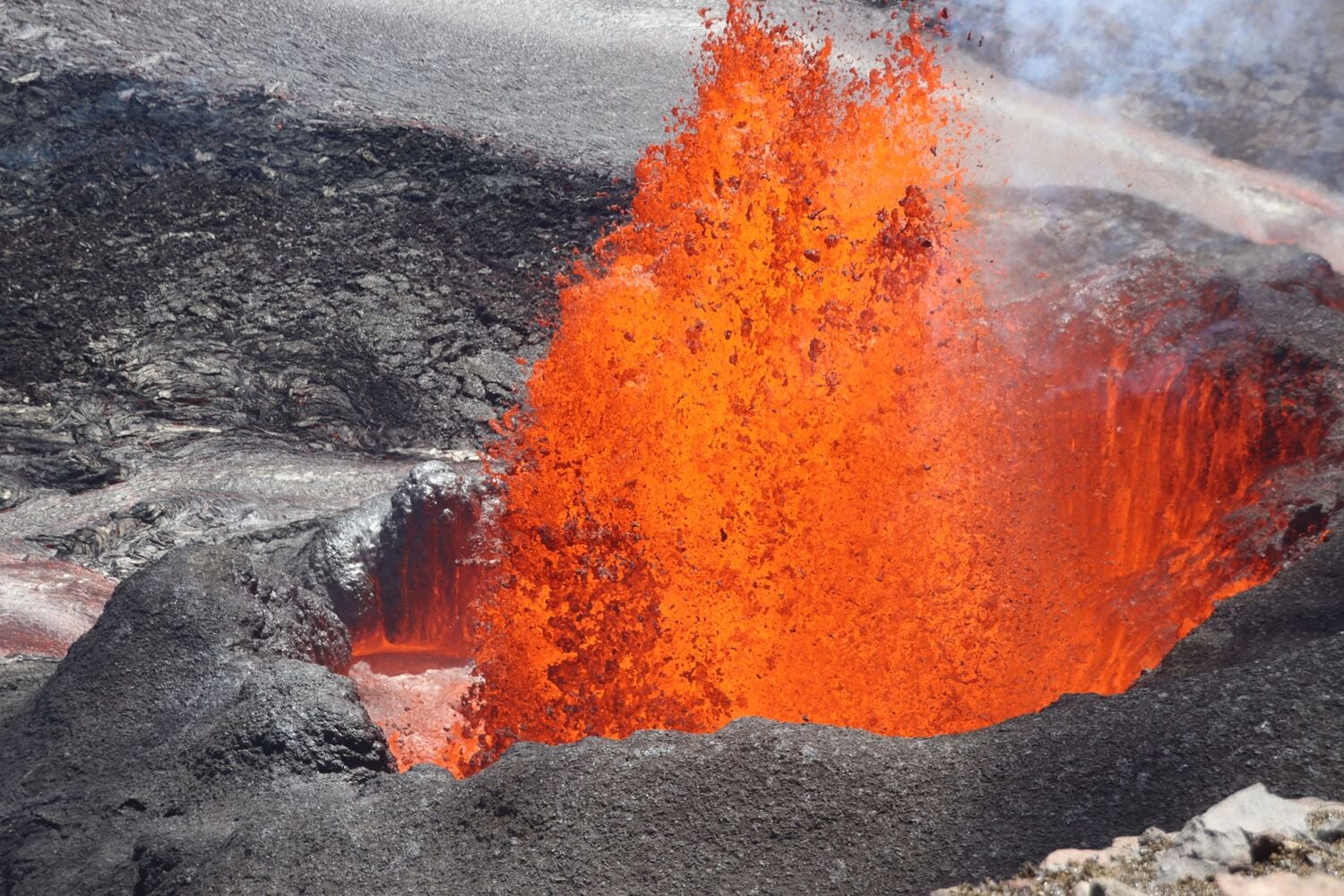
Hawaii sits above a volcanic hotspot rather than a tectonic plate boundary. Unusually hot rock rises through the mantle in a plume, partially melts at shallower depths, and supplies its volcanoes.
Some plume models place the roots of that circulation close to the boundary between the rocky mantle and the liquid outer core. Space Daily has previously reported on seismic imaging of an iron-rich, ultra-low-velocity zone beneath Hawaii. Even then, core leakage was one possible explanation for the region’s unusual composition.
The new isotope work adds a chemical tracer to that picture. It suggests that a small amount of material crossed the core-mantle boundary, became incorporated into the deep source of the Hawaiian plume, and travelled upward with immense volumes of slowly moving rock.
“Leaking” is useful shorthand, but it can give the wrong visual impression. There is no known crack carrying molten core metal directly to Kilauea. The proposed exchange occurs at extreme pressure and temperature, then the signal is heavily diluted on its way upwards.
The 50-centimetre figure comes from an older calculation
The estimate in the title predates the 2025 study. In 2006, Macquarie University geologist Bernard Wood said calculations based on experimental work on early Earth chemistry implied there was enough gold in the core to cover the planet’s land surface to a depth of half a metre.
Gold is siderophile, meaning it readily partitions into iron-rich metal. When young Earth was hot enough for metal and silicate to separate, gold overwhelmingly moved into the core. More than 99.999 per cent of Earth’s gold and other precious metals is now thought to lie below the mantle, according to the University of Göttingen’s account of the 2025 work.
That older global estimate and the newer isotope measurement support different claims. One addresses how much gold is probably stored in the core. The other provides evidence that some core-derived material has crossed into the mantle. Combining them does not mean a meaningful fraction of that hidden reserve is moving towards us.
The core was not assumed to be perfectly sealed by everyone
The 2025 result strengthened a case that geochemists had been assembling for decades. Unusual osmium, tungsten and helium isotope ratios in some ocean-island basalts had already been interpreted as possible signs of interaction between the core and mantle. Alternative explanations remained available, including isolated reservoirs of ancient silicate material or remnants delivered by early impacts.
Ruthenium offers a cleaner test because its early removal into the core was so thorough. The combined positive ruthenium-100 and negative tungsten-182 signals in the Hawaiian rocks are difficult to reproduce with the competing models considered in the paper. The authors describe the core as the most viable source, while still discussing those alternatives rather than treating them as impossible.
There are limits. The clearest ruthenium anomaly appeared in the Hawaiian group. Samples linked with the Réunion and Galápagos plumes were not distinguishable from the modern upper mantle, and the Baffin Island average was also unresolved. The study establishes neither a uniform global leak nor its rate through geological time.
What the finding changes
The practical consequence is not a new source of precious metals. Any core contribution reaching erupted rock is minute, diluted and mixed with several reservoirs. Hawaiian lava does not become economically useful because some atoms began far below the mantle.
Geologists cannot sample the core, so they reconstruct its history using seismic waves, high-pressure experiments, meteorites and chemical traces. If ruthenium isotopes can identify material that crossed the core-mantle boundary, volcanic rocks become indirect samples of an inaccessible interface.
The next test is repetition. More high-precision measurements from Hawaii and other ocean-island basalts should show whether the signal follows the tungsten and helium patterns already associated with deep plumes, and whether different hotspots preserve distinct records of exchange.
For now, the conclusion is narrower than the image of a golden core leaking towards the surface. The Hawaiian rocks contain a measurable isotope signature best explained by core material entering the mantle. That is enough to show that Earth’s deepest chemical boundary is permeable, even if only slightly.
Related: There’s a specific kind of tiredness that belongs to people who spent their entire twenties building a life they thought they wanted, only to reach their thirties and realize they were building someone else’s definition of success