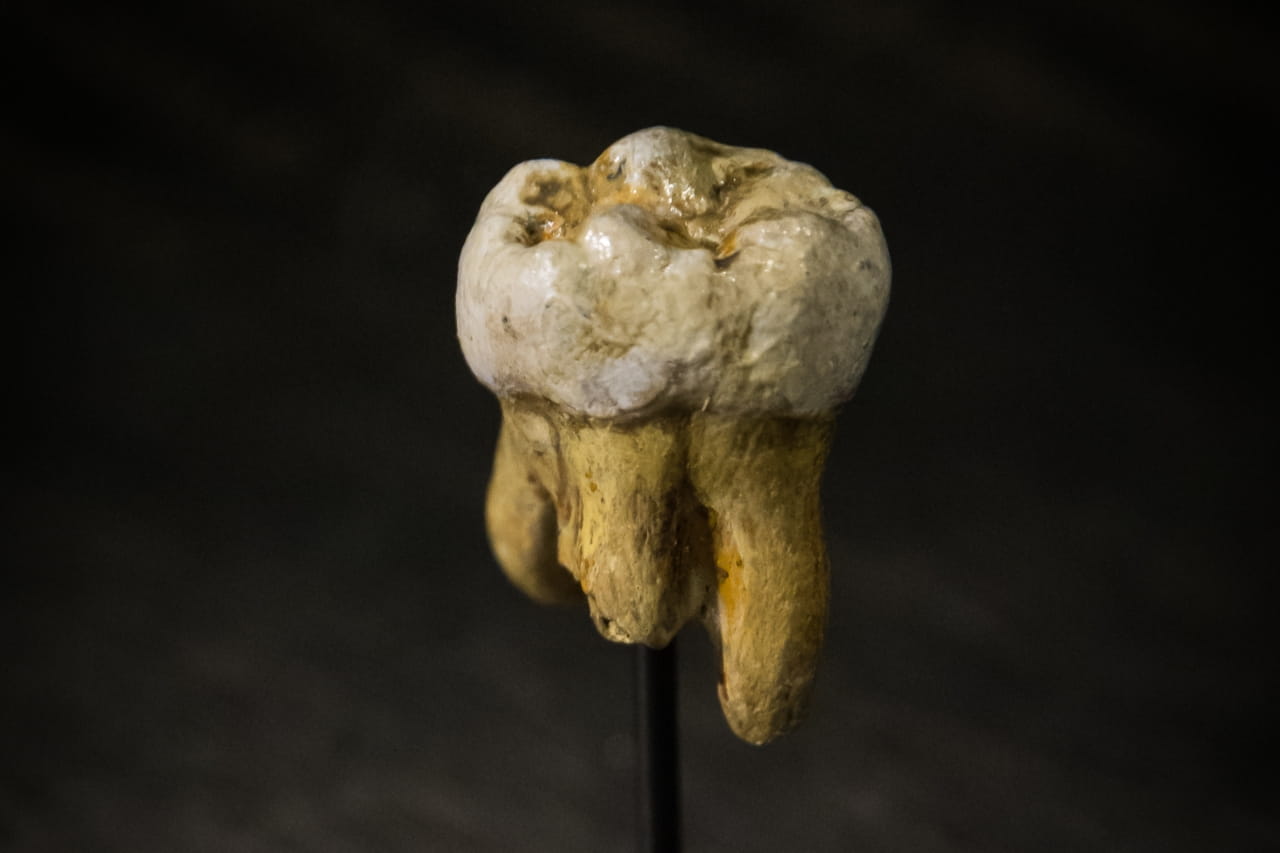
Four teeth from two caves in Guangxi, southern China, tell two different stories about who lived in the region more than 40,000 years ago. Song The other doesn’t fit into any known group. Replica of a Denisova male molar, the original of which was found in the Denisova cave. Credit: Thilo Parg, CC BY-SA 3.0 Denisovans are an extinct branch of humans that were first found in Siberia. Fossils and proteins from Harbin, Taiwan, Tibet, and southwestern China have led many experts to label most East Asian fossils from this period as Denisovan. Almost none came from the hot, humid south, where DNA breaks down quickly. Tooth enamel retains proteins much longer, which is why the team read them. Chuanshandong Cave in Long’an County revealed two lower premolars that likely came from a single person. Dating the left tooth with uranium series gave a minimum age of 100,800 years. The dirt around the teeth turned out to be much more recent, between 49,500 and 34,200 years old. The authors believe that the water slowly moved the teeth into the cave, so burial occurred long after death. Longchuandong Cave in Luzhai County produced an upper molar dating back 42,600 years and a lower premolar dating back 104,500 years. Neither cave contained stone tools. Both contained mainly loose teeth and animal bones. Hominid teeth from Longchuandong (Luzhai) and Chuanshandong (Long’an) and the virtual reconstruction of the enamel-dentin junction. Credit: S. Xing et al., Nature (2026), CC BY-NC-ND 4.0 Longchuandong teeth match Denisovans. Both carry a protein variant called AMBN 273V, which is also found in Denisovans from Harbin, Penghu, Bianfu Cave and the Altai Mountains. The molar looks more like Denisova 4 from Altai than any other tooth in the comparison set. A family tree built from proteins placed both teeth next to the Denisova 3 individual with 100 percent support. Chuanshandong looks different. Its enamel bore AMELY 179M, an ancient variant shared with Homo antecessor and the great apes. It also carried AMBN 253G, a variant seen in Homo erectus from Zhoukoudian, Hexian and Sunjiadong. No Denisovans, Neanderthals or modern humans in the study have that. The tooth is also missing from the Denisovan 273V variant. The shape of the teeth fits the mix. The short crowns and complex roots look like erectus. Crowns that are less twisted resemble later humans. The family tree places this person as the sister of the common ancestor of Neanderthals, Denisovans and modern humans. The team calls the person an unresolved archaic Homo. An ancient lineage could have survived in a refuge, or could have mixed with other archaic groups or picked up genes from erectus. Adding the new findings to previous work, Denisovans now range from Siberia through northern China, Tibet and the Taiwan Strait to southern China and Laos. The Longchuandong molar also resembles Neanderthal molars, although no Neanderthals are known from those regions. The authors say that the shape of the molar poorly separates the two groups, while the shape of the premolar distinguishes them. A skull from Maba, in nearby Guangdong province, has been linked to a group related to Neanderthals. This places at least three types of archaic humans in southern China. The evidence is scarce. Three teeth provided protein data, all from males, and only about 15 percent of each protein sequence returned. The authors consider the pedigree results to be preliminary. They want ancient DNA and more fossils from the region to test the idea. Publication: Xing, S., Rao, H., Xie, G., Bai, F., Ge, J., Bennett, EA,… Fu, Q. (2026). Middle-late Pleistocene Denisovans and unresolved Homo in southern China. Nature. doi:10.1038/s41586-026-11341-6