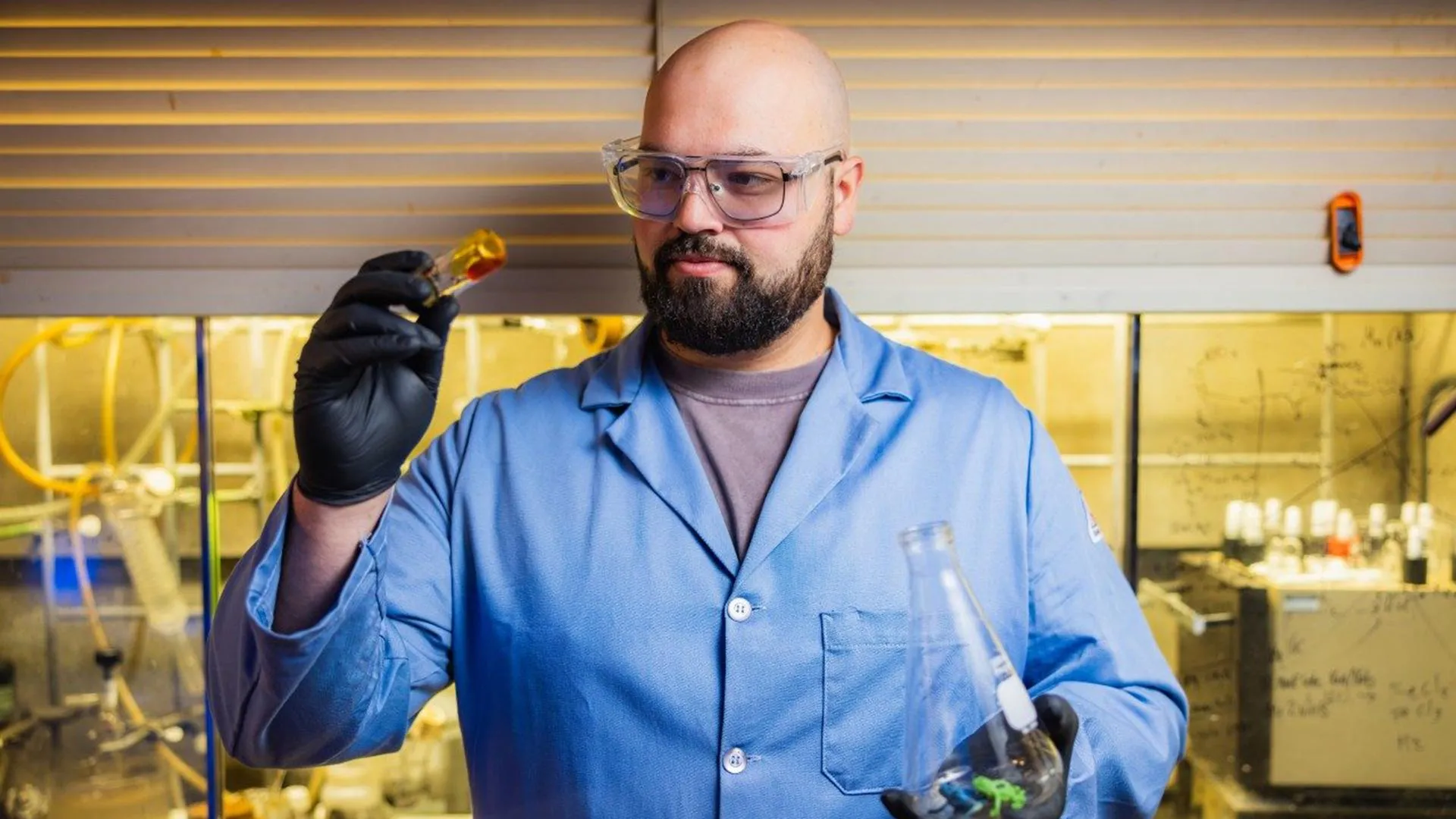
Old pipes, discarded window frames, and expired credit cards could one day become valuable motor oil ingredients. Virginia Tech researchers have developed a new chemical process that transforms one of the world’s most difficult to recycle plastics into a high-performance lubricant material. Led by chemist and chemical engineer Guoliang “Greg” Liu, the research team discovered how to convert polyvinyl chloride (PVC) into polyalphaolefin, a key ingredient in synthetic lubricants such as motor oil. Published in the journal Nature, the research offers a potential solution to two environmental challenges: reducing the accumulation of stubborn plastic waste and finding more sustainable ways to make valuable industrial lubricants. PVC is particularly difficult to recycle due to its chlorine content and the wide range of chemical additives that manufacturers incorporate into their products. These additives can give PVC different properties, such as flexibility, rigidity and heat resistance. However, they also complicate conventional recycling methods. Consequently, much of the world’s discarded PVC ends up in landfills. Turning waste plastics into high-performance lubricants Meanwhile, global demand for lubricants continues to grow and the production of these materials can carry significant environmental costs. Transforming discarded PVC into a valuable lubricant ingredient could help address both problems. Although lubricants rarely get much attention, they are essential for modern machinery. They reduce friction and wear between moving components, helping engines run efficiently and extending the life of mechanical equipment. Everything from lawnmowers and passenger vehicles to jet engines depend on reliable lubricants. The Virginia Tech team’s process could provide an alternative source of these important materials while also helping to address the growing problem of plastic pollution. To make the lubricant, researchers place PVC of the type commonly used in home plumbing, window frames and credit cards in a solvent. They then introduce aluminum trichloride and alpha-olefins, a class of hydrocarbons used in the manufacture of synthetic lubricants. The mixture is heated to 158 degrees Fahrenheit for three hours, after which the researchers extract a relatively thick lubricating oil. The resulting polyalphaolefin belongs to a family of synthetic base oils valued for their stability, lubricating properties and ability to operate over a wide range of temperatures. These materials are commonly used as a base for high-performance synthetic motor oils. “First, we have shown that it is feasible to use plastic waste to make high-performance lubricants. Second, these lubricants are environmentally friendly and can meet the market’s emerging sustainability needs,” Liu said. Building on previous advances in plastic recycling The discovery emerged from previous research by Liu’s lab, published in Science and Nature Sustainability. In those studies, researchers demonstrated how other types of plastic waste could be transformed into surfactants, substances that help water interact with oils and fats and are widely used in soaps and detergents. Encouraged by those successes, the researchers decided to tackle the more challenging problem of PVC waste. “We want to help improve PVC recycling and recycling,” Liu said. Unlike conventional recycling, which normally aims to recover materials for reuse, upcycling seeks to transform discarded materials into products with greater value or utility. Liu recruited a group of graduate researchers to investigate this possibility. Eric Munyaneza Nuwayo, who was completing the final year of his PhD programme, was selected to lead the project. Connor S. Thompson, a chemistry graduate student who had been researching a different topic, joined the effort after Liu suggested changing direction. Abby Civiello, a first-year graduate student, also joined the team and quickly became a major contributor to the research. “I often called them the three musketeers,” Liu said. An unexpected discovery in polymer chemistry Researchers initially experimented with ways to modify the molecular structure of PVC and convert it into more useful substances. Like other plastics, PVC is a polymer, meaning it is made up of long molecular chains made up of repeating chemical units. Initially, researchers hoped that changing the chemical groups attached to these chains would produce a material with desirable properties. “The idea was simple. PVC, as one of the most activated forms of polyethylene, should be easily converted into other molecules by replacing chlorine atoms with other groups,” Liu said. However, early experiments consistently produced disappointing results. Instead of creating a functional material with the desired performance characteristics, the team ended up with soft, sticky substances that had little practical value. Those frustrating results ultimately inspired Liu to approach the problem differently. Instead of continuing to modify the long molecular chains, he wondered if breaking them into smaller pieces could produce something more useful. “One day it hit me: If this polymer is so sticky and so soft, why don’t I just keep breaking the polymer chains into smaller segments?” Liu said. As the researchers refined their chemical process and evaluated the properties of the materials they produced, Liu began to recognize that the team had discovered something with implications that extended far beyond plastic recycling. They had found a potential new route to making valuable industrial lubricants. Bringing recycled plastic lubricants to the market To better understand the properties and commercial potential of the new oil, Liu enlisted the expertise of researchers from several institutions. He provided samples to Ali Erdemir of Texas A&M University, where researchers evaluated the performance of the finished materials. William Goddard of the California Institute of Technology (Caltech) contributed chemical calculations to help investigate the underlying chemistry. At Virginia Tech, Xi Chen examined the economics and manufacturing aspects of the technology and developed models to explore how oil could be produced on a larger scale. Research establishes that discarded PVC can serve as a starting material to produce high-performance lubricants. However, expanding the process beyond the laboratory remains an important next step. Liu hopes to further improve the environmental sustainability of the technology while making the resulting lubricants more available. Ultimately, this approach could give a valuable second life to one of the world’s most problematic plastics and provide industries with an alternative source of essential lubricant materials. “Lubricants are the silent hero out there. We often don’t recognize that they exist, but they are out there working silently. We want to be able to produce the oil on a larger scale to reach more people in the world,” Liu said.