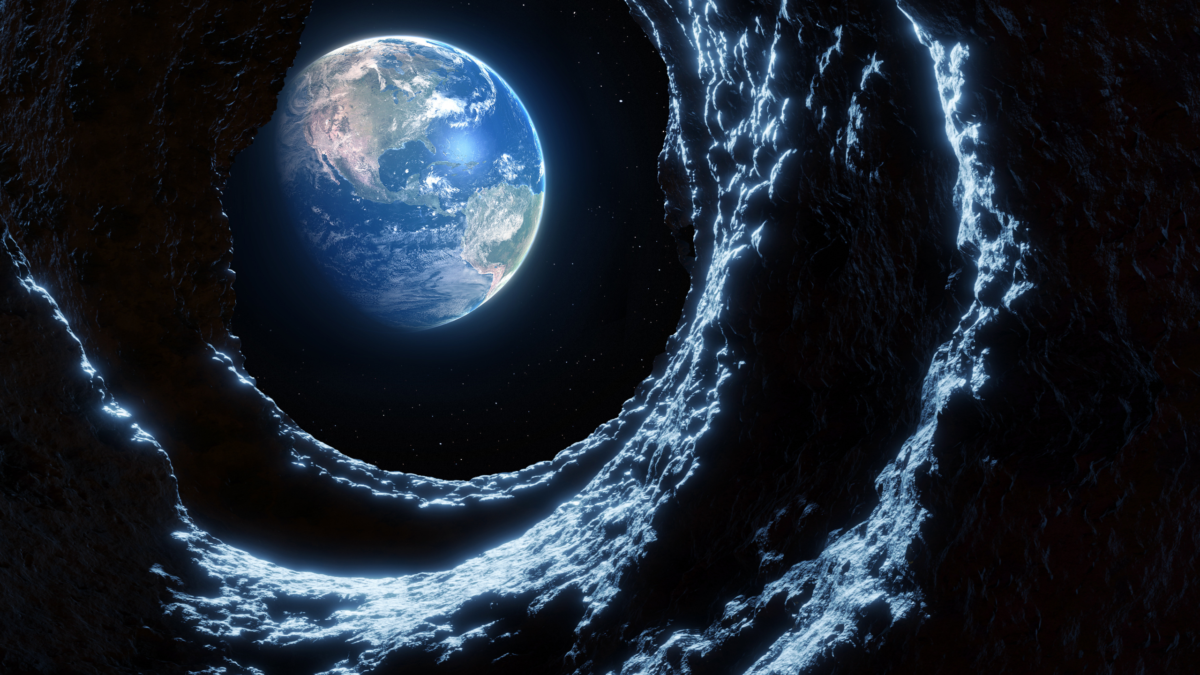
The gray, scarred face of the Moon is an image of inscrutable stoicism, but there may be much more going on beneath. Scientists have long suspected that the Moon’s volcanic past left it riddled with tunnels, carved by rivers of molten rock eons ago. Now, subtle variations in the Moon’s gravitational pull have turned up evidence of four such tunnels, each potentially more than a kilometer wide, hidden beneath just 100 meters of lunar surface. rock. These tunnels, especially those that have not collapsed, are a kind of scientific Orthrus. On the one hand, they represent an important window into the geological history of the Moon. On the other hand, they could one day become safe havens for lunar explorers, offering protection from the harsh radiation and extreme temperatures to which the Moon is prone. Suspected collapsed lava tubes on the flank of Pavonis Mons, a giant volcano on Mars. (ESA/DLR/FU Berlin/G. Neukum)Lava tubes are not a phenomenon exclusive to the Moon. They can be found right here on Earth, and are formed when the surface of a flowing lava river cools and hardens, creating an insulating roof beneath which molten rock continues to flow. As the eruption subsides and the remaining lava drains away, it may leave behind a long, hollow tunnel, topped by a volcanic stone roof. On the Moon, these structures could be much more imposing, due to different formation conditions. Weaker gravity, higher lava eruption rates and relative ease. with which lunar lava flowed could have allowed the formation of underground structures on a scale that dwarfs their terrestrial counterparts. The problem lies in finding them. At an average distance of 384,400 kilometers (238,855 miles) from Earth, spotting small details on the Moon’s rugged surface with the naked eye can be quite difficult, let alone discovering what lies beneath. However, there are clues. The lunar surface is marked by long, winding channels known as sinuous channels, some of which may be remains of collapsed lava tubes. Vallis Schröteri, the largest sinuous channel on the Moon, photographed from lunar orbit during the Apollo 15 mission in 1971. (NASA/GSFC/Arizona State University) And scattered across the lunar landscape are deep pits that could be skylights, places where a small section of the roof of a lava tube lies. has collapsed. There’s also more than one way to skin a cat, or try to figure out what’s inside the Moon. A hollow tunnel, you see, contains less mass than an equivalent volume of solid rock. This means that the Moon’s gravitational pull should be slightly weaker in the vicinity of a lava tube, a discrepancy that can be detected by spacecraft orbiting above us. Between 2011 and 2012, NASA’s twin Gravity Recovery and Interior Laboratory (GRAIL) spacecraft mapped the Moon’s gravitational field in unprecedented detail, measuring small changes in the distance between them as they flew over regions of different gravity. Using that data, studies in 2017 and 2024 identified several places where lava tubes could be hiding, with estimated widths of up to 9 kilometers. However, it didn’t take long for the kibosh to arrive; Later studies found that, in all likelihood, many of those tunnels would have been too wide to support the weight of their own roofs. A pit that could be a lava tube skylight in Mare Tranquillitatis. (NASA) So when NASA released a higher-resolution model of the Moon’s gravitational field in May 2025, geoscientists Juan Losarcos and Andrew Dombard at the University of Illinois at Chicago took another look to see if they could find something a little more structurally sound. They painstakingly mapped small dips in the gravitational field, after taking into account the topography of the Moon’s surface, comparing them with simulations of the gravitational signatures that would produce hollow tunnels of different dimensions. They compared them with observations of the lunar surface, looking for geological features that could support the presence of an underground cavity. Four candidates stood out: one in the vicinity of Vallis Schröteri, the largest sinuous crack on the Moon; one in Rima Mairán; and two near Wollaston crater. In each case, the gravitational signature was consistent with a tunnel less than 2 kilometers wide, buried beneath about 100 meters of rock, dimensions much more in line with what we now know about the structural limitations of lunar lava tubes. Maps of gravitational variations in the Vallis Schröteri region, with blue indicating weaker gravity or negative gravity gradients, and red indicating positive anomalies. (Losarcos & Dombard, Icarus, 2026) And the geological features associated with all four suggest that they may have formed in a slightly different way than the process described above. Instead of forming a roof over a vast open river of lava, they may have started out as much smaller underground channels, gradually enlarging as the molten rock flowing through them melted and wore away the surrounding material, like a giant moonworm boring a hole, rather than a moon caterpillar building a cocoon. However, at this point, the four can only be classified as candidates rather than confirmed detections. Other variations in the density of lunar rock could produce similar gravitational signatures, and researchers cannot directly measure the dimensions of the cavities using gravity data alone. Future radar observations and more detailed geological mapping could help establish whether the tunnels are really there. The researchers also note that their reliance on geological clues at the surface means that completely intact lava tubes, without telltale collapses in their roofs, could be particularly difficult to find. The results suggest that the Moon may be even better at hiding its nooks and crannies than we thought, and that there may be many more of these hidden passageways lurking underground than its surface might suggest. “These pristine tubes,” the researchers write, “could preserve important evidence of lunar volcanic and thermal evolution, even if they are less accessible for exploration.” The research has been published in Icarus. This article was fact-checked by Fiona MacDonald and edited by Fiona MacDonald. While we take pride in our process, we are human. If you spot an error, please let us know.