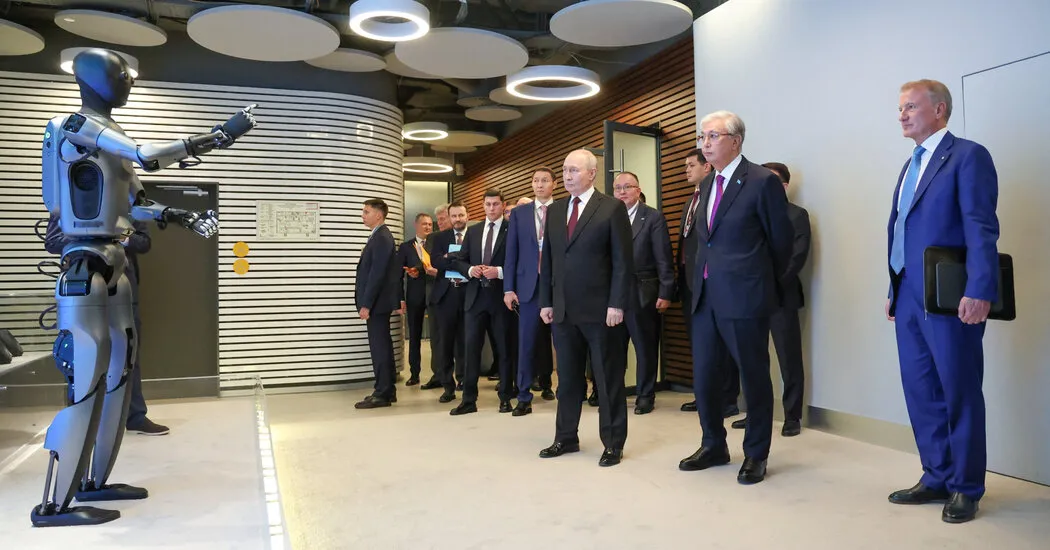
The humanoid robots swayed and jumped in perfect sync with the flesh-and-blood dancers behind them. President Vladimir V. Putin, at times wide-eyed, watched the spectacle from the audience at Russia’s most important technology conference. In this exhibition and many others at the event, called AI Journey, it was presented that the future of the country was not determined by the war in Ukraine, but by the development of artificial intelligence. Russia, Putin said in his keynote speech Thursday, wants AI adoption to cover “all spheres of the economy and people’s lives.” However, even as Russian officials turn to technology to offset a host of problems such as labor shortages, the country’s technological development has been limited. Russian AI models rely on American and Chinese hardware that has become harder to obtain and more expensive due to sanctions. Immense military spending has diverted resources. Technological talent has left Russia because of the war. Security officials monitor national AI models to make sure they comply with censorship rules. And this year, a new challenge emerged after Ukrainian drones attacked some of the country’s most powerful data centers. Still, Putin and senior technocrats remain determined to push Russia forward in AID. During the conference, German O. Gref, head of Russia’s largest bank, Sberbank, unveiled the latest model of its flagship GigaChat bot, stating that it comes close to the capabilities of leading Chinese models such as DeepSeek. The bank has integrated the model into everyday life in Russia. Some Moscow restaurants offer AI-assisted menus, and museum exhibitions use AI-powered guides to explain the works on display. The model remains censored. For example, GigaChat refuses to give concrete examples of why Putin’s opponents criticize it, saying it is a “sensitive” issue. A Russian data scientist involved in the robot’s development said security services watched closely to make sure the model met a set of vaguely defined “traditional values.” The developer spoke on condition of anonymity because he was not authorized to speak publicly. Gref has presented the bank’s model as the only genuinely domestic option, arguing that it can therefore be used in sensitive fields such as defence, according to a Russian official involved in digital infrastructure development. The official spoke on condition of anonymity to discuss internal deliberations. Even as Russia and China have grown closer in recent years, there is concern in Moscow that it is becoming too reliant on Chinese technology. In his speech, Putin said Russia was “betting on sovereign foundational models.” “We should not end up in a situation that we have already experienced, where someone presses a button for us and everything stops working completely,” he said. At the conference, Russian officials and business leaders struck an effusive tone about AI, suggesting in their speeches that the technology could help solve many pressing problems at once. Endless screens showed how AI could improve Russia’s justice system, healthcare, and even pothole repair. Officials argued that the technology could offset labor shortages caused by Russia’s demographic challenges. The country is expected to lose approximately 820,000 people due to population decline this year, according to a leading demographer. That includes some of the hundreds of thousands of soldiers who have died during nearly five years of war in Ukraine, according to recent estimates. “For Russia, as we are developing amid serious demographic challenges and a shortage of labor resources, such technologies are a real opportunity to overcome limitations and strengthen our potential,” Putin said in his speech. Although Western sanctions are an obstacle to the development of AI in Russia, the technical specifications published with the GigaChat model underlined how Russian companies had managed to acquire advanced chips. Aleksandr A. Vedyakhin, first vice president of Sberbank, declined to comment on how the company obtained the chips, saying only: “We are doing it somehow.” Still, while Russian companies can get some of the hardware they need, many of them, including state-owned ones, use American and Chinese models in their work, rather than developing their own. According to Stepan Gershuni, a Russian technology investor and entrepreneur, “it’s not just about computing power, it’s also about access to capital, access to talent and the willingness of companies to do it.” “A serious effort to create a competitor today would require investments in the single digits or tens of billions of dollars,” Gershuni said in response to written questions. “In the current economic climate, Russian companies simply don’t have that kind of money. I can’t speak for the government, although it appears they are spending their money elsewhere.” Since invading Ukraine, Russia has invested hundreds of billions of dollars in its military. In addition to financial shortfalls, the war has left Moscow struggling to protect the national technological infrastructure. This fall, Ukrainian drones attacked several data centers, including a facility being developed by Sberbank. The company’s main rival, Yandex, suffered three data centers affected and damaged. But Kremlin officials have argued that Russia has advantages in the age of AI, including its vast energy reserves and remote territory. On Tuesday, Putin approved a program to build data centers in Russia’s Kuzbass and Yakutia coal-mining regions, areas far from the front lines in Ukraine. The depleted coal pits and pits there could be used to protect the facilities from attack. Kirill A. Dmitriev, the Kremlin’s top envoy for talks with the United States, said at the conference that cheap domestic energy gave Russia “a unique global advantage as a lowest-cost energy provider for data centers around the world.” He added that Moscow could build data centers for both the United States and China. “In the current geopolitical climate, that may seem like a fantasy,” Dmitriev said. But within a few years, he added, “countries will realize that managing complex AI systems requires capabilities that Russia can provide and that others simply cannot.” Oleg Matsnev contributed reporting.