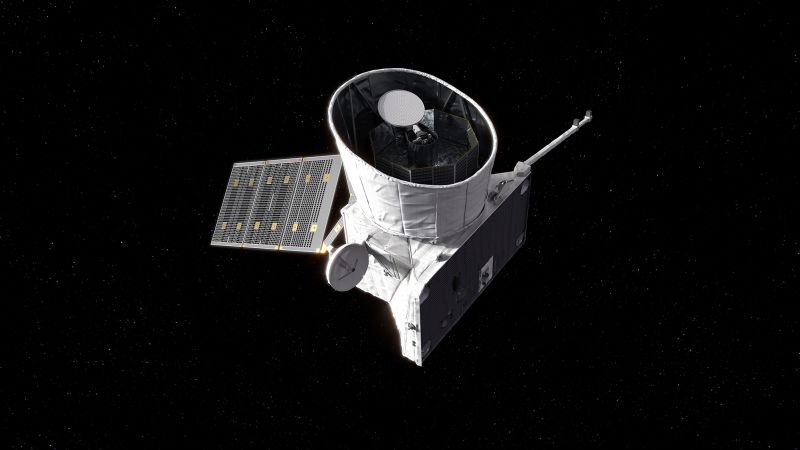
The harrowing arrival of a $2 billion spacecraft at Mercury last week had engineers anxiously searching for answers, and their problems may not be over. BepiColombo, a joint effort between the European Space Agency and the Japan Aerospace Exploration Agency, was heading toward its destination on November 21 after an eight-year journey, ready for the delicate task of securing a durable orbit around Mercury. It is only the third mission to visit the innermost planet in the solar system. Just 395 miles (635 kilometers) above the planet’s surface, the spacecraft entered a scheduled communications blackout as it pointed its thrusters in the right direction for orbit and moved its antenna away from Earth. Tension rose at ESA’s operations center in Darmstadt, Germany, as the spacecraft approached the end of its planned 37-minute booster run. But the burn ended prematurely, after just 28 minutes. “The first indication that things were not going as planned was the fact that we received the signal earlier than expected; that meant something was not right,” said Ignacio Tanco, head of ESA’s Inner Solar System Mission Operations. “That was really like flipping a switch. You could see the whole room immediately go into contingency mode; we needed to figure out what was happening.” After four hours of data analysis, the team was finally able to confirm that the partial burn put BepiColombo in Mercury’s orbit, although not in the predicted orbit. The probe was supposed to orbit Mercury every 58 hours, but instead entered a 75-hour orbit. At its highest point, BepiColombo will be about 10,000 kilometers (6,200 miles) higher than expected above Mercury, which Tanco calls “inconvenient, but not terrible.” At a news conference Friday in London, ESA acknowledged that the new orbit leaves less room for new problems, although the spacecraft will perform as expected. “In the end we were pretty lucky, because it could have been a lot worse,” Tanco said previously. “We still managed to achieve virtually all orbital parameters.” Even so, BepiColombo has a significant obstacle ahead. Its two orbiters, ESA’s Mercury Planetary Orbiter and JAXA’s Mercury Magnetospheric Orbiter, will have to separate from each other to begin their respective scientific missions. That maneuver is scheduled for December 9, but recent problems have made it more complicated and forced engineers to make some changes. “There is a price to pay,” Tanco said. “We will have to correct.” In those tense moments following the abbreviated booster burn, engineers discovered that BepiColombo had achieved only 77% of the planned change in speed needed to reach orbit. An unexpected interruption in the maneuver put the probe into safe mode, which protects the spacecraft by stopping all non-essential activities. There was immediate concern, Tanco said. “The spacecraft was clearly safe, but the maneuver had not been completed,” he said. “Were we in orbit around Mercury or had we just flown by?” If the probe had not managed to slow down enough to enter Mercury’s orbit, it would have overshot its target and continued its orbit around the sun. Mission control would still have had the opportunity to recover the spacecraft and attempt orbit insertion again, Tanco said, but at great cost. The amount of fuel spent returning to Mercury would have made it difficult to achieve a good enough orbit to collect scientific data. “We absolutely did not want to end up in that scenario,” he added. The failure was due to an unlikely timing mismatch between the spacecraft’s guidance software and its thruster controls, triggering an abnormally loud command that interrupted the planned 37-minute burn. This issue was among a variety of simulated scenarios that could present potential challenges, although the mission team did not use it in training before the orbit insertion attempt. Only later did the ESA calculate a 1 in 6 chance of the failure occurring. It’s difficult to address issues like these on a mission like BepiColombo, Tanco said, because the spacecraft is so far from Earth that it takes a commando about 20 minutes to complete a round trip, requiring engineers to plan ahead. The probe also completely changed its configuration in early September, when the Mercury Transfer Module, or MTM, which provided propulsion during the multi-year journey to Mercury, separated from BepiColombo’s stack of two scientific orbiters. “We are using the BepiColombo software in flight for the first time,” Tanco said. “Since we separated from MTM in September, we are basically flying a new spacecraft.” BepiColombo, named after the Italian engineer and mathematician Giuseppe “Bepi” Colombo, who studied the peculiar rotation of Mercury and proposed the trajectories that enabled NASA’s first flybys of the planet in 1974, launched on an Ariane 5 rocket from the European spaceport near Kourou, French Guiana, in October 2018. Since then, it has traveled more than 6 billion miles (10 billion kilometers). The mission has already suffered an 11-month delay in arriving at Mercury after a propulsion system problem in 2024 forced engineers to rethink its route. The scientific part of the mission is currently scheduled to begin in April 2027. The proximity of the Sun makes it especially difficult to explore Mercury, due to the star’s immense gravitational pull and grueling heat. The planet’s surface temperatures can reach about 800 degrees Fahrenheit (430 degrees Celsius) during the day. Two previous missions, both from NASA, successfully studied the planet: Mariner 10, launched in 1973, and MESSENGER, which took off in 2004. But only the latter entered Mercury’s orbit. “There are many fundamental questions that arose from previous explorations that can now be addressed with BepiColombo’s extensive instrument suite,” said James W. Head, professor of earth, environmental and planetary sciences at Brown University, who was a MESSENGER co-investigator. It does not participate in the BepiColombo mission. Among the questions the mission could help answer, Head said in an email, are why Mercury is so small and yet has a density similar to Earth’s, as well as a huge core, and why it has an active magnetic field, while the Moon, Venus and Mars do not. BepiColombo differs from the MESSENGER mission, which ended in 2015, in several important ways, according to Sean Solomon, MESSENGER principal investigator and adjunct senior research scientist at Columbia University in New York City. The main difference is that BepiColombo involves two spacecraft, carrying different scientific instruments and offering comparable coverage of the planet’s northern and southern hemispheres. By contrast, MESSENGER was in an elongated orbit with much better coverage of the northern hemisphere. “There are a number of features and processes that MESSENGER was able to describe well in the north, but we expect BepiColombo to provide corresponding information for the southern hemisphere,” Solomon said in an email. All eyes will now be on the crucial moment when the two spacecraft, still attached after the software failure, will separate and enter their own orbits. The event will be preceded by several trajectory adjustments, which were originally planned, but the time available to make these adjustments has decreased following the spacecraft’s eventful arrival. Some of those maneuvers will have to be longer, Tanco said, and will have to be performed at a different time than expected, due to the different orbital period. However, once the two orbiters separate, the team will have to fly a reconfigured spacecraft again. “Dynamically, the spacecraft will be different. There are important questions there,” he added. “I’m not nervous; I know the team can handle pretty much anything the spaceship throws at them, but I hope it’s not as bad as it could be, because some of the scenarios are really difficult. We could face a difficult Christmas and New Year’s. I’m hoping for the easier version.” The nightmare scenario, Tanco said, is the loss of the spacecraft without a clear cause, which would preclude any learning. But a certain level of uncertainty is always to be expected with interplanetary probes. “They’re essentially prototypes, and we operate them in very extreme and poorly understood environments; that’s the goal of exploration, to go somewhere you don’t really know,” Tanco said. “There are many, many things that could go wrong,” he said. “For example, how will the spacecraft react to the thermal environment once we enter low orbit of Mercury. The final orbit is really low, and we are modeling that, but how accurate are our models? We know that the spacecraft has aged in space for eight years, and the models can only be accurate to a certain point.” If successful, BepiColombo could rewrite – or at least significantly improve – scientists’ understanding of how planets form so close to their stars, shedding light on the evolution of Earth and the rest of the solar system, Tanco added. “The thing about science is that you never know what the next question is going to be,” he said. “You just ask a question, you get an answer, and it’s never a satisfactory answer because it raises more questions. We don’t know where this will take us, but it’s certainly interesting.” Subscribe to CNN’s Wonder Theory science newsletter. Explore the universe with news about fascinating discoveries, scientific breakthroughs and more.