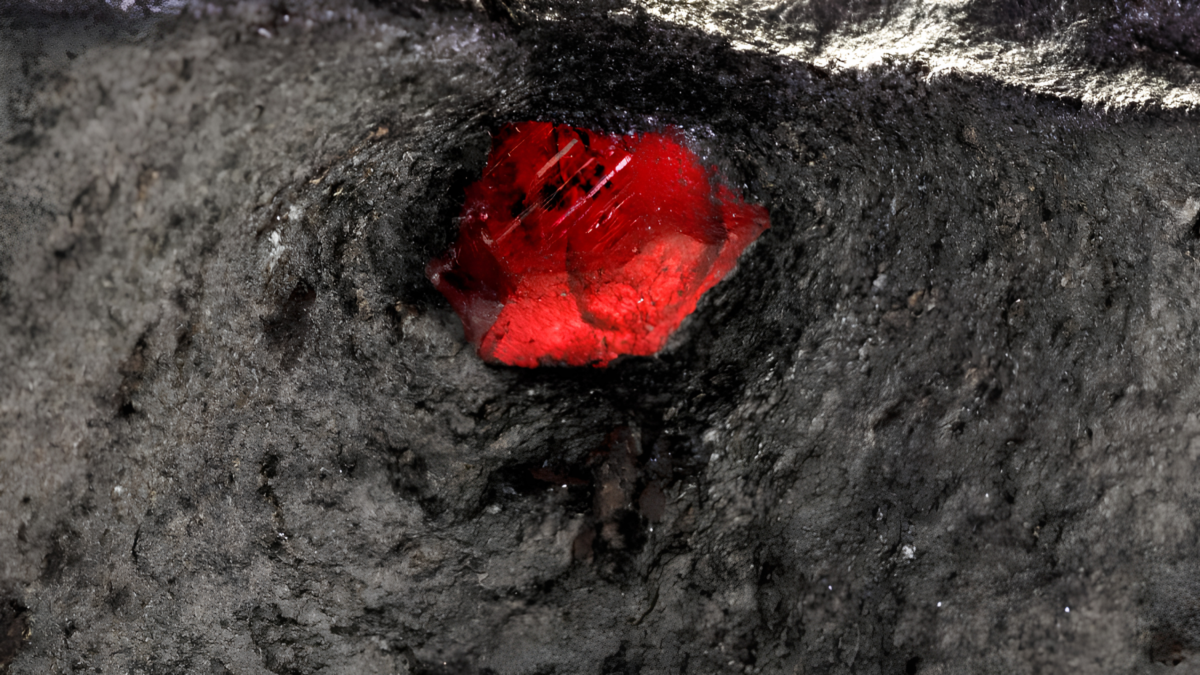
A closer look inside a meteorite that landed on Earth from Mars revealed an unexpected treasure. Hidden inside a rock fragment, scientists found some grains of garnet, a mineral that had never before been found in a Martian sample. This little speck raises huge questions. On Earth, garnet often forms under conditions involving intense heat, pressure, or chemical alteration. The correct set of conditions for garnet on Mars has never been identified. So this meteorite, which is stored in the collection of the Royal Ontario Museum, has some explaining to do. Was garnet formed inside on Mars? If it did, what process produced it and when? And if not, where did it come from and how did it get to Mars? The video below has a summary: “This discovery will expand our knowledge of the geological processes that are possible on this planet,” says planetary geologist Tanya Kizovski of Brock University in Canada. garnet and related minerals.” When we think of garnets, we tend to think of the shape of the mineral prized for its deep blood-red hue. The Martian version looks nothing like that. “The chemistry was a little strange.” – planetary geologist Tanya Kizovski Like many minerals, garnet doesn’t always look the way we might expect. In particular, an iron-rich form of garnet known as andradite typically has a more yellowish-green color that is very similar to other minerals that are often found in meteorites and doesn’t stand out in the same way. Andradite may have an olive hue. (Robert M. Lavinsky/iRocks.com, CC-BY-SA-3.0) For this reason, the researchers almost missed their discovery. “This small section of the meteorite looked really interesting and the chemistry was a little strange,” says Kizovski. “At first, we assumed it was a mineral called pyroxene, which is very common, but then we decided to take a second look. Follow-up tests confirmed that the mineral was andradite. Only a few grains were found in a small fragment of rock measuring approximately 0.8 by 0.5 millimeters, smaller than a poppy seed. The meteorite, called NWA 8171, is already of great interest to planetary scientists. It is one of 18 fragments from the same Martian meteorite fall, the most famous of which is a piece nicknamed “Black Beauty” (NWA). 7034). It consists of a basaltic breccia, a type of rock that forms when magma cools and hardens around other mineral blobs. Its composition is a bit like a fruit pie, where the basalt is the pasty cake and the other mineral inclusions are the fruits and nuts. Between the basalt and its inclusions, NWA 8171 has a lot to say about Martian geology, from ancient magma flows to any information that may be locked away. inside the grains. Related: Man keeps a rock for years, hoping it’s gold It turned out to be even more valuable This is what makes the garnet discovery in NWA 8171 so exciting, because these minerals are particularly excellent storytellers and often contain traces of past geological processes. of other minerals that can reveal the chemistry of its formation environment. “On Mars, the heat and pressure needed to produce garnet through metamorphism could have come from a meteorite impact hitting the surface of Mars, from magma rising into the Martian crust, or from both.” Researchers also cannot yet rule out the possibility that garnet did not form on Mars. Related: NASA’s Curiosity rover opened up a rock on Mars and found a big surprise. Martian. But because NWA 8171 is a breccia that contains multiple types of material, it’s still possible that the fragment theoretically originated elsewhere and landed on Mars before being incorporated into the breccia. To investigate, the next step will be to look at the isotope ratios in the mineral. If they are similar to the isotope ratios in other minerals on Mars, that will indicate that garnet formed there, which, in turn, will shed new light on the deep geological history of the red planet. “The findings add a surprising new dimension to our understanding of the geology of Mars,” says planetary scientist James Darling of the University of Portsmouth in the United Kingdom, “and open an interesting new window into the evolution of our planetary neighbor.” The findings have been detailed in Geochemical Perspectives Letters. This article was fact-checked by Fiona MacDonald and edited by Fiona MacDonald. While we take pride in our process, we are human. If you spot an error, please let us know.