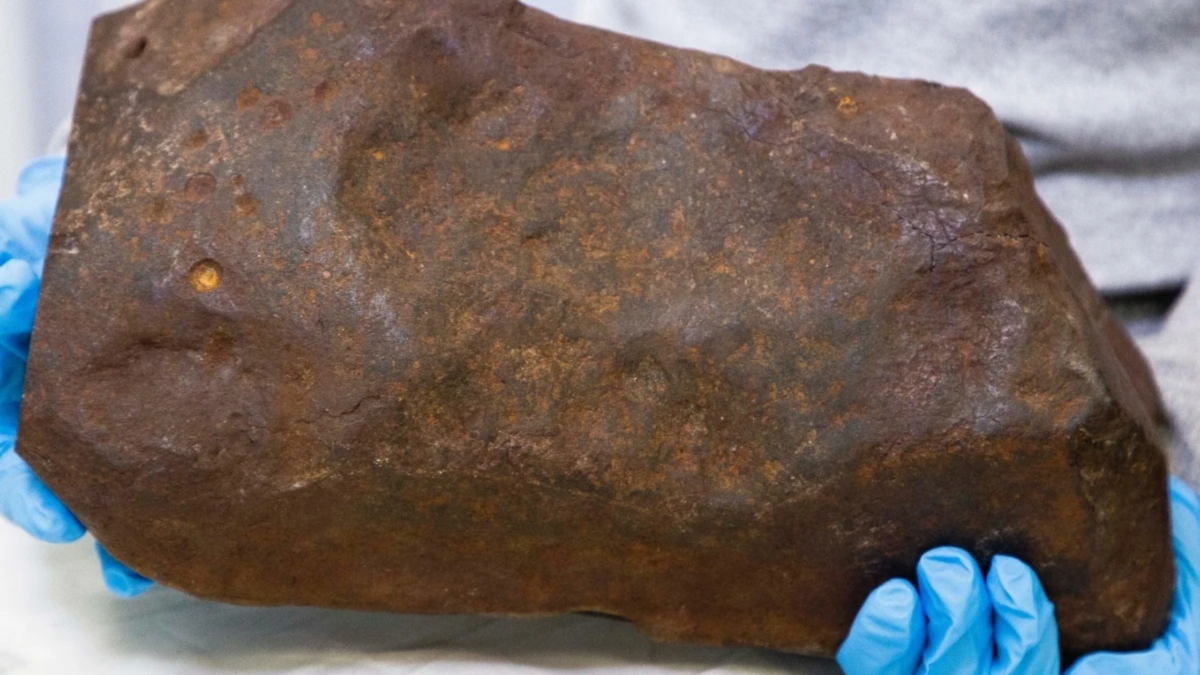
In 2015, David Hole was surveying in Maryborough Regional Park in central Victoria, Australia. Armed with a metal detector, he discovered something out of the ordinary: a very heavy reddish rock resting on yellow clay. He took it home and tried everything to open it, sure that there was a nugget of gold inside the rock. After all, Maryborough is located in the Goldfields region, where the Australian gold rush peaked in the 19th century. To open up his find, Hole tried a rock saw, an angle grinder, a drill and even spraying it with acid. However, not even a sledgehammer could make a crack. That’s because what he was trying so hard to open was not a gold nugget. As he discovered years later, it was a rare meteorite. The video below has a summary: “It had a sculpted, dimpled look,” Melbourne Museum geologist Dermot Henry told the Sydney Morning Herald in 2019. “It forms when they go through the atmosphere; they are melting on the outside and the atmosphere sculpts it.” Unable to open the ‘rock’, but still intrigued, Hole took the nugget to the Melbourne Museum for identification. “I’ve looked at a lot of rocks that people think are meteorites,” Henry told Channel 10 News. In fact, despite having worked at the museum for 37 years at that point and examining thousands of rocks, Henry said only two of the offerings had turned out to be actual meteorites. This was one of the two. Dermot Henry and Melbourne Museum geologist Bill Birch with the Maryborough meteorite. (Museums Victoria) “If you saw a rock like this on Earth and picked it up, it shouldn’t be that heavy,” Melbourne Museum geologist Bill Birch, current curator emeritus, told The Sydney Morning Herald. The researchers published a scientific paper in the Proceedings of the Royal Society of Victoria, describing the 4.6 billion-year-old meteorite, which they named Maryborough after the town near where it was found. “In some meteorites there is ‘stardust’ even older than our Solar System.” – geologist Dermot Henry The Maryborough meteorite weighs a whopping 17 kilograms (37.5 pounds). After the researchers used a diamond saw to cut off a small portion, they discovered that its composition had a high percentage of iron, making it an ordinary H5 chondrite. The Maryborough meteorite, with a slab cut from the mass. (Museums Victoria) Once opened, you can also see small crystallized blobs of silicate minerals, called chondrules. “Meteorites provide the cheapest form of space exploration. They take us back in time and provide clues about the age, formation and chemistry of our Solar System (including Earth),” Henry said. “Some provide a glimpse into the deep interior of our planet. In some meteorites, there is ‘stardust’ even older than our Solar System, showing us how stars form and evolve to create elements of the periodic table. Other rare meteorites contain organic molecules such as amino acids – the building blocks of life.” A radial pyroxene chondrule formed in the Maryborough meteorite. (Birch et al., PRSV, 2019)Although researchers still don’t know where the meteorite came from and how long it may have been on Earth, they do have some guesses. Our Solar System was once a spinning pile of dust and chondrite rocks. Over time, gravity pulled a lot of this material toward the planets, but the remains mostly ended up in a huge asteroid belt. Related: Scientists Opened a Mars Meteorite and Found a Big Surprise “This particular meteorite probably came from the asteroid belt between Mars and Jupiter, and some asteroids pushed it out of there by crashing into each other, then one day it crashes into Earth,” Henry told Channel 10 News. A slab cut from the Maryborough meteorite (Birch et al., PRSV, 2019) Carbon dating suggests the meteorite. It has been on Earth for less than 1,000 years, and there have been several meteorite sightings between 1889 and 1951 that could correspond to its arrival on our planet. Related: NASA’s Curiosity rover opened up a rock on Mars and found a big surprise Researchers argue that the Maryborough meteorite is much rarer than gold, making it much more valuable to science. It is one of 17 meteorites ever recorded from the Australian state of Victoria, and is the second largest chondritic mass, after a huge 55 kilogram specimen identified in 2003. Barred olivine chondrule formed in the Maryborough meteorite (Birch et al., PRSV, 2019) “This is only the 17th meteorite found in Victoria, while thousands of nuggets of gold,” Henry told Channel 10 News. You could say it’s astronomical that it was discovered.” Related: Giant gold deposit confirmed, valued at more than $160 billion It’s not even the first meteorite to take a few years to reach a museum. In a particularly surprising story that ScienceAlert covered in 2018, it took a space rock 80 years, two owners, and a stint as a doorstop before it was finally revealed for what it really was. Until recently, only a small fraction of the meteorites that land on Earth had been discovered, firmly linked to their parent body in space, but in 2024, three newly published papers gave us compelling origin stories for more than 90 percent of today’s meteorites. Now is probably as good a time as any to check your backyard for particularly heavy, hard-to-break rocks. was fact-checked by Rebecca Dyer and edited by Rebecca Dyer. While we take pride in our process, we’re human. If you spot an error, please let us know.