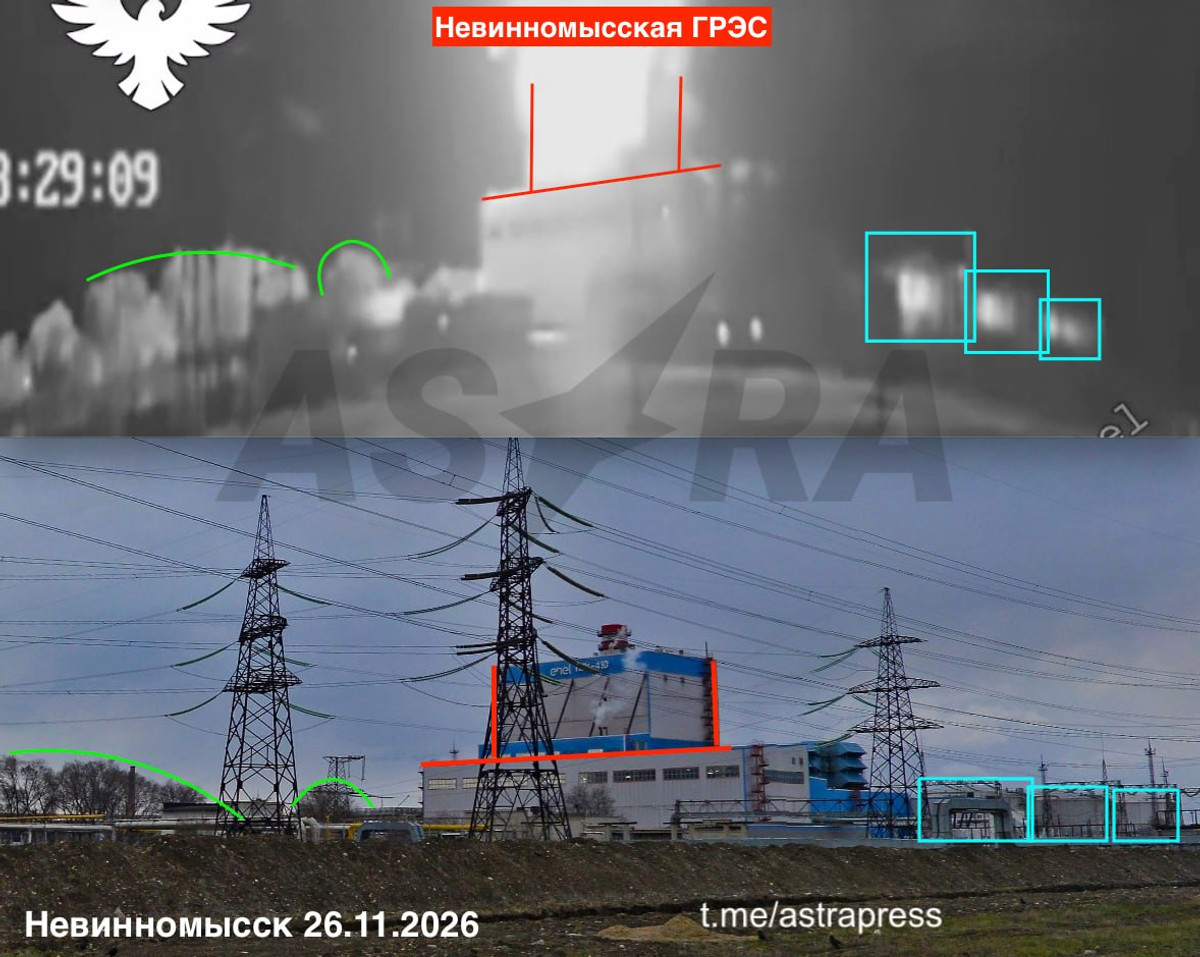
Ukraine attacked a major power plant in Russia’s Stavropol Krai early Thursday, November 26, targeting a facility that supplies electricity to much of the North Caucasus region. Overnight, the Nevinnomyssk industrial zone came under a massive drone attack, regional governor Vladimir Vladimirov said. Debris from intercepted drones fell near industrial and energy facilities, causing damage, he wrote on Telegram. JOIN US ON TELEGRAM Follow our war coverage at @Kyivpost_official. Two people were injured and sought medical attention. Emergency services were working at the scene to deal with the aftermath of the attack. Surveillance camera images reviewed by independent Russian media Astra indicated that the target was Nevinnomyssk GRES, a gas-fired thermal power plant with an installed capacity of 1,551 megawatts. The facility supplies electricity to much of the North Caucasus, as well as local industrial companies. Also located in the industrial zone is a major chemical facility, JSC Nevinnomyssky Azot, which is part of the EuroChem group. The plant had previously been attacked by Ukrainian drones. According to a report from the Russian Ministry of Defense, air defense forces intercepted and destroyed 343 Ukrainian drones overnight. The drones were shot down over the Bryansk, Belgorod, Kursk, Oryol, Voronezh, Tula, Saratov, Samara, Rostov and Ulyanovsk regions; Moscow region; the Stavropol and Krasnodar Territories; the republics of Tatarstan, Bashkortostan and Crimea; and the waters of the Sea of Azov and the Black Sea. Other topics of interest In a joint statement, Trump and Rutte urge Moscow to avoid further escalation and emphasize the need to increase defense spending across NATO. Ukraine has not yet commented on its possible involvement in the attack. The Nevinnomyssk industrial zone was attacked on October 13, when several facilities were damaged. In May, a drone strike injured two employees of local businesses, Vladimirov said. Since the start of the large-scale Russian invasion of Ukraine, Nevinnomyssky Azot has been attacked by drones at least six times, according to the report provided. In 2024, three attacks occurred, in May, March and January. Ukrainian forces attacked the facility twice last year, in December and August. The latest attack comes as Russian officials warn of growing challenges in protecting the country’s utility infrastructure before winter. Deputy Prime Minister Marat Khusnullin recently told the State Duma that winterizing public services amid the threat of drone attacks was the “most critical issue,” particularly in regions bordering Ukraine. Russian oil refining hit by Ukrainian attacks The attack on the power plant also comes amid a broader campaign of Ukrainian attacks against Russia’s energy infrastructure, including oil refineries. According to Bloomberg, a new wave of Ukrainian attacks against Russian refineries began on October 30. By the end of November, total Russian refining production had fallen from around 5 million barrels per day to between 2.6 and 2.7 million barrels per day, the lowest level for the industry since the early 2000s. Viktor Kurilov, an analyst at Rystad Energy, told Bloomberg that production at Russian refineries in late November had fallen even more than during previous waves of Ukrainian attacks. The fall has also affected the domestic fuel market. Bloomberg reported that weekly average retail gasoline prices rose 0.5% between Nov. 17 and Nov. 23. The outlet added, however, that the Kremlin has kept almost all data on Russia’s oil production and refining classified since 2022. It also warned that some damage inflicted on Russian refineries could be repaired in the near future. In less than a month, Ukrainian forces attacked at least 18 Russian facilities, including five major refineries: Omsk, Kstovo and Ryazan, as well as KINEF in the Leningrad region and Taneco in Nizhnekamsk, Tatarstan. All three refineries that play a key role in supplying fuel to Moscow and its surrounding metropolitan area were damaged. By the end of the first 10 days of November, Russian refineries had lost more than 30% of their capacity. A week later, the cumulative damage had reached about 50%, Reuters reported, citing industry sources. The Kaleykino pumping station in Tatarstan, a key facility for transporting oil between Russia’s European and Asian regions, was also targeted twice in major attacks. Fuel shortages spread across Russia Damage to Russia’s energy infrastructure has contributed to reduced wholesale sales of gasoline and other fuels by oil companies. At least 16 Russian regions, including annexed territories, have been forced to introduce limits on the sale of gasoline and diesel at filling stations. Crimea and Sevastopol are experiencing the most serious fuel shortages. There, the decline in refinery production has been exacerbated by the interruption of the Crimean Bridge highway following the Ukrainian attacks on November 17.