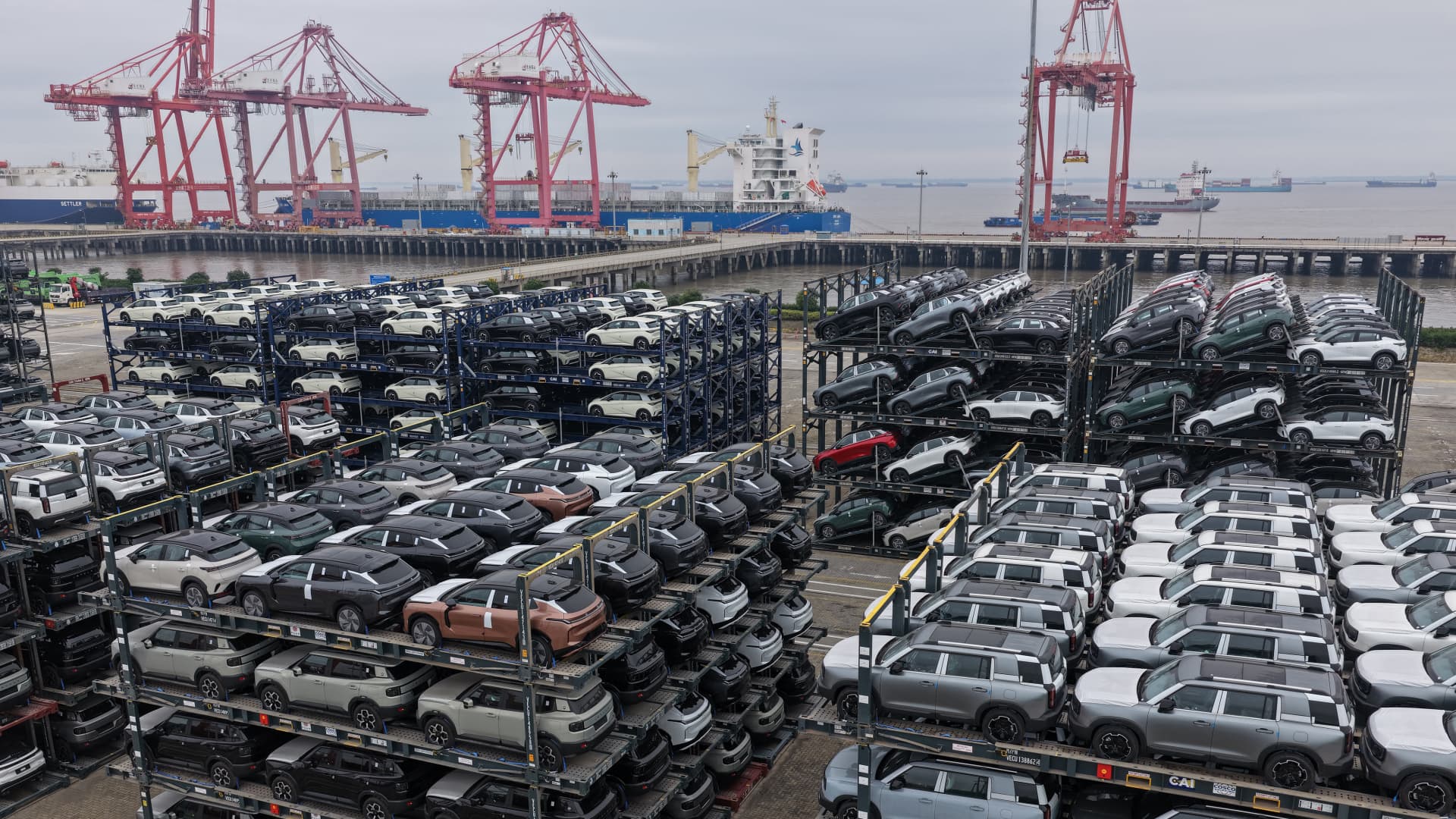
Chinese-made cars are seen on specialized vehicle frames in preparation for loading onto ships for export, in the Taicang port area of Suzhou port, east China’s Jiangsu province, Oct. 12, 2026. – | afp | Getty Images The Trump administration has unveiled a new tariff barrage against more than a dozen trading partners, with China, Vietnam and India facing some of the highest potential rates and growing pressure to strike trade deals with Washington. The proposed tariffs, framed as a curb on industrial overcapacity, start at 15% for the European Union, South Korea, Switzerland and Taiwan and increase to 35% for Vietnam. The Office of the U.S. Trade Representative said it intends to limit new tariffs to lower levels for countries that have completed trade deals. or they are still negotiating with Washington. The overall impact on the region is likely to be limited, said Mark Williams, chief Asia economist at Capital Economics. The proposal “returns most of the targeted countries to where they were at the beginning of the year,” he said, after the Supreme Court struck down Trump’s emergency tariffs in February. Still, the proposal could give some countries an incentive to speed up trade negotiations in order to secure lower tariff rates, analysts said. On Wednesday, U.S. Trade Representative Jamieson Greer said the new policy probably won’t take effect for months, and a senior U.S. official said the tariffs could take effect as early as January. China China faces a capped 20% rate on top of an existing 25% tariff imposed during President Donald Trump’s first term. The rate could rise to 40% if the trade truce reached in South Korea last October is not extended beyond January, the USTR said. Beijing has rejected Washington’s claim about excess capacity and has promised to take necessary measures to protect its rights. On Thursday, Chinese Commerce Ministry spokesman He Yadong called on Washington to “rectify its wrongdoings and return to the right path to resolve problems through dialogue.” The ministry also urged the United States to implement reciprocal tariff cuts worth $30 billion agreed to by the two sides in late September. Although it is not happy, Beijing appears willing to live with the new rates as long as they do not exceed 20%. Wendy Cutler Senior Vice President of the Asia Society Policy Institute The renewed tensions come despite several conciliatory meetings between Trump and Chinese President Xi Jinping this year, as well as what Williams described as Trump’s “apparent lack of concern” over accusations that Chinese tech companies have circumvented U.S. chip export controls. The two leaders are expected to meet for the fourth time this year at the Group of 20 leaders’ summit in Miami in December. “While unhappy, Beijing appears willing to live with the new rates as long as they do not exceed 20%,” said Wendy Cutler, senior vice president of the Asia Society Policy Institute. rare earths and more purchases of American agricultural products,” Cutler said. Washington has warned that tariffs on Chinese goods could double to 40% if the USTR finds that Beijing is not participating. “If the trade war were to start again, today’s actions would provide the United States with some ammunition,” Williams said. Even the sweeping actions against the other 13 trading partners appear to take direct aim at China, said Williams, who tallied that the word “China” appears 253 times in the U.S. report. USTR on Vietnam, and 315 times in the document on the European Union. to restrict imports and FDI from China,” Williams said. Vietnam, India, Singapore While the proposed tariffs generally raise average rates only modestly, India and Vietnam stand out because of the wider gaps between the rates they would face with and without a deal, analysts said. India and Vietnam face proposed tariffs of 25% and 35%, respectively, but those rates could fall sharply to 17% and 20% if ongoing talks with the US produce reciprocal trade deals. The two countries have “a strong incentive” to conclude agreements with Washington to secure lower rates, Cutler said. Vietnam’s Ministry of Commerce said on Thursday it was working with the United States to complete a trade deal as soon as possible, according to Reuters. India could also gain an advantage over some Asian rivals through comparatively lower taxes if New Delhi concludes its long-pending trade deal with Washington. Singapore faces a similar challenge. The proposal sets a maximum potential rate of 20% on its exports, net of existing Section 301 tariffs, which could fall to 10% if it reaches an agreement on reciprocal trade with the US or concludes other negotiations that address the USTR’s findings, according to Singapore’s Ministry of Energy, Trade and Industry. The ministry said it disagreed with the findings and was “very disappointed” with the proposed action, arguing that it did not take into account the structure of Singapore’s economy. Speaking to reporters, Deputy Prime Minister Gan Kim Yong said about 33%, or S$9.4 billion ($7.2 billion) of direct exports will be affected, and the effective tariff rate on affected Singapore exports will rise to 10.3% from the current 7.8%, should Washington impose the higher 20% tax. “I am also very surprised that this has happened because it is not something that would be expected from a major trading partner,” Gan added, saying: “We have been working together for many years and we have an FTA with the United States,” Gan said, referring to the US-Singapore Free Trade Agreement that had been in force since 2004. Under the FTA, Singapore imposes zero tariffs on American products, while the United States has had a trade surplus with the city-state for more than 20 years, he said. ministry. said. That surplus rose to $33 billion in 2025 from $27 billion in 2024. Singapore said it would submit further comments during the public consultation period and urge the USTR to reconsider. Who benefits? Exemptions for semiconductors and other electronic products should cushion the impact on South Korea and Taiwan, whose economies are heavily concentrated in those sectors, analysts said. The USTR singled out South Korea for its concentration on memory chip production and what it described as outsized government support. However, it excluded the country’s chips from the proposed tariffs for overcapacity. Taiwan, which faces a 15% excess capacity tariff cap, also benefits from exemptions for other electronic products, including mobile phones and networking equipment. Its effective tariff rate would rise from 6% to about 9%, Williams estimated. CNBC’s Evelyn Cheng contributed to this report.