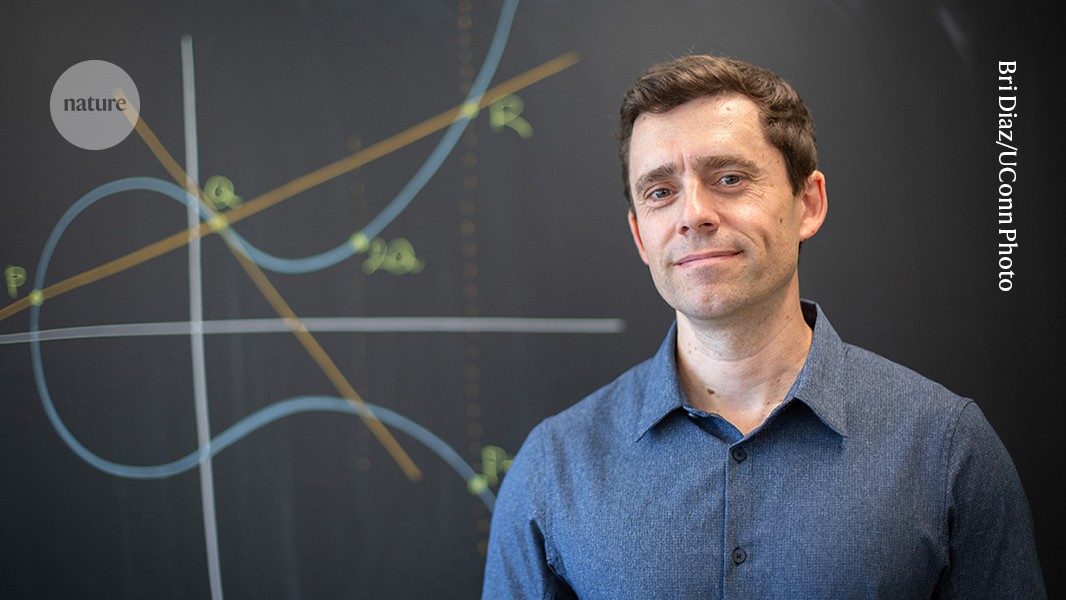
Mathematician Álvaro Lozano-Robledo thought the Riemann hypothesis was out of reach for AI for now. Credit: Bri Diaz/UConn Photo The news came on a Friday, and it was shocking. For months, reports have been mounting about artificial intelligence models that have demolished some of the most difficult problems in mathematics, plunging the field into confusion. But the last claim was the most striking yet: an AI model had helped solve the field’s most famous open problem, the Riemann hypothesis. AI is “the end of mathematics as we know it.” Where will the field go next? The test was published on November 20 by mathematician Levent Alpöge of AI giant Anthropic in San Francisco, California, who used an advanced version of the company’s Claude model. It came in the form of 17 million lines of code in the open-source Lean programming language, which translates mathematical arguments into computer-certifiable code. Within hours, a separate group of mathematicians rushed to present a human-written proof of the Riemann hypothesis, which belongs to the branch of number theory and refers to the randomness of prime numbers. Alpöge’s proof has been independently verified by the nonprofit organization behind Lean and the Mathlib Initiative, which manages the reference library of formalized mathematical results written in Lean. “We are fully confident that Alpöge’s proof of the Riemann hypothesis is correct and we congratulate him,” the community said in a statement on November 21. The mathematical community has widely accepted the claim, although answers differ greatly. Some celebrate Alpöge’s achievement, but others see this development as proof that humans are fighting machines for the future of mathematics. Nature listens to four mathematicians’ reactions to what solving the Riemann hypothesis means to them. Mathematician Tasmin Chu is part of the Association for Human Mathematics, whose members are committed to conducting research without AI. Credit: Elizabeth Xiao’My reaction is serious concern’Tasmin Chu, a doctoral student in mathematics at the California Institute of Technology in Pasadena. A technology that can autonomously test the Riemann hypothesis is not a trivial matter. I believe it is imperative that our society acts to stop the development of AI as soon as possible. Over the past year, mathematical institutions have faced the impossible task of adapting to the rapidly changing capabilities of AI in real time. It is hugely disruptive for early-career researchers – the people who are the intellectual future of our field. Soon other sectors of society will face the same problems. My reaction is one of great concern. AI companies urgently require democratic oversight. I don’t think the invasion of AI into mathematics is inevitable, nor is the death of human mathematical practice. It is a choice to take away our power, just as it is a choice to continue developing these technologies despite serious security concerns. I continue to practice mathematics without an LLM, because I believe it is essential that scientific research continues in the hands of human beings. Many of us in the Association for Human Mathematics (on whose organizing committee I sit) are collectively making the same decision. ‘It could present a huge opportunity for discovery’ Harini Desiraju, postdoc in mathematics at the University of Warwick, UK. Considering the events of the past few months, this news was not entirely a surprise, but we must wait to understand Lean testing and let the experts verify it. After all, it’s several million lines of code. I’m not a number theorist, so I may not have the same emotional attachment to the Riemann hypothesis. However, I deeply appreciate the ubiquity and importance of the problem in various areas of mathematics and physics. Regarding recent events, I want to distinguish between formal evidence and knowledge. It is an impressive feat to solve a problem of this type. However, because it is a million-line Lean test, it will be a while before the community gets a real understanding and validity of the test. By also having an independent approach to AI, it could present a great opportunity to discover new ideas and mathematics. We need to see how it all plays out. There is another discussion to be had, involving the role of cutting-edge laboratories in research. Most of us see the potential benefits of this technology, but it is critically important that we work toward a future where the agency is with the scientific community and not with a couple of companies. Mathematician Marcus Du Sautoy is anxious about the future of his field. Credit: David Levenson/Getty ‘Three months ago, I would never have predicted it’ Marcus Du Sautoy, mathematician and professor of public understanding of science at the University of Oxford, UK. It was a real mix of emotions. Part of me says, what a thrill to be alive when this big problem was solved! I think even when Fermat’s last theorem was solved, we had the same excitement and the same melancholy: that great motivator is gone. Mixed in with that is the complete surprise that it ended up proving itself this way. If you had asked me three months ago, I would never have predicted it. There is a lot of anxiety about what “math 2.0” will look like. ‘If we can solve Riemann, what can’t we do?’ Xin Zhang, assistant professor of mathematics at the University of Hong Kong.