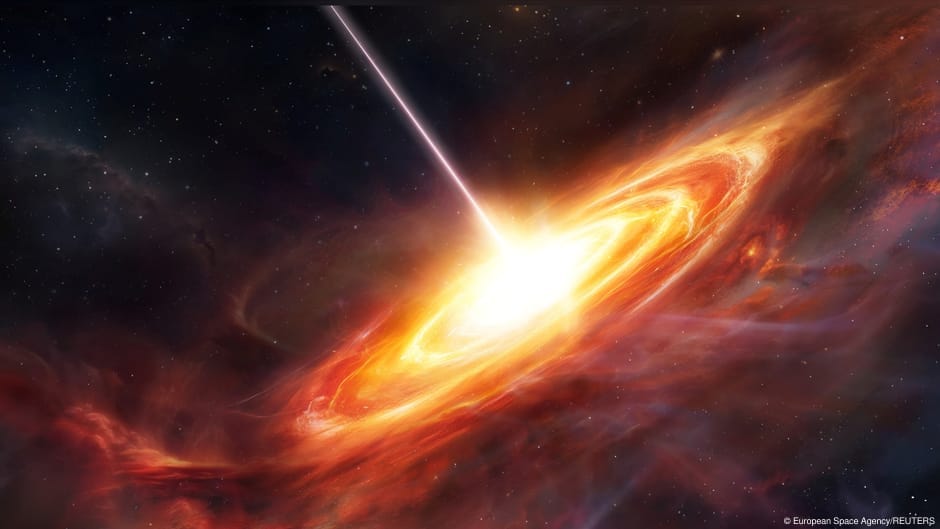
ESA’s Euclid telescope revealed the most distant known quasar, formed 630 million years after the Big Bang that formed the universe. This is considered a very early development in the 13.8 billion year history of the cosmos and surpasses previous records. Light carries valuable information about the early history of the universe. Researchers from the European Space Agency announced on Tuesday the discovery of the most distant and therefore oldest quasar ever observed. The discovery, made by a German astronomer and his team, was published in the journal Astronomy and Astrophysics. A quasar refers to an extremely bright nucleus of an active galaxy driven by gas that falls into a supermassive black hole. Quasars represent a brief phase in the life of a galaxy, during which the nucleus can eclipse the rest of the system. “As enormous amounts of gas, dust and matter fall toward the black hole, they form a rotating accretion disk that heats up to extreme temperatures and radiates enormous amounts of energy, dwarfing the rest of the galaxy by factors of hundreds or even thousands,” said astronomer and study co-author Silvia Belladitta of the Max Planck Institute for Astronomy in Germany and the INAF Bologna Observatory for Astrophysics and Space Sciences in Italy. “This makes quasars visible across billions of light years, allowing us to observe them from the early universe. Studying quasars helps astronomers understand how the first galaxies formed and evolved, and how the supermassive black holes at their hearts grew to such enormous sizes,” Belladitta said. More evidence that black holes were extremely massive very early The newly discovered object, formally known as J1504+6252, is nicknamed Dún Aonghas. The red dot in the image below corresponds to seeing the universe as it was approximately 13.1 billion years ago, just 5% of its current age. “I think it adds to the evidence that some objects in the early universe developed remarkably quickly. Just 630 million years after the Big Bang, this black hole had already grown to about 360 million times the mass of the Sun and was shining like a quasar,” said astronomer Julien Wolf of the European Southern Observatory in Germany, lead author of the research. The discovery thus supports the scenario in which supermassive black holes form through the direct collapse of large gas clouds and subsequently accumulate additional matter. Dún Aonghas was first detected by the European Space Agency’s Euclid telescope, and the images were characterized using a combination of ground-based and space-based telescopes. ESA’s orbital telescope is intended for missions that uncover the mysteries of dark matter, the invisible glue that holds galaxies together, and dark energy, the force that pulls them apart. Euclid Telescope’s First Deep Map Reveals Dark Universe. To view this video, please enable JavaScript and consider upgrading to a web browser that supports HTML5 video.