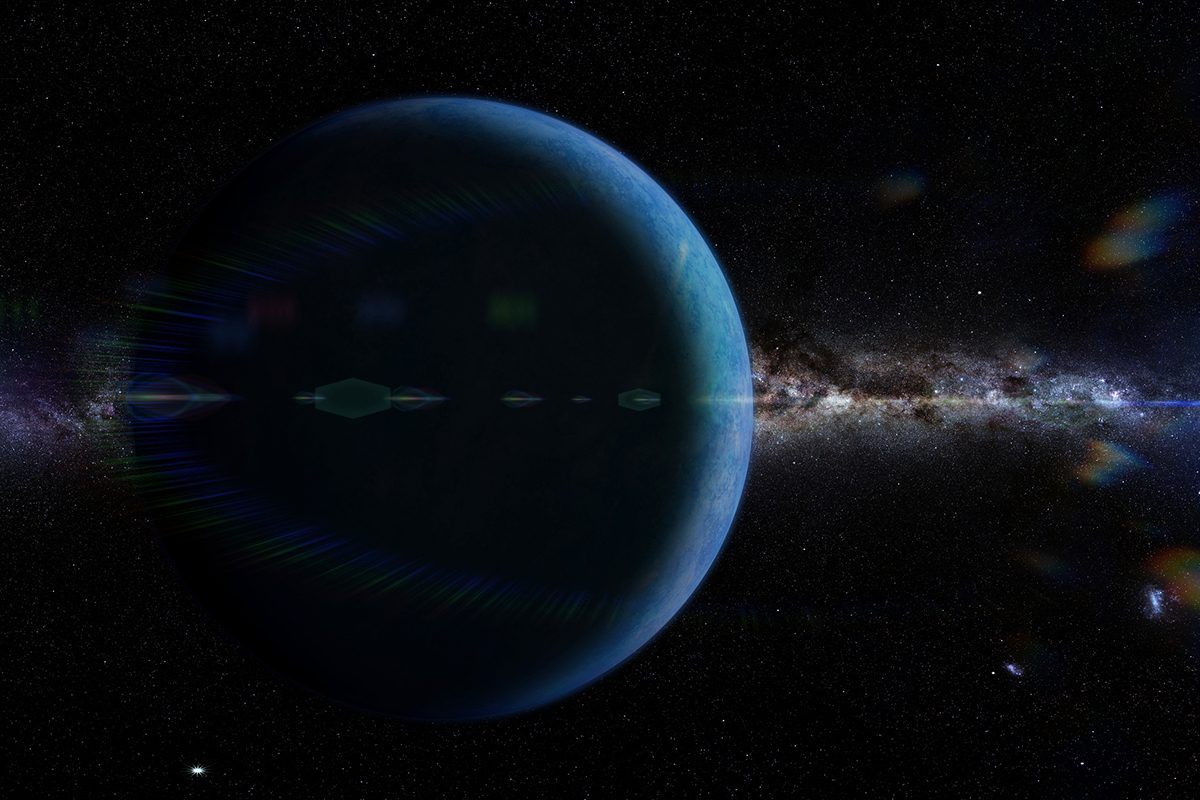
A new paper published by the Royal Astronomical Society suggests that the Solar System may have a hidden ninth planet, which researchers have named Planet X2 (or PX2 for short). The idea that there could be a ninth planet beyond the orbit of Neptune has, of course, existed in different forms for a long time; in fact, since Neptune was first discovered in 1846. Perhaps most famously, in 1906 American astronomer Percival Lowell began his search for a massive Planet X that could explain the perceived anomalies in the orbits of Uranus and Neptune. The first images of Pluto sent back from New Horizons revealed the dwarf planet’s icy heart. Credit: NASA/JPL – NASA/Johns Hopkins University Applied Physics Laboratory/Southwest Research Institute – https://solarsystem.nasa.gov/resources/855/color-pluto/ When Pluto was discovered in 1930, it briefly seemed that Lowell was right, until the discovery of Pluto’s moon Charon in 1978, which allowed scientists to form a more accurate estimate of Pluto’s mass, proving so it could not be the supposed Planet The idea gained traction again about 10 years ago, when Caltech astronomers Konstantin Batygin and Mike Brown postulated the existence of what they called Planet Nine – a body about 10 times the mass of Earth – in an attempt to explain the peculiar orbits of some of the most remote objects in the Solar System: extreme trans-Neptunian objects, or ETNOs. Planet X2, however, is a different proposal than either of these two. Artist’s impression of the hypothetical Planet X2, which could be hidden beyond Neptune. Credit: Patryk Sofia Lykawka/SpaceEngine Planet However, their calculations led them to a different conclusion. Instead of a body with 10 times the mass of the Earth, like Planet Nine, their modeling suggests a planet just 1.5 to 2 times the mass of the Earth, but orbiting the Sun at a greater distance: around 200-500 AU, where 1 AU is the distance between the Sun and the Earth. An artist’s impression of the hypothetical Planet Nine. “Our model reproduces several of the unusual orbital patterns observed between distant icy objects, although there are still differences between the model and observations that we need to investigate further,” says Lykawa. The team published their findings in the journal Monthly Notices of the Royal Astronomical Society on November 23. Study co-author Professor Jonti Horner, also from the University of Southern Queensland, suggests that the recently built Vera C Rubin Observatory in Chile could help prove or disprove the existence of PX2. “Now we have the opportunity to test this idea,” he says. “As the Rubin Observatory studies the sky, we will find new clues that will help us understand the distant reaches of the Solar System and whether there is still another planet waiting to be discovered.”