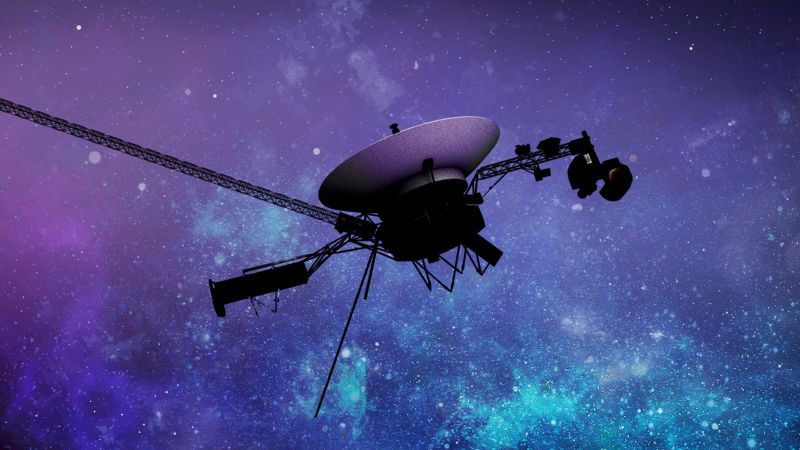
Just as it was about to reach a historic milestone that made it the first man-made object to travel within one light-day of Earth, NASA’s aging Voyager 1 spacecraft experienced another communications failure. The deep space probe no longer sends scientific and engineering data and only returns an empty “carrier signal”: a continuous radio signal that typically also contains information collected by the spacecraft’s instruments. NASA detected the problem on November 14, five days before Voyager 1 marked the achievement of the light day. A light day is the distance it takes a radio signal, moving at the speed of light, 24 hours to reach the spacecraft: approximately 16 billion miles (26 billion kilometers). Using the carrier signal and trajectory calculations, Voyager engineers were able to confirm that the probe had reached that distance. However, there is now concern about the condition of the 49-year-old spacecraft, which launched in September 1977 and has extended its mission more than 10 times longer than expected. The presence of a carrier signal, according to NASA, means that Voyager 1’s navigation computer keeps the spacecraft pointed correctly at Earth and its antenna and transmission equipment continue to function. But the absence of data suggests a problem with an onboard computer tasked with collecting information from the probe’s scientific instruments. Of the 10 instruments aboard Voyager 1, only two are still working, while the others have been turned off to save power. The Voyager 1 team is working on the problem, but its extreme distance makes applying solutions extremely slow, as any command sent to the spacecraft takes 24 hours to arrive, and any response takes another 24 hours to reach the mission team on Earth. CNN contacted NASA’s Jet Propulsion Laboratory in Pasadena, California, from where both Voyager spacecraft are managed, for comment. A NASA spokesperson said the problem is still ongoing but did not offer further details. The malfunction echoes one that occurred exactly three years earlier, on November 14, 2023, when Voyager 1 also stopped sending scientific data via its carrier signal. On that occasion, NASA engineers identified a problem with the flight data subsystem, or FDS, one of three computers aboard Voyager 1. The FDS collects and packages scientific and engineering data before transmitting it. A single chip inside the computer stopped working, so NASA simply excluded that chip from executing any code. This adjustment, however, created a cascade of problems, because the remaining chips did not have enough memory to hold the entire code. As a workaround, Voyager engineers divided the code into sections and made adjustments that allowed the separate sections to run as a whole. NASA has yet to confirm that the FDS is also the source of the current problem, but available information suggests it may be the culprit. More recently, in late October, Voyager 1 experienced a complete loss of communication and did not send any signals to Earth for two days. Although the issue resolved itself, the incident was an alarming and poignant reminder that the investigation is being run on borrowed time. NASA is investigating a possible link between this problem and the latest interruption in data flow. It is difficult to predict exactly how much longer the spacecraft will be able to operate. For decades, mission controllers have continued to estimate that Voyager 1 would last three to five more years, and they continued to add time by finding creative ways to extend its lifespan. Since Voyager 1 took off, it has racked up an impressive list of scientific achievements. The probe and its twin spacecraft, Voyager 2, which launched in late August 1977, were originally built to last just five years to explore Jupiter and Saturn. Both probes are currently studying interstellar space, having left the heliosphere (a huge protective bubble generated by the sun’s magnetic field) in 2012 and 2018, respectively. Subscribe to CNN’s Wonder Theory science newsletter. Explore the universe with news about fascinating discoveries, scientific breakthroughs and more.