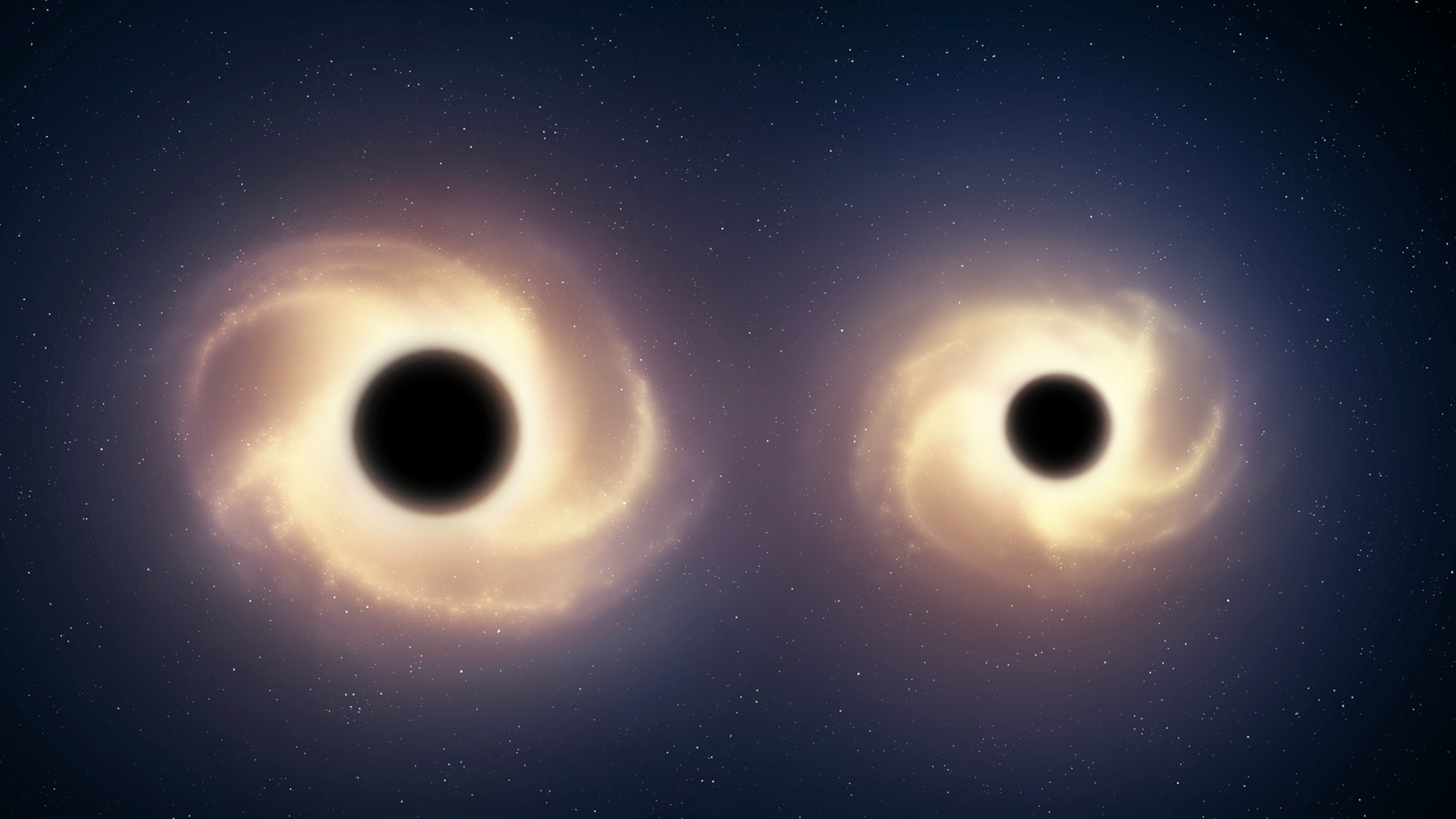
Follow Us Add us as a preferred source on Google Newsletter Subscribe to our newsletter Black holes are known to collide and combine in monstrously violent merger events, but new research suggests these celestial stalwarts can also fragment into smaller bodies, like a pair of cosmic pants splitting in half. In a paper published Oct. 22 in the journal Physical Review D, researchers used several mathematical modeling methods to propose a “pair of pants” topology for black holes. The hypothesis suggests that, under extremely specific conditions, these dark giants could fragment into numerous less massive black holes. “Understanding precisely what is prohibited, what is simply improbable, and what becomes possible once assumptions are relaxed is the central goal of this work,” the researchers wrote in the paper. Latest videos from Live Science Black hole fragmentation could contribute to other cosmic mysteries. For example, it could help explain black holes with masses too small to form through conventional astrophysical processes. These supposed “bites” of black holes would be so small that astronomers could see them evaporate before their eyes on observational time scales. Do black holes wear pants? In the new paper, the researchers explored whether black holes’ event horizons (the limits beyond which nothing, not even light, can escape) could split under various cosmological conditions. These situations included classical four-dimensional general relativity (Einstein’s description of our large-scale universe as we currently understand it), as well as cosmologically esoteric frameworks such as higher-dimensional spacetime and modified gravity scenarios. You might like it But modeling the dynamics of black holes, especially the splitting of an event horizon, is complicated work. So the researchers simplified it by comparing discrete slices of space-time, effectively condensing the fragmentation process into static snapshots of before and after the split. In our classical cosmos, it seems virtually impossible for black holes to split up, the researchers found, but they identified a loophole that could allow this to happen. Get the world’s most fascinating discoveries delivered straight to your inbox. The “pair of pants” topology for black hole fragmentation. (Image credit: University of Southern Denmark) The first impediment is entropy, the possible dispositions of the energy of an isolated system, which cannot decrease spontaneously but only remain the same or increase. This has been theorized by Stephen Hawking and recently demonstrated by detecting ripples in space-time called gravitational waves, suggesting that the surface area of a black hole cannot decrease. For these reasons, splitting a static Schwarzschild black hole (the simplest type of black hole in our four-dimensional general relativity) would be strictly prohibited because it would violate the second law of thermodynamics. The second impediment is kinematics, the motion of orbital dynamics, which excludes the possibility of a split because the black hole fragments would recombine into a single body incredibly quickly. What to read next But there’s a loophole: A rapidly spinning black hole could literally break apart. “This is why, in four-dimensional general relativity, an isolated black hole in empty space could only split up if it spins very close to the maximum speed allowed by the theory, what we call a near-extreme black hole,” study co-author Manuel Del Piano, a theoretical physicist at the University of Southern Denmark, told LiveScience by email. “Generally speaking, the equator of the horizon is dragged at almost the speed of light.” Through this theoretical process, the two resulting black hole fragments could be gravitationally separated from each other before they could recombine. So, under conventional space-time conditions, it seems that “black holes don’t wear pants.” The researchers then mathematically modeled the fragmentation of black holes into versions of space-time with more than four dimensions. In higher-dimensional space-time models, a black hole’s rotation speed is no longer limited because gravity weakens with increasing dimensionality. Therefore, any ultra-rapidly spinning black hole could, in theory, break up, the researchers explained in the paper. A diagram from the new study illustrating the theoretical method of pants splitting. (Image credit: Cacciapaglia et al. (2026)) In the “black string” model, a normally spherical black hole would become cylindrical or string-like, extending along any additional dimensions. It could then be pinched to fragment into multiple smaller bodies, similar to “beads on a string.” Furthermore, the researchers calculated that black hole fragmentation may be entropically favored in space-time models with modified gravity, which alter gravitational interactions in extremely warped environments near the black hole. proton, and the heavier the progenitor, the smaller the fragments,” Del Piano explained. Fragmentation may also be more likely if there is a “rugged horizon” around black holes, similar to a dense blanket or mantle of exotic matter that acts as a singular but gigantic quantum entity. The superfluid qualities of this matter could create strange vortices that eventually cause a black hole to fragment into multiple smaller bodies. Scientists could see a black hole shrink in size, a actual fragmentation or just an indirect gravitational signature, depending on the dimensions and whether it intersects the “brane” or slice of dimensionality of the viewer shortly after the Big Bang, are more likely to split, compared to much more massive astrophysical black holes, such as those found in the centers of galaxies. “The analysis shows when entropy and conservation laws allow division, not when it actually happens,” Del Piano said. “As we put it in the paper, broken glass has more entropy than intact glass, but glass doesn’t break on its own. Resolving the issue requires full dynamic simulations, which is the natural next step.” Cacciapaglia, G., Del Piano, M., Sannino, F. and Vellucci, V. (2026). When black holes support pair-of-pants topologies. Physical examination. D/Physical Review. D., 114(8). https://doi.org/10.1103/cx69-t466 See how much you know about black holes with our black hole quiz!