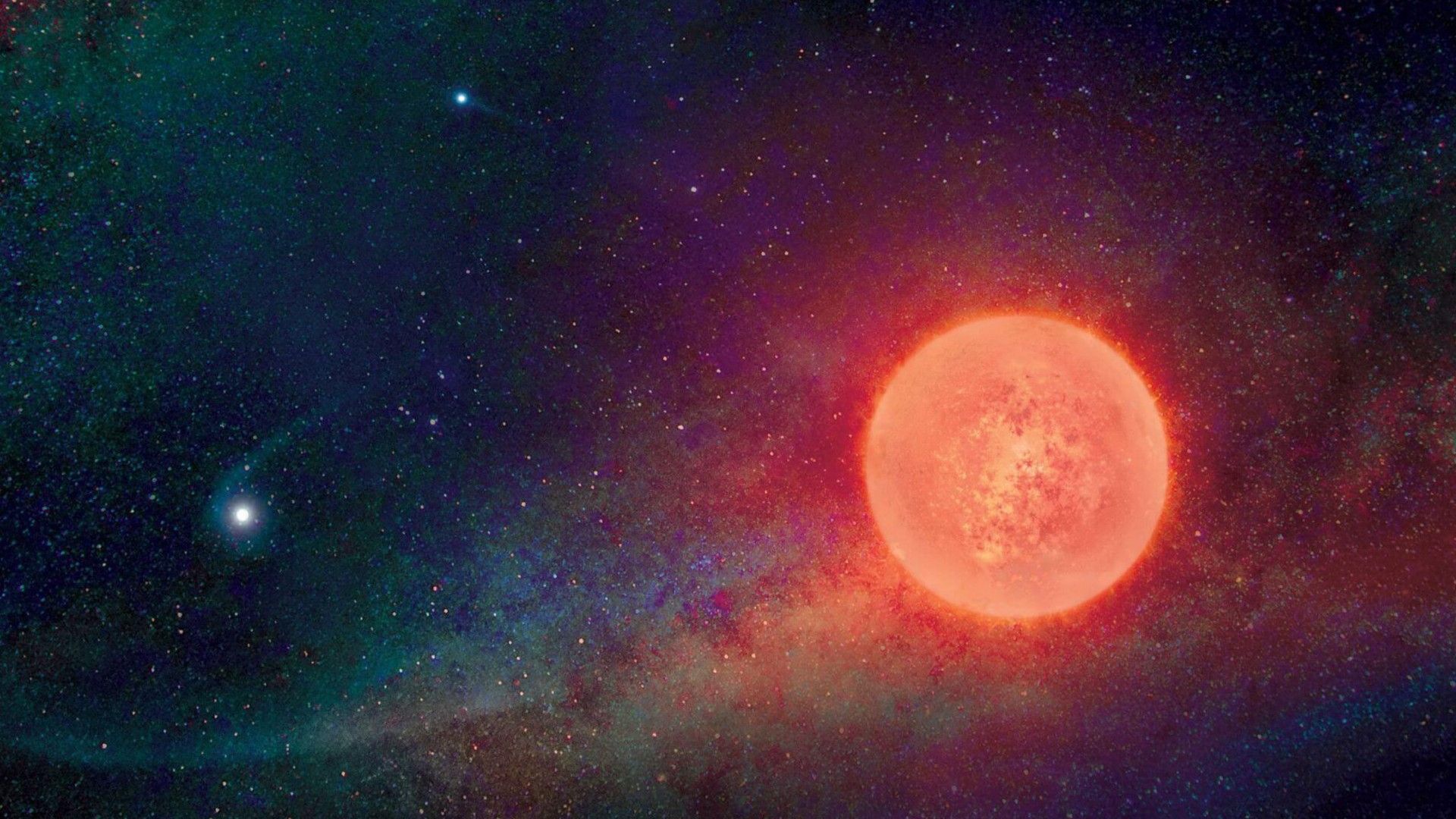
Follow us Add us as a preferred source on Google Newsletter Subscribe to our newsletter A triple system containing a faint red dwarf star and not one but two white dwarfs has been discovered by chance just 28 light years from our solar system. “We were actually looking for planets,” Étienne Artigau of the Trottier Institute for Exoplanet Research at the University of Montreal, who led the discovery, said in a statement. “Instead, we found something much more surprising.” So surprising is that there are no similar systems for at least 100 light years. Also, configuring the system seems impossible. “This system should not exist,” added Montreal’s Patrick Dufour. “We don’t have a clear explanation of how it got here.” This triple system has been called Welopō’ai, which is an acronym for two Hawaiian words meaning a “path of familiar features,” and understanding the mystery behind it requires astronomers to uncover the history of the three objects. A white dwarf is what remains when a star with a mass similar to our sun reaches the end of its life. As it begins to run out of hydrogen for nuclear fusion reactions in its core, the star’s power generation begins to fail and its interior begins to contract under gravity. This has the effect of raising the temperature throughout the star, causing an outer layer of hydrogen to initiate its own fusion reactions. The star quickly swells into a red giant tens or even hundreds of millions of kilometers in diameter. You may like Very soon the star completely ceases fusion reactions. The star’s outer layers peel off and expand into space, while its core contracts to become an inert white dwarf with a diameter similar to that of Earth but with a mass generally between half and two-thirds that of the Sun. Therefore, the Welopō’ai system was once a triple system with two Sun-like stars plus the red dwarf. Now the two Sun-like stars have gone through this stage of stellar death, while their red dwarf companion continues to persist, since its low mass gives it a longer life because it does not consume the hydrogen in its core as quickly. One of the white dwarfs orbits the red dwarf at a distance of 129.3 astronomical units (19.3 billion kilometers or 12 billion miles) and takes about 1,000 years to complete one orbit. This white dwarf and the red dwarf were previously known, and Artigau’s team had been using the SPectropolarimètre InfraROUge (SPIRou) instrument on the Canada-France-Hawaii Telescope atop Mauna Kea to look for planets orbiting the red dwarf when they noticed something very unusual. Observations of the Welopō’ai triple star system, located 28 light years from Earth. The image on the left shows the two components of the system: Welopō’ai A, a pair of red dwarfs and white dwarfs orbiting very closely, and Welopō’ai B, a second white dwarf located much further away. The image on the right provides a close-up view of the inner pair, revealing the faint white dwarf companion (Ab) detected using the ‘Alopeke’ instrument on the Gemini North telescope. The superimposed curves illustrate the orbital paths of the stars. (Image credit: Photo: Pan-STARRS1/STScI/MAST (left); Gemini International Observatory/NSF NOIRLab (right). Graphic compilation: Étienne Artigau and Heidi White (UdeM/IREx))SPIRou discovers planets by measuring how much their gravity pulls on their host star. Think of a star and a planet orbiting a sort of gravitational balance point between them called the center of mass. This center of mass is usually inside the star, since the star is much more massive than the planet, but not at its very center, so the star appears to wobble back and forth around the combined center of mass. The spectrometer measures this wobble in the form of a Doppler shift in the star’s light that can be translated into the speed at which the star moves around this center of mass. Astronomers call this “radial velocity.” A large gas giant like Jupiter could reach a radial velocity of hundreds of meters per second, while a planet the mass of Earth generates a radial velocity of tens of meters. What to read next However, the object SPIRou found orbiting near the red dwarf was creating huge radial velocity signatures of 10 miles (16 kilometers) per second. Whatever it was, it wasn’t a planet. With the help of the eight-meter Gemini North telescope on Mauna Kea in Hawaii, Artigau’s team was able to identify the mysterious object as a white dwarf. “The unusual combination of high mass and very low brightness left only one plausible explanation: it was the remnant of a dead star,” said Charles-Antoine Parent, an undergraduate at Laval University and co-author of the study. White dwarfs aren’t exactly rare, and even finding two white dwarfs together isn’t unheard of: WD 0727+482 is a white dwarf binary system 37 light-years away, for example. However, finding two white dwarfs in a triple system with a regular star is a beautiful find. The reason is that the masses of white dwarfs are generally not well defined. However, their masses are not random; They are directly related to the mass of the star that produced them. Because the newly discovered white dwarf is separated from the red dwarf by about 4.6 astronomical units (688 million kilometers/428 million miles), or closer than Jupiter orbits our sun, Artigau’s team was able to measure their masses with an uncertainty of less than 1%. They discovered that the red dwarf has a mass 42% that of our sun and the newly discovered white dwarf has a mass 62% that of our sun. When the white dwarf was a normal star, it would have had a mass 40% greater than that of our sun. The second most distant white dwarf orbits both. The Gemini North telescope in Hawaii, which helped identify the stars of the Welopō’ai triple system. (Image credit: Gemini International Observatory/NOIRLab/NSF/AURA/J. Warner) Therefore, the Welopō’ai system is a good system to test our stellar evolution models that dictate how massive a white dwarf should be. If we know the white dwarf’s mass with high precision, scientists can also use it as a starting point to explore the extreme physics of the white dwarf’s condensed matter, which is being held back and prevented from contracting further by something called electron degeneracy pressure: the unwillingness of negatively charged electrons to squish further and fuse with positively charged protons to form neutrons. That requires the additional gravity of a more massive star to form a neutron star. So why shouldn’t Welopō’ai exist? The problem is that when stars become red giants, they really shake things up. Even if the red giant did not expand as far as the red dwarf, the expansion should have destabilized the red dwarf’s orbit and potentially even caused it to crash into the red giant. However, here the red dwarf is in a happily stable orbit, as if nothing had happened. “That’s the question that drives our next observations,” Dufour said. Additional, more detailed measurements of the gravitational interactions between the three members of the Welopō’ai system are expected to help the team unravel the evolutionary history of the trio to better understand their orbits and how the red dwarf survived. And since they are relatively close to us, we have the advantage of being able to make high-precision measurements. “Discoveries like this remind us that our own cosmic neighborhood still contains notable surprises,” Artigau said. “Even when we look for planets, our universe often has something completely unexpected waiting for us.” The discovery of the Welopō’ai triple system is described in a paper published November 19 in Astronomy & Astrophysics.